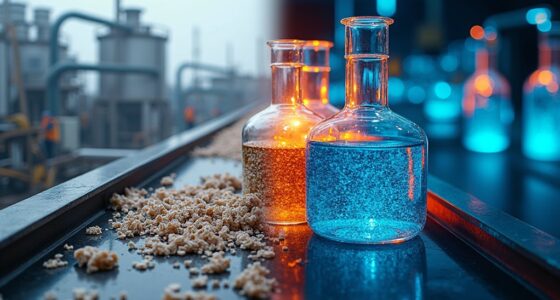

Enzyme immobilization involves attaching enzymes to solid supports, allowing you to reuse them efficiently in large-scale processes. Techniques like covalent bonding or physical adsorption help stabilize enzymes, enhancing their durability and making recovery easy. This approach reduces costs and improves process consistency, ideal for industries like biofuels, food, and pharmaceuticals. To discover more about how immobilization boosts enzyme performance and scale, keep exploring the options and innovations available.
Key Takeaways
- Covalent immobilization enhances enzyme stability, enabling repeated use and large-scale industrial applications.
- Immobilized enzymes can be recovered easily, reducing operational costs and improving process efficiency.
- Selecting appropriate carriers like alginate or silica supports ensures optimal enzyme activity and scalability.
- Physical and covalent immobilization techniques are tailored to balance enzyme activity retention and immobilization strength.
- Reusable immobilized enzymes facilitate continuous processes in biofuel, food, and pharmaceutical manufacturing.
Have you ever wondered how enzymes can be reused and made more efficient in industrial processes? The key lies in enzyme immobilization, a technique that anchors enzymes onto a solid support, allowing them to function repeatedly without losing activity. At the heart of this process is the enzyme carrier, a material that provides a stable platform for enzyme attachment. Choosing the right enzyme carrier is vital because it affects enzyme stability, activity, and how easily you can recover and reuse the enzyme. Common carriers include porous beads, fibers, and membranes made from materials like alginate, silica, or polymer resins. These carriers must be compatible with the enzyme’s properties and the specific industrial environment to guarantee superior performance.
Immobilization techniques vary depending on the desired application, enzyme characteristics, and the nature of the carrier. Physical adsorption is one of the simplest methods, where enzymes stick to the carrier surface through weak forces like van der Waals interactions or electrostatic attraction. This method is quick and preserves enzyme activity but may suffer from enzyme leakage over time. Covalent bonding is more robust, involving the formation of strong chemical bonds between enzyme functional groups and reactive groups on the carrier. This technique enhances enzyme stability and prevents leakage, making it suitable for long-term industrial use. Cross-linking is another popular method, where enzymes are linked together using bifunctional agents, forming insoluble enzyme aggregates that can be easily separated from the reaction mixture. This approach often results in high enzyme loading efficiency and improved reusability.
The choice of immobilization technique directly impacts the enzyme’s reusability and efficiency. For instance, covalent immobilization typically provides higher operational stability, allowing enzymes to withstand harsher conditions and multiple cycles of use. Immobilization also simplifies process control, as the enzyme remains fixed in place, minimizing contamination and enabling continuous operation. Additionally, immobilized enzymes can be easily recovered from the reaction mixture, which reduces costs associated with enzyme loss and substitution. This reusability is especially valuable in large-scale applications such as biofuel production, food processing, and pharmaceutical manufacturing, where enzyme costs are significant. Furthermore, advances in technology’s influence on artistic expression continue to shape how creativity is approached in the digital age, highlighting the importance of innovation in both scientific and cultural realms.

AWF PRO 20 Gallon Universal Spill Kit, 59 Pieces – 20 gal DOT Approved Drum, Socks, Pads & Pillows, & Accessories
Spill Response: Includes absorbent pads, socks, pillows, and accessories designed to contain and clean up a wide range...
As an affiliate, we earn on qualifying purchases.
Frequently Asked Questions
How Does Enzyme Immobilization Affect Enzyme Activity Over Time?
Enzyme immobilization can initially boost enzyme stability, helping maintain activity retention over time. However, it may also cause some activity loss due to mass transfer limitations or structural changes during the immobilization process. Over extended use, you might notice a gradual decrease in activity, but proper immobilization techniques can minimize this decline. Overall, immobilization helps sustain enzyme activity longer, making it more reliable for repeated or industrial applications.
What Are the Environmental Impacts of Enzyme Immobilization Methods?
Think of enzyme immobilization methods as a double-edged sword. While they help reduce waste and improve efficiency, you should also consider biodegradability concerns since some immobilization supports aren’t biodegradable. Additionally, solvent use in certain techniques can pose environmental risks, contaminating water and soil. Balancing these impacts is essential; choosing eco-friendly supports and minimizing harmful solvents can make enzyme immobilization more sustainable for the planet.
Can Immobilized Enzymes Be Used in Non-Aqueous Systems?
Yes, immobilized enzymes can be used in non-aqueous systems, especially with organic solvents. These systems often enhance enzyme stability, allowing you to perform reactions in environments where free enzymes might denature or lose activity. By immobilizing enzymes, you improve their resistance to organic solvents, making them more effective and reusable in non-aqueous systems. This expands their applications in various industrial processes, including pharmaceuticals and biofuels.
How Do Immobilization Techniques Vary for Different Enzyme Types?
You’ll find that immobilization techniques vary based on enzyme type to enhance stability and activity. For example, enzymes with delicate structures may need gentle methods like adsorption on porous matrices, while more robust enzymes can be covalently bound to immobilization matrices for stronger attachment. These techniques aim to improve enzyme stability, prevent leaching, and optimize performance, ensuring your immobilized enzymes work effectively across different applications.
What Are the Latest Advancements in Large-Scale Enzyme Immobilization?
Imagine opening a treasure chest—today’s advancements in large-scale enzyme immobilization act as the key. You harness nanomaterial enhancements and carrier material innovations to boost stability, activity, and reusability. These innovations allow you to scale up processes efficiently, reducing costs and increasing throughput. By integrating cutting-edge nanotech and novel carrier designs, you’re transforming industrial enzyme applications, making them more sustainable and adaptable for future demands.

PIG Chemical Cleanup Kit - for Small Laboratory Spills - 9.25" L x 4" W x 13" H - PM50002
CLEANUP KIT INCLUDES: 3 - 10" W x 13" L PIG HazMat Chemical Absorbent Pad, 1 - 3.5...
As an affiliate, we earn on qualifying purchases.
Conclusion
By immobilizing enzymes, you can considerably enhance their stability and enable reuse, reducing costs and waste. Studies show that immobilized enzymes can be reused up to 10 times without losing over 50% of their activity, making processes more sustainable. Embracing immobilization techniques allows you to scale up production efficiently, meeting increasing demands while minimizing environmental impact. This approach not only improves economic viability but also pushes the boundaries of industrial enzyme applications.

INTSUPERMAI 5L Jacketed Glass Reactor, Single Layer, with Heating Bath, 110V Chemical Reaction Unit for Reflux and Distillation of Reaction Solution
The 5L glass reaction vessel can be safely operated under vacuum. Jacketed glass reactor systems which can do...
As an affiliate, we earn on qualifying purchases.

5L Lab Jacketed Glass Reactor – Double Layer Cylindrical Jacket Type with Digital Display for Chemical & Pharmaceutical Durable & Heat-Treated Glass for Batch Reaction & Experiments
Voltage: 110V/60HZ.GG17 high borosilicate glass, which can ensure good chemical and physical properties. If hot oil cycles through...
As an affiliate, we earn on qualifying purchases.