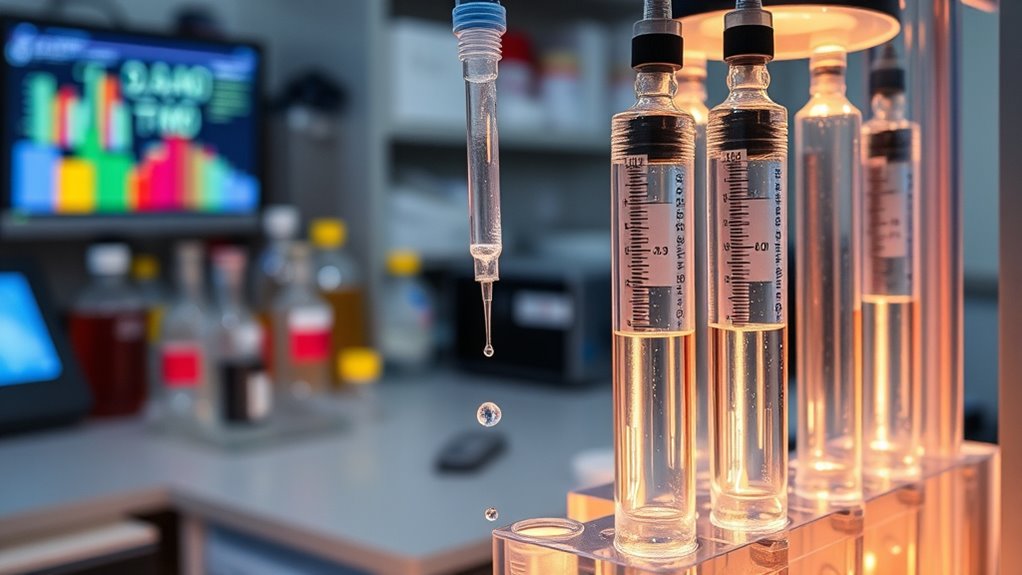

To minimize nitrosamine risks during synthesis, you should implement sensitive analytical methods like GC-MS or LC-MS/MS to detect trace contaminants early in production. Regular monitoring helps identify and control contamination before products reach consumers. Follow regulatory guidelines and keep detailed records of testing results. Incorporate these practices into your quality control to prevent contamination and guarantee safety. If you want to learn more about effective strategies, you’ll find valuable insights ahead.

Prime made for students and young adults
- Fast, free delivery for dorm and study essentials
- Prime Video and Amazon Music included
- Member-only deals
Key Takeaways
- Implement rigorous analytical testing (GC-MS, LC-MS/MS) throughout synthesis to detect nitrosamines early.
- Optimize reaction conditions and raw materials to minimize nitrosamine formation during manufacturing.
- Incorporate routine monitoring and validation protocols aligned with regulatory standards for ongoing safety.
- Use data-driven process adjustments to reduce nitrosamine precursors and byproducts.
- Stay updated on evolving guidelines and adopt best practices for risk mitigation and compliance.

Nitrosamines are potentially harmful compounds that can form during the manufacturing and storage of certain products, posing health risks. As someone involved in chemical synthesis or product development, you need to be proactive in minimizing these risks. One of the most effective steps is implementing rigorous analytical detection methods. These techniques allow you to identify even trace amounts of nitrosamines in raw materials, intermediates, and final products. High-sensitivity tools like gas chromatography-mass spectrometry (GC-MS) and liquid chromatography-tandem mass spectrometry (LC-MS/MS) are essential for this purpose. They help you detect nitrosamines at very low levels, making certain that your products meet safety standards. Regular monitoring through analytical detection not only helps identify potential contamination but also enables you to verify the effectiveness of your mitigation strategies over time.
Alongside analytical detection, adhering to regulatory compliance is essential. Different regions have set specific limits for nitrosamine levels in pharmaceuticals, food, and other consumer products. By understanding and complying with these regulations, you reduce the risk of legal issues, recalls, and damage to your reputation. Staying updated with guidelines from agencies like the FDA, EMA, or equivalent authorities in your country is crucial. This might involve implementing validated testing protocols, maintaining detailed documentation, and training your team on compliance requirements. Regulatory compliance isn’t just about avoiding penalties; it also guarantees that your manufacturing processes are aligned with best practices for safety and quality. Additionally, reliable analytical detection methods are vital for maintaining ongoing quality assurance and ensuring compliance throughout your product lifecycle.
As an affiliate, we earn on qualifying purchases.
Frequently Asked Questions
How Do Nitrosamines Form During Synthesis Processes?
Nitrosamines form during synthesis through nitrosation pathways, where nitrogen compounds react with nitrosating agents like nitrous acid. You’ll find that nitrosamine precursors, such as secondary amines, are key players in this process. When these precursors encounter nitrosating agents under specific conditions—like acidic pH—they undergo nitrosation, resulting in nitrosamines. To reduce this risk, you should control reaction conditions and carefully select starting materials.
What Are the Most Sensitive Chemical Reactions to Nitrosamine Formation?
Did you know that over 60% of nitrosamine formation occurs during specific chemical reactions? You should watch out for reactions involving nitrosating agents and secondary amines, as they are highly sensitive to nitrosamine formation. Reaction pathways involving nitrite or nitrate catalysts can considerably influence this risk. Using appropriate catalysts and controlling reaction conditions helps reduce nitrosamine formation, protecting your product’s safety and compliance with regulations.
Are There Specific Solvents That Increase Nitrosamine Risk?
Certain solvents can increase nitrosamine risk, especially those with high polarity, which facilitate nitrosamine formation. You should be cautious with polar solvents like dimethylformamide (DMF) or acetonitrile, as they can promote nitrosation reactions. Additionally, higher reaction temperatures accelerate this risk, so keeping temperatures low helps control nitrosamine formation. Always choose solvents carefully and monitor conditions to minimize potential hazards in your synthesis process.
How Can Real-Time Monitoring Reduce Nitrosamine Contamination?
You can reduce nitrosamine contamination through real-time monitoring by closely tracking reaction conditions and process parameters. This process control allows you to detect any deviations early, enabling prompt adjustments to prevent contamination. By actively managing reagents, temperature, and pH, you minimize the risk of nitrosamine formation, ensuring safer synthesis. Continuous monitoring serves as a vital tool for contamination prevention and maintaining high-quality standards throughout your production process.
Which Analytical Techniques Are Best for Detecting Trace Nitrosamines?
You should use mass spectrometry and chromatography techniques, like LC-MS/MS or GC-MS, to detect trace nitrosamines effectively. These methods offer high sensitivity and specificity, enabling you to identify even very low levels of nitrosamines in your samples. By selecting the right combination of chromatographic separation and mass detection, you can guarantee accurate, reliable results, helping you monitor and control nitrosamine contamination throughout your process.
Conclusion
By implementing proper controls, you can substantially reduce nitrosamine risks in your synthesis processes. Remember, studies show that even trace amounts of nitrosamines can pose serious health concerns, with some formulations containing as little as 0.1 parts per million. Imagine that tiny amount, equivalent to just a few drops in a swimming pool—highlighting how vigilant you need to be. Staying proactive and adhering to best practices ensures safer production and protects both your reputation and public health.
Fall Picks
fall essentials
As an affiliate, we earn on qualifying purchases.