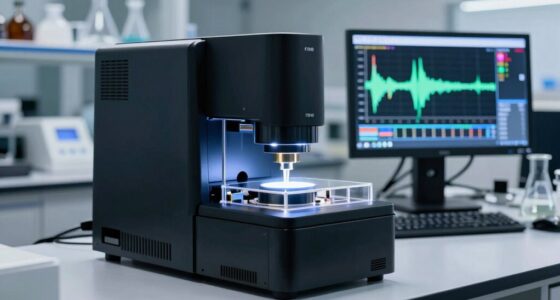

Karl Fischer’s water test was discovered accidentally when a chemist noticed a reaction between iodine and water, leading to a highly accurate method for measuring water content. This breakthrough uses a specific chemical reaction involving iodine, sulfur dioxide, and a base, which produces a measurable change, ensuring precision even at tiny water levels. Its reliability and industry importance have made it a gold standard—if you want to understand how this remarkable method evolved, keep exploring.
Key Takeaways
- Karl Fischer’s Water Test was discovered accidentally through curiosity about iodine chemistry, leading to a highly specific water measurement method.
- The test relies on a chemical reaction between iodine, sulfur dioxide, and water, producing a quantifiable change.
- Its high precision and accuracy made it the industry standard for detecting water content, even at parts per million levels.
- The discovery highlighted how accidental insights can revolutionize analytical techniques and scientific standards.
- The method’s reliability depends on strict reagent control and calibration, ensuring consistent and trustworthy results.
Have you ever wondered how scientists accurately measure water content in a sample? The answer lies in a method that revolutionized analytical chemistry: Karl Fischer’s water test. This technique is renowned for its precision, but its origins are as intriguing as its reliability. At its core, the test depends on carefully controlled chemical reactions that selectively target water molecules, guaranteeing measurement accuracy that’s hard to match. The process involves a reagent that reacts specifically with water, converting it into a different chemical form, which can then be quantified. This specificity is key—other substances in the sample don’t interfere, so you get an exact measure of water content.
The discovery of this method was largely accidental, stemming from a chemist’s curiosity about the reactions involved in iodine chemistry. Once the reaction between iodine and water was understood, it became clear that this could be harnessed for precise water measurement. The reaction is straightforward: the iodine reacts with water in the presence of sulfur dioxide and a base, leading to a measurable change in the reagent’s color or electrical properties. By carefully monitoring this change, you can determine exactly how much water was present in the original sample. This process offers unparalleled measurement accuracy because the chemical reactions are highly specific, minimizing errors caused by other components in the sample.
What makes Karl Fischer’s test stand out is its ability to detect even tiny amounts of water, down to parts per million. This sensitivity is vital across various industries—pharmaceuticals, petrochemicals, food production—where even trace amounts of water can compromise quality or safety. The accuracy of the measurement hinges on the precise control of the chemical reactions involved. Factors such as reagent purity, proper titration techniques, and calibration ensure that your results are consistent and dependable. Precise reaction control is essential for maintaining the test’s reliability and accuracy.
Because water reacts directly with the reagent, the method sidesteps many issues that plague other measurement techniques, like evaporation losses or interference from other chemicals. In addition, modern advancements have improved the method’s efficiency and ease of use, making it an indispensable tool in quality assurance and research laboratories. In essence, the brilliance of Karl Fischer’s water test lies in its clever use of chemical reactions that are both specific and reliable. It turned a serendipitous discovery into a standard for water measurement, emphasizing accuracy above all else. Whether you’re working in a lab or manufacturing plant, understanding the chemistry behind this test helps you appreciate why it remains the gold standard today. It’s a perfect example of how a simple, accidental insight can lead to a powerful, precise tool—one that continues to set the benchmark for measuring water content with confidence and consistency.

EQCOTWEA Coulometric Karl Fischer Moisture Analyzer Trace Water Tester
- High Sensitivity & Accuracy: Detects 0.01μg water with ±2μg precision
- Wide Measurement Range: Measures 1ppm to 100% moisture
- Versatile Sample Compatibility: Tests liquids, solids, and gases
As an affiliate, we earn on qualifying purchases.
As an affiliate, we earn on qualifying purchases.
Frequently Asked Questions
How Accurate Is the Karl Fischer Test Compared to Other Moisture Analysis Methods?
You’ll find that the Karl Fischer test is highly accurate compared to other moisture analysis methods. Its precision comparison shows it consistently delivers reliable results, especially for small water contents. Reliability factors like reagent quality and proper technique influence its accuracy, but overall, it’s considered the gold standard. You can depend on it for precise moisture measurement, making it preferable over less sensitive or more variable methods.
Can Karl Fischer’s Test Be Used for All Types of Samples?
Sure, Karl Fischer’s test can handle many samples, but don’t assume it’s foolproof for all. You’ll face sample limitations and matrix effects that can throw off your results. Some samples, like those with interfering substances or complex matrices, may require special preparation or alternative methods. So, while versatile, it’s not a one-size-fits-all solution—always consider your sample’s unique characteristics before relying solely on this test.
What Are Common Errors to Avoid During the Test?
To avoid common errors during the Karl Fischer test, guarantee sample contamination is minimized by using clean, dry containers and proper handling techniques. Always check reagent stability before testing, as degraded reagents lead to inaccurate results. Avoid over- or under-filling the titration vessel, and verify calibration regularly. Maintaining consistent procedures and careful sample preparation help ensure precise, reliable water content measurements.
How Has the Method Evolved Since Its Invention?
Since its invention, the Karl Fischer method has substantially shifted with smarter instrument advancements and automation trends. You now benefit from more precise, rapid, and reliable results thanks to digital displays, integrated titrators, and automated sampling. These innovations reduce human error, streamline sample handling, and enhance efficiency. As a result, you can trust modern Karl Fischer titrators for consistent, accurate water measurements, making the test even more dependable and accessible.
What Are the Cost Considerations for Implementing Karl Fischer Analysis?
When implementing Karl Fischer analysis, you should consider cost factors like equipment expenses, reagents, and maintenance. The initial investment in a titrator and specialized chemicals can be significant, but ongoing costs include calibration, replacement reagents, and routine servicing. While the method offers high accuracy, balancing these equipment expenses with the need for precise water content measurements helps you determine if it’s cost-effective for your application.
Conclusion
So, here you are, relying on Karl Fischer’s water test, a technique born from accidental genius. It’s ironic how a simple mistake led to a gold standard in moisture analysis, saving countless industries from guesswork. Next time you measure water content, remember—sometimes, the biggest breakthroughs come not from perfect plans, but from unexpected errors. After all, who knew that a happy accident would become the most trusted method in the lab?