
TL;DR
Open a free Amazon Business account
Business pricing, bulk buying and tax-exempt orders.
Create a free accountAs an affiliate, we earn on qualifying purchases.
IdeaClyst creates a digital war room for your ideas, combining AI-driven debate, real-time research, and structured planning—all on your own device. It helps founders make smarter, faster decisions by turning idea validation into a strategic process.
Ever stared at three tabs, each promising the next big thing, feeling that knot tighten in your stomach? That’s the founder’s version of decision paralysis. The hard part isn’t building anymore; it’s choosing what to build. And that choice can make or break your startup’s fate. Learn more about fostering innovation.
Enter IdeaClyst—an innovative system that turns your chaotic brainstorm into a strategic war room. It’s not just about ideas; it’s about shaping them with real debate, grounded research, and clear plans. Think of it as a command center that helps you see what’s worth fighting for—before you invest months and thousands of dollars. Discover more about innovation strategies.
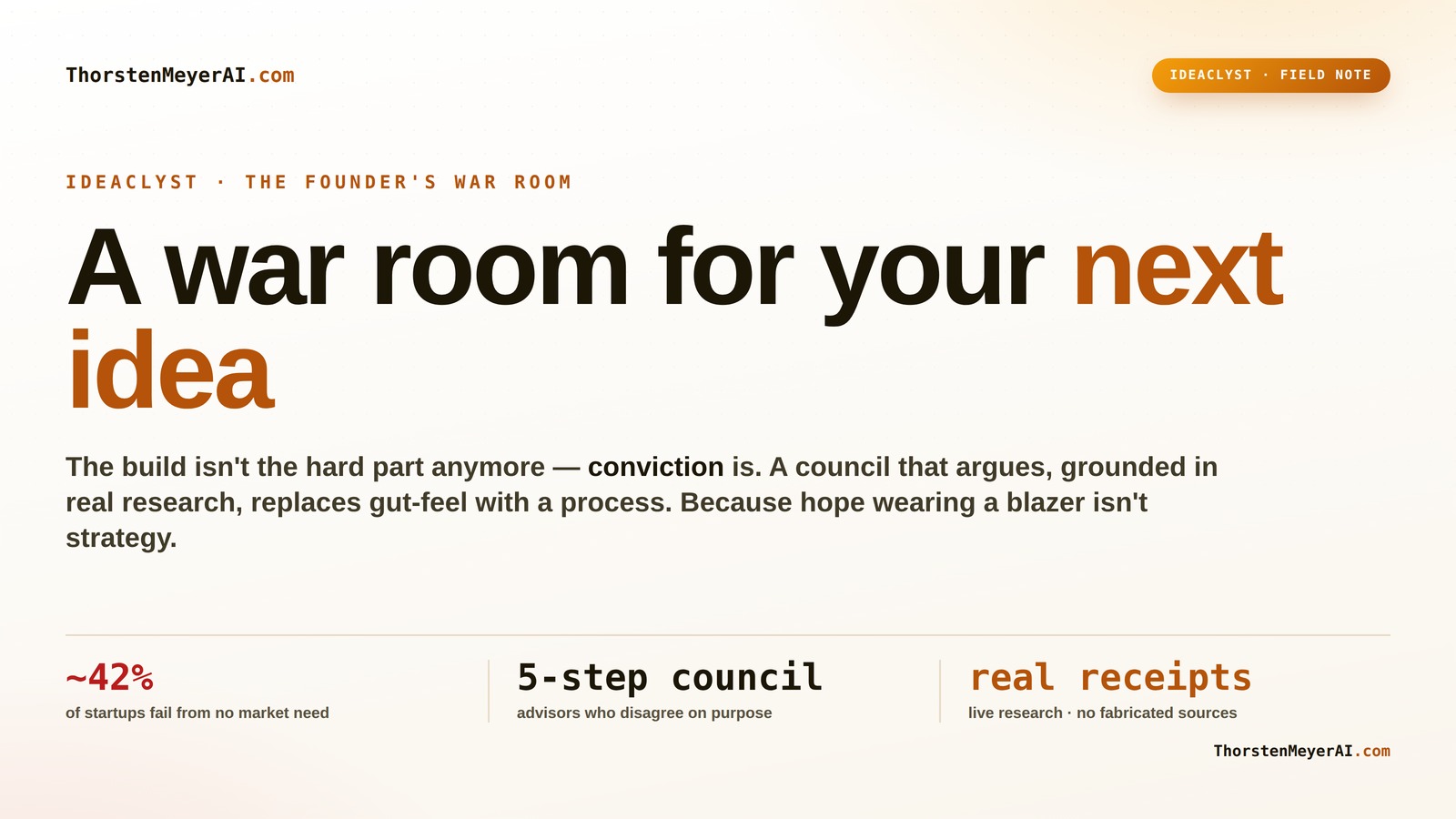
A war room for your next idea
The build isn’t the hard part anymore — conviction is. Knowing which idea deserves the next six months, and being able to defend it. Most founders answer with gut feel and optimistic math. That’s hope wearing a blazer. IdeaClyst replaces it with a process.
The most expensive decision is what to build
The single most valuable thing a tool can do is talk you out of the wrong six months. The numbers make the case better than any pitch.
Three tools in one — on your own machine
Strip away the framing and IdeaClyst is three things at once, all running locally with nothing leaving your laptop.
An AI council
Pressure-tests an idea you bring it — advisors who argue on purpose.
A discovery engine
Finds ideas you didn’t know to look for by hunting real demand signals.
A founder’s workspace
Carries winners from “interesting” all the way to “ready to build.”
Advisors who disagree on purpose
Not one confident, agreeable answer — a structured five-step deliberation where models play different roles and turn on their own work. The disagreement is the feature.
The five-step deliberation
A council that leads with the bad news surfaces the objections you’d otherwise find the expensive way, on month five.
Product strategy
Who’s it for, what’s the wedge, why now, what’s the business model.
Technical architecture
What would it actually take to build — and where’s the risk.
Critique pass
The council turns on its own work. Where’s the hand-waving? What kills this?
Second, independent critique
A different voice, a different angle — so blind spots don’t survive.
Final synthesis
Everything into one coherent founder packet: strategy, architecture, validation, plan.
When IdeaClyst cites a source, it actually fetched it
The hard departure from “ask an AI what it thinks of my startup.” It runs in a strict, real-data-only mode — if it can’t gather genuine evidence, it says so plainly rather than inventing a plausible paragraph.
Confidence with receipts
No fabricated statistics, no imaginary competitors, no made-up citations. The packet survives a skeptical co-founder or a sharp investor because the reasoning has receipts.
Market research first
Scouts the landscape before the council reasons about anything.
Competitor read
Real positioning, pricing signals, feature claims — differentiation vs. reality.
Validation with links
Not “talk to customers” — concrete signals & sources you can click.
From the blank page to build-ready
Evaluation is half the problem; the blank page is the other half. And a plan is worthless if it dies in a tab you never reopen.
Bring a space, not an idea
“AI for accountants,” “tools for indie game studios” — plus your goal and real capacity. It hunts demand signals across HN, Reddit, Product Hunt, GitHub, pricing pages.
- An honest market read — leads with the bad news when a space is hard
- An opportunity map — high pain, thin competition
- Ranked candidates — wedge, who pays, effort, risk, confidence
- each with KILL CRITERIA — when to walk away
A home and a forward path
Every promising idea gets carried forward, with every artifact in plain files on your disk.
- Validation tooling — sprint board, interview list, evidence browser
- Founder profile — a personal-fit lens; same discovery, different advice
- Build workspaces — funnel, personas, landing draft, version history
- “Build this idea” → a PRD + task queue, ready for a coding agent
Key Takeaways
- IdeaClyst acts as a structured, debate-driven war room that surfaces risks early and guides better decisions.
- Grounding AI advice in real-time web research prevents overconfidence and false validation.
- A mix of physical and digital tools creates an effective, adaptable idea workspace for remote or in-person teams.
- The structured final report becomes a strategic blueprint, boosting clarity and confidence in your idea.
- Using a council of models that disagree mimics real-world debate, leading to more robust, validated decisions.
As an affiliate, we earn on qualifying purchases.
What is IdeaClyst — The Digital War Room That Saves Your Sanity
IdeaClyst is a local-first, open-source platform that acts as your personal war room for ideas. It’s a mix of an AI council, a discovery engine, and a founder’s workspace. You bring an idea—say, launching a new SaaS feature—and it pressures-tested from multiple angles. It’s like having a panel of startup veterans, engineers, and marketers arguing for and against your plan. Explore how innovation labs work.
Unlike traditional brainstorming, IdeaClyst’s AI council stages five deliberate debates: market fit, technical risks, critique, independent critique, and final synthesis. The output? A comprehensive, Markdown-based report you own, version, and can directly include in your pitch decks or roadmap. Best part? It runs entirely on your machine, keeping your ideas private and secure.
Deeply, this process matters because it transforms a nebulous idea into a well-rounded strategic position. The debates surface hidden assumptions, challenge biases, and highlight overlooked risks—crucial for making informed decisions. The tradeoff is that this process requires discipline and time investment upfront, but it pays off by reducing costly mistakes later on. Learn about AI-driven decision-making.
Why a War Room Supercharges Your Idea Development
Having a war room for your ideas isn’t just a buzzword. It’s a proven way to make better decisions faster. When a team or founder visualizes their ideas in a dedicated space—whether physical or digital—they gain clarity about the true state of their project. This clarity reveals gaps—be it market assumptions, technical hurdles, or resource needs—that might be hidden in scattered thoughts or informal discussions.
For example, a startup working on a new app used a digital war room to map out user flows, technical challenges, and market positioning. Weekly updates and visual boards not only aligned the team but also exposed potential bottlenecks early. This proactive approach led to a 20% reduction in development time and prevented costly pivots—saving both money and morale. The key here is that structured visual spaces foster transparency and accountability; they compel teams to confront issues head-on, rather than gloss over them. The implication? Faster, smarter decision-making that minimizes surprises and aligns everyone around a shared understanding.
How to Turn Your Idea Space Into a Powerhouse — The Proven Layouts and Tools
Creating a war room that actually works involves choosing the right tools and layout. Here’s a quick guide: See more about effective innovation spaces.
- Whiteboards or digital boards: Use large wall surfaces or tools like Miro or Notion for visual mapping. These tools facilitate real-time collaboration and help externalize complex ideas, making them easier to analyze and iterate.
- Notes and deadlines: Stick to a flexible system—sticky notes, digital checklists—that can evolve as your idea matures. This flexibility is vital because ideas are dynamic; rigid systems can stifle creativity or cause clutter.
- Sketches and prototypes: Visuals cut through ambiguity. Use simple sketches or Figma to illustrate features or flows. Visual prototypes help identify practical challenges early, saving time and resources.
- Tech for collaboration: Keep video conferencing, chat, and version control integrated for remote or hybrid teams. These tools ensure seamless communication, preserving momentum across different locations.
- Regular updates: Schedule weekly reviews to keep the space current and relevant. Consistent engagement prevents stagnation and encourages continuous refinement, which is essential for turning raw ideas into actionable plans.
For instance, a product team used a physical whiteboard for initial sketches, then transitioned to a digital dashboard as concepts matured. This mix allowed for immediate brainstorming and later detailed analysis, accommodating different working styles and locations. The tradeoff is balancing flexibility with discipline—too much clutter hampers clarity, but too rigid a process stifles creativity. The goal is to find a rhythm that fosters ongoing innovation while maintaining focus.
The Secret Sauce: Diverse AI Debate for Smarter Choices
The real magic of IdeaClyst lies in its AI council’s structured disagreement. Instead of one AI giving you a pat on the back, it stages a debate among models playing different roles—market analyst, tech skeptic, customer advocate. This setup surfaces blind spots and weak spots early, forcing you to confront uncomfortable truths that might otherwise be overlooked. Discover more about AI debate systems.
A founder once used this method to evaluate a new feature idea. The product AI argued it was essential, while the technical AI flagged risks that could cause delays. The final synthesis balanced these views, saving weeks of rework and avoiding a failed launch. This deliberate disagreement mimics a real-world debate, where diverse perspectives challenge each other—leading to more robust, less biased decisions. The tradeoff? It requires careful setup and a willingness to consider uncomfortable truths, but the payoff is decisions grounded in comprehensive analysis rather than echo chambers.
Grounding Ideas in Real Research — Why It Matters
IdeaClyst doesn’t just rely on model vibes; it pulls real-time web research into the debate—covering market size, competitors, technical feasibility. This grounding prevents the common trap of overconfidence from generic AI answers, which can often be overly optimistic or outdated. Incorporating live data ensures your decisions are based on current, relevant information, reducing the risk of costly misjudgments.
For example, a SaaS startup used IdeaClyst to validate their target market. During research, they discovered recent data showing a 15% shrinkage in their segment over six months—a critical insight that prompted a pivot in their positioning. This real-time validation altered their strategy, preventing a failed product launch. The implication is clear: relying solely on assumptions or outdated data can lead to failure; grounding debates in current research anchors your decisions in reality, making them more reliable and less risky. The tradeoff is that integrating live research requires access to quality data sources and some extra setup, but it significantly enhances decision accuracy and confidence.
From Idea to Action — The Final Synthesis and How to Use It
After debates, IdeaClyst produces a structured founder packet—think of it as your strategic blueprint. It includes research, critique, validation plans, and architecture. This comprehensive document synthesizes all insights into a clear, actionable plan. You can export this Markdown report directly into your project roadmap or pitch deck, making it a living document that evolves with your project.
For example, a startup used the final report to pitch investors, confidently explaining their market opportunity, technical approach, and validation strategy. This clarity not only increased their chances of securing funding but also streamlined internal alignment. The key is to treat this synthesis as a dynamic tool—regularly revising it as new insights emerge—so it remains relevant and useful for guiding both strategic decisions and operational execution.
This final step consolidates all the debates and research into a practical, strategic document that guides your next steps and communicates your vision with clarity. It acts as a reference point, reducing ambiguity and aligning your team around a shared understanding, ultimately accelerating progress from idea to implementation.
Frequently Asked Questions
What exactly is a war room in an idea or business context?
A war room is a dedicated space—physical or digital—where teams visualize, discuss, and refine ideas and strategies. It keeps everything visible, encourages collaboration, and helps make quick, informed decisions.
Do I need a physical room, or can it be digital?
You don’t need a physical space. Digital war rooms—like IdeaClyst—offer flexibility, especially for remote teams. The key is having a central, visual, and organized place for ideas and debates.
What tools should I include in an idea war room?
Use whiteboards or digital boards (Miro, Notion), note systems for tracking, sketches/prototypes, and collaboration tech like Slack or Zoom. Keep everything updated and visible for maximum effect.
How do I keep the space from becoming cluttered?
Set regular review cycles and clear ownership for updating the space. Remove outdated ideas, organize notes, and stick to a simple, consistent layout. This way, it stays a productive tool, not a junk drawer.
How can I adapt the war room for remote or hybrid teams?
Leverage digital tools that support real-time collaboration. Schedule regular virtual reviews, and assign clear roles for updating and maintaining the space. The goal is to keep everyone aligned regardless of location.
Conclusion
Think of IdeaClyst as your personal strategic command center—turning chaos into clarity. It’s not just a tool; it’s a mindset shift toward rigorous, debate-driven decision-making.
If you want to avoid building something nobody cares about and save months of wasted effort, start by setting up your own digital war room today. Your next big idea deserves the strategic edge only this kind of disciplined, grounded approach can give.
NFL SEASON / TAI NFL season / tailgating Picks
team gearteam gear
As an affiliate, we earn on qualifying purchases.