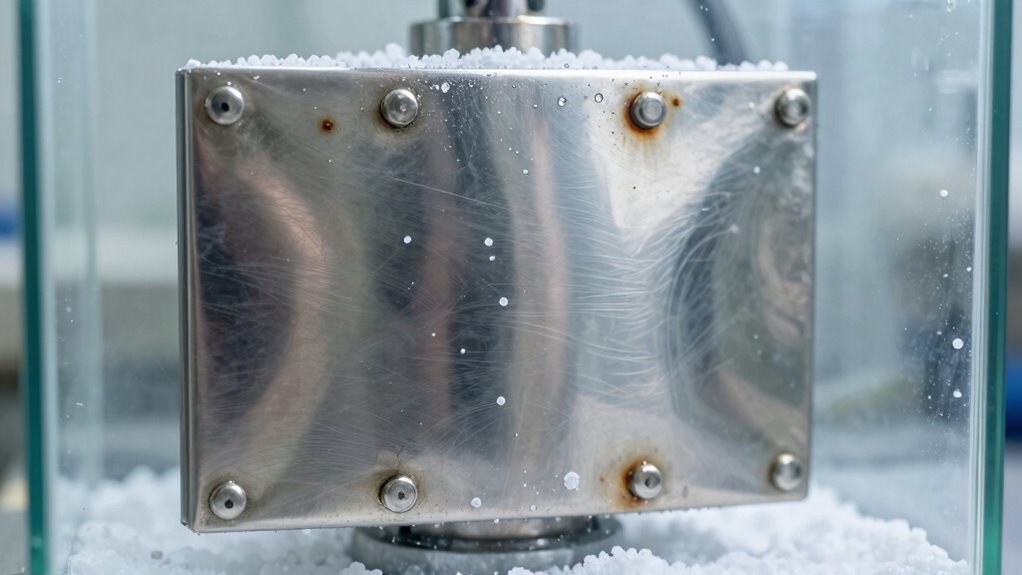
Salt spray testing is often seen as a perfect way to predict outdoor corrosion, but that’s a myth. The test accelerates corrosion with constant salt mist in controlled conditions, which doesn’t mimic real-world environments that include temperature changes, UV exposure, and weather variations. It mainly shows uniform corrosion and may miss localized issues like pitting. To get a true picture of durability, understand the test’s limitations and explore more all-encompassing evaluation methods. If you continue, you’ll discover what other factors influence outdoor corrosion and how to better assess materials.
Key Takeaways
- Salt spray tests accelerate corrosion but do not replicate all environmental factors influencing real-world corrosion.
- They mainly simulate uniform corrosion, failing to predict localized forms like pitting or crevice corrosion.
- Continuous saline mist exposure differs from intermittent outdoor conditions, affecting corrosion rates.
- Results from salt spray testing can be overly conservative or not fully indicative of long-term outdoor durability.
- It should be used as an initial screening tool, complemented by other tests for accurate real-world performance prediction.
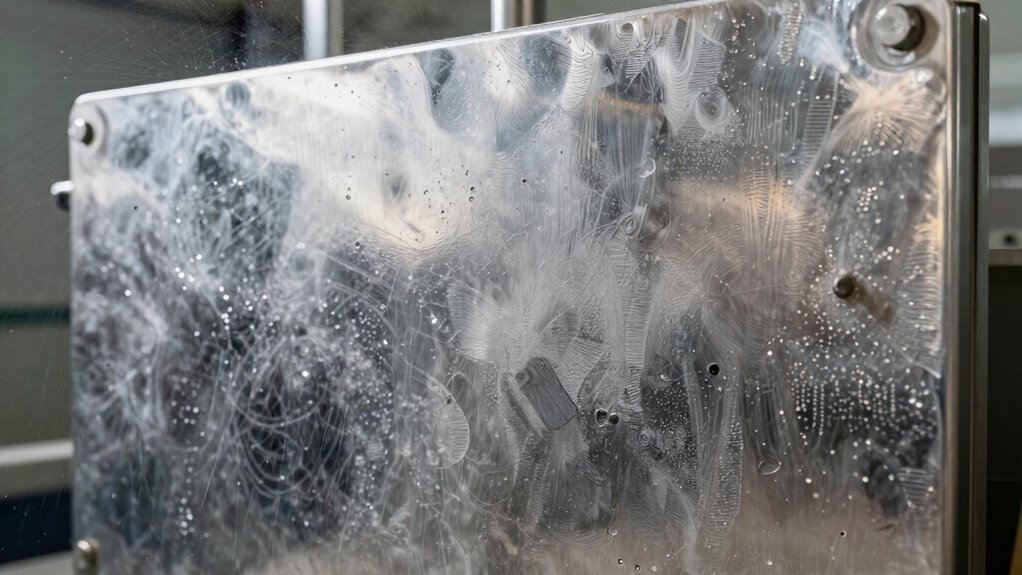
Many people believe that salt spray testing perfectly predicts how materials will corrode in real-world environments, but this isn’t entirely true. While it’s a popular method for evaluating corrosion resistance, salt spray testing has notable limitations when it comes to accurately reflecting real-world conditions. Understanding these test limitations helps you recognize that the corrosion mechanisms encountered outdoors are often more complex than what a controlled salt spray chamber can simulate.
Salt spray testing primarily accelerates the corrosion process by exposing materials to a continuous, high-humidity saline environment. However, this approach oversimplifies the multitude of factors that influence corrosion in real life. For example, environmental variables such as temperature fluctuations, UV radiation, rainfall, and pollution are rarely replicated in a lab setting. These factors can alter corrosion mechanisms considerably, leading to different types and rates of deterioration. Consequently, the test’s ability to predict how a material will behave over time in diverse environments is limited.
Salt spray tests oversimplify corrosion factors like temperature, UV, and pollution, limiting real-world predictability.
One of the key test limitations is that it often produces uniform corrosion, which doesn’t always mirror the uneven, localized corrosion forms like pitting, crevice, or galvanic corrosion seen outdoors. These localized forms are influenced by specific conditions—such as moisture pockets or differing metal potentials—that a salt spray chamber doesn’t reproduce. Because of this, the test might underestimate or overestimate a material’s resistance to certain corrosion mechanisms, giving you a misleading picture of its durability.
Moreover, salt spray testing typically involves constant exposure to a saline mist, but in real environments, exposure is intermittent and varies with weather patterns. This continuous exposure can accelerate corrosion beyond what’s typical outdoors, leading to conservative or overly pessimistic results. Conversely, some corrosion processes, like microbial-induced corrosion, do not occur in the test environment at all, further limiting its predictive accuracy. Additionally, the test may not account for long-term environmental effects, which are critical in assessing durability over extended periods.
Ultimately, while salt spray testing can serve as a useful initial screening tool, it shouldn’t be relied upon solely to predict long-term performance. Recognize that the test’s limitations mean it offers only a partial view of how your materials will hold up in real-world conditions. To get an extensive understanding, you need to consider additional testing methods and environmental simulations that better replicate the complexities of natural environments. Only then can you make more informed decisions about the durability and longevity of your materials under actual service conditions.
Frequently Asked Questions
How Does Salt Spray Testing Compare to Other Corrosion Testing Methods?
You’ll find that salt spray testing mainly assesses surface corrosion and doesn’t fully mimic real-world corrosion mechanisms. Unlike other methods like immersion or cyclic testing, it has test limitations, such as overestimating corrosion resistance. While useful for screening, it doesn’t predict long-term performance accurately. So, compare it with other tests to get a thorough understanding of how materials will behave in actual environments.
Can Salt Spray Testing Predict the Lifespan of a Product Accurately?
Imagine a crystal ball, but it’s limited in scope—salt spray testing can’t accurately predict your product’s lifespan. While it simulates accelerated aging, testing limitations mean it often overlooks real-world variables like climate, mechanical wear, and chemical exposure. So, you can’t rely solely on it for precise lifespan predictions. Instead, combine it with other methods for a more complete picture of your product’s durability over time.
What Environmental Factors Are Not Simulated by Salt Spray Testing?
Salt spray testing doesn’t simulate environmental factors like UV exposure and mechanical stress. UV rays can degrade coatings over time, while mechanical stresses from impacts or vibrations can cause cracks or damage not reflected in salt spray conditions. These factors influence corrosion but aren’t accounted for in standard salt spray tests, so relying solely on this method can lead to an incomplete understanding of how a product will perform in real-world environments.
How Can Manufacturers Improve Corrosion Resistance Beyond Salt Spray Testing?
Think of your corrosion resistance like a fortress—you need multiple layers of defense. You can enhance it by applying advanced surface treatments and exploring coating innovations that go beyond traditional methods. Incorporate real-world testing conditions, like humidity and temperature variations, to mimic actual environments. Regularly update your coatings based on new research, and perform field tests to ensure your protective measures hold strong against corrosion’s relentless assault.
Are There Industry Standards Governing Salt Spray Test Procedures?
Industry standards do govern salt spray test procedures, ensuring consistency and reliability across testing labs. You should be aware of industry compliance requirements, which specify testing parameters and acceptance criteria. However, keep in mind the testing limitations—salt spray tests don’t perfectly predict real-world corrosion. By understanding these standards and limitations, you can better interpret test results and improve your products’ corrosion resistance beyond just meeting minimum requirements.
Conclusion
Remember, salt spray testing isn’t a crystal ball for real-world corrosion. It’s just one tool, and studies show it overestimates corrosion rates by up to 10 times in some cases. So, don’t rely solely on these tests to predict how your materials will hold up outdoors. Instead, combine them with real-world testing and field data for a more accurate picture. Trust me, your projects will thank you for it.