
A handheld 4–20 mA loop calibrator can source or measure current for checking transmitters, PLC inputs, and control loops, but models vary widely in their extra functions and workflow. My best overall pick is the ennoLogic eC380V for its combination of signal generation and measurement in a portable process-calibrator format. The ET2715 stands out for its stated 0.05% accuracy, while the Extech 412355A is a stronger fit for buyers who want a current-and-voltage calibrator and meter from an established instrument brand. The main tradeoffs are measurement capability versus simple signal generation, and broader functions versus a smaller, easier-to-carry tool. Read on for the full comparison, selection criteria, and advice on matching a calibrator to your loop-testing work.

Prime made for students and young adults
- Fast, free delivery for dorm and study essentials
- Prime Video and Amazon Music included
- Member-only deals
Key Takeaways
- The ennoLogic eC380V ranks first because its generator-and-meter approach suits technicians who need both to create a loop signal and check one.
- The ET2715 is the accuracy-focused pick in this lineup, with a stated 0.05% accuracy and added mV and Hz calibration functions; verify the relevant range and accuracy conditions before relying on it for formal work.
- Several compact signal-generator models prioritize simplicity over broad measurement capability, so check whether you need to measure current or only source a test signal.
- The product names reveal meaningful function differences: active/passive loop support, voltage output, resistance measurement, and thermocouple functions are not interchangeable features.
- The Extech 412355A is the clearest established-brand alternative, while multiple LB78 and Victor 05S listings make exact model and function verification especially important before ordering.
| ennoLogic eC380V Volt/mA Loop Process Calibrator |  | Best Overall for Measurement and Source Accuracy | Current measurement range: 0–24 mA | Current measurement accuracy: 0.015% | Current output range: 0–24 mA | VIEW ON AMAZON | See Our Full Breakdown |
| C703 4-20mA Signal Generator Calibrator |  | Best for Active and Passive Loop Simulation | Current output: 4–20 mA | Voltage output: 0–30 V | Current-loop modes: Active and passive | VIEW ON AMAZON | See Our Full Breakdown |
| LB78 Signal Generator 4-20mA / 0-10V / mV |  | Best Compact Signal Source | Current output: 0–24.00 mA | Voltage output: 0–11.00 V | Millivolt output: 0–110.0 mV | VIEW ON AMAZON | See Our Full Breakdown |
| SG-004A Mini Multi-Function Handheld Signal Generator Calibrator |  | Best for Multi-Signal Diagnostics | Current output: Active and passive, 0–24 mA | Current input: Active, 0–24 mA | Voltage input and output: 0–24 V | VIEW ON AMAZON | See Our Full Breakdown |
| ET2715 4-20mA Loop Current and Voltage Calibrator |  | Best for Wet or Rough Field Conditions | Accuracy: 0.05% | Signal functions: 4–20 mA, millivolt, and frequency calibration | Protection: IP67 waterproof | VIEW ON AMAZON | See Our Full Breakdown |
| LB78 Current Signal Generator, 4-20mA / 0-10V / mV Signal Source Calibrator Tester | 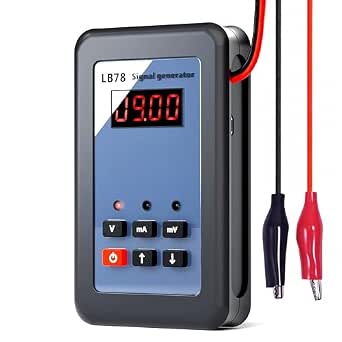 | Best Multi-Signal Value | Output signals: 0–24.00 mA; 0–11.00 V; 0–110.0 mV | Power source: 24 V, 1500 mAh lithium battery | Voltage and millivolt output runtime: More than 20 hours | VIEW ON AMAZON | See Our Full Breakdown |
| Eujgoov Process Calibrator 4-20mA 0-30V Active Passive Loop |  | Best for Active/Passive Loop Work | Current support: 4–20 mA, passive current support | Voltage output: 0–15 V | Voltage measurement: 0–30 V | VIEW ON AMAZON | See Our Full Breakdown |
| Victor/RuoShui Multifunction Calibration 05S 4-20mA Signal Generator Loop Calibrator |  | Best for Stated Measurement Accuracy | Model: G-VICTOR 05+ | Measurement accuracy: 0.05% | Display: 5-digit LCD | VIEW ON AMAZON | See Our Full Breakdown |
| LB02 Process Calibrator 4-20mA 0-10V mV Resistance Voltmeter Signal Generator |  | Best for Broad Instrument Maintenance | Measurement type: Voltmeter | Signal functions listed: Current, voltage, resistance, and thermocouple inputs | Compatible equipment: PLC, DCS, ESD, field instruments, control valves, frequency converters | VIEW ON AMAZON | See Our Full Breakdown |
| VICTOR 05S Multi-Function Calibration Loop Calibrator with 4-20mA Signal Generator | | Best Precision-Focused Pick | Basic measurement accuracy: 0.02% | Output accuracy: 0.05% | Loop voltage supply: 24 V | VIEW ON AMAZON | See Our Full Breakdown |
| Extech 412355A Current and Voltage Calibrator and Meter, 24mA 10V |  | Best for Straightforward Process Signal Calibration | Current range: 0–24 mA | Voltage range: 0–10 V | Measurement type: Ammeter | VIEW ON AMAZON | See Our Full Breakdown |
| loop calibrator 4 20 ma handheld | Power source | Display |
|---|---|---|
| ennoLogic eC380V Volt/mA Loop | — | — |
| C703 4-20mA Signal Generator C | AAA batteries or external 5 V adapter | Backlit LCD |
| LB78 Signal Generator 4-20mA / | Battery powered | — |
| SG-004A Mini Multi-Function Ha | — | — |
| ET2715 4-20mA Loop Current and | — | Large LCD with adjustable backlight |
| LB78 Current Signal Generator | 24 V, 1500 mAh lithium battery | — |
| Eujgoov Process Calibrator 4-2 | — | Backlit LCD |
| Victor/RuoShui Multifunction C | 3 AA batteries, included | 5-digit LCD |
| LB02 Process Calibrator 4-20mA | Battery powered | LCD |
| VICTOR 05S Multi-Function Cali | 1 LR41 battery, included | 5-digit LCD, 61.8 × 29.4 mm |
| Extech 412355A Current and Vol | Battery powered | — |
More Details on Our Top Picks
ennoLogic eC380V Volt/mA Loop Process Calibrator
The eC380V is my strongest pick for technicians who need both a handheld 4–20 mA source and a measurement instrument, rather than a generator alone. Its current range extends from 0–24 mA, and the listed 0.015% current accuracy gives buyers a clearer performance basis than the C703, whose description does not specify accuracy. A built-in 24 V loop supply also helps power a transmitter during checks without relying on a separate supply. It measures and sources voltage and current across stated ranges, but it cannot measure and source simultaneously, so it is less suited to workflows that require both at once. The LB78 is smaller and simpler for basic signal output; I would choose the eC380V when measurement precision and loop power matter more than minimum size.
Pros:- Specified 0.015% current accuracy for measurement and output
- Measures and sources current up to 24 mA
- Built-in 24 V loop supply simplifies powered transmitter checks
- Includes a carrying case and test leads
Cons:- Cannot measure and source signals simultaneously
- Needs six AAA batteries or a separately purchased 12 VDC adapter
- Its voltage and current ranges may not cover applications outside the stated limits
Best for: Process technicians and instrumentation repairers who need specified current accuracy, voltage and current measurement, and a built-in loop supply for transmitter checks.
Not ideal for: Technicians who must measure and source signals simultaneously, or buyers who want a rechargeable handheld unit rather than AAA batteries or a separate adapter.
- Current measurement range:0–24 mA
- Current measurement accuracy:0.015%
- Current output range:0–24 mA
- Current output accuracy:0.015%
- Voltage measurement and output ranges:0–100 mV and 0–20 V
- Loop supply:24 V ±10%
- Power:Six AAA batteries or 12 VDC/2 A adapter (not included)
- Size and weight:8 × 3.9 × 1.8 inches; 460 g (16 oz)
Our verdict“Choose the eC380V if you want a well-specified loop calibrator that can measure, source, and power loop devices, and can accept its sequential rather than simultaneous operation.”
C703 4-20mA Signal Generator Calibrator
The C703 earns its place for buyers who need a straightforward way to simulate a loop in either active or passive mode. That distinction matters when commissioning PLC inputs or checking transmitters with different loop arrangements: the mode options offer more setup flexibility than the LB78 listing, which focuses on signal output. It also generates 4–20 mA and voltage signals, with a backlit LCD that helps when adjusting settings in dim plant rooms. The main drawback is the thin technical detail: unlike the eC380V, this listing gives no accuracy figure, resolution, measurement function, or explicit loop-supply specification. I would treat it as a practical signal source, not a precision reference. Choose it over the eC380V only if active/passive simulation and simple output take priority over documented measurement performance.
Pros:- Supports active and passive current-loop modes
- Outputs 4–20 mA current and voltage signals
- Backlit LCD aids setup in low-light work areas
- Can run on AAA batteries or an external 5 V adapter
Cons:- No accuracy or resolution figures are provided
- Measurement capability and built-in loop-supply details are not specified
- At 1.54 pounds, it is heavier than the compact LB78
Best for: PLC commissioning technicians and field service staff who need a portable source with active and passive current-loop modes for basic loop simulation.
Not ideal for: Calibration teams that need published accuracy, fine resolution, signal measurement, or a documented built-in loop supply.
- Current output:4–20 mA
- Voltage output:0–30 V
- Current-loop modes:Active and passive
- Display:Backlit LCD
- Power source:AAA batteries or external 5 V adapter
- Intended applications:PLC commissioning, transmitter testing, and loop calibration
- Dimensions:7.48 × 5.31 × 3.35 inches
- Weight:1.54 pounds
Our verdict“Pick the C703 for active/passive loop simulation and clear display access, but choose the eC380V when documented accuracy and measurement functions are required.”
LB78 Signal Generator 4-20mA / 0-10V / mV
The LB78 is the most compact choice here for technicians who mainly need to generate a 4–20 mA test signal and carry the instrument between work areas. Its body measures just 108 × 66 × 20 mm, a clear portability advantage over the larger eC380V and C703. The output also covers 0–24 mA, 0–11 V, and 0–110 mV, making it useful for common analog checks beyond current loops. However, the provided specifications describe output rather than a measurement function, and they do not state a numerical accuracy figure. That makes the LB78 less suitable as a documented calibration reference than the eC380V. Battery runtime for voltage and millivolt output is listed as over 20 hours, while current-output runtime depends on load, so extended field use needs some planning.
Pros:- Very compact 108 × 66 × 20 mm body
- Outputs up to 24 mA, 11 V, and 110 mV
- Voltage and millivolt output runtime is listed as over 20 hours
- Includes a carry bag and has a simple key layout
Cons:- No numerical accuracy specification is provided
- The listed functions focus on signal output, with no measurement function specified
- Current-output battery life depends on current draw
Best for: Mobile maintenance technicians who need a pocketable source for common current, voltage, and millivolt signals and do not require documented measurement accuracy.
Not ideal for: Calibration specialists who need a stated accuracy specification, a built-in loop supply, or verified signal measurement rather than output alone.
- Current output:0–24.00 mA
- Voltage output:0–11.00 V
- Millivolt output:0–110.0 mV
- Dimensions:108 × 66 × 20 mm
- Power source:Battery powered
- Voltage and millivolt output runtime:More than 20 hours
- Working temperature:-10 to 50 °C
- Working humidity:20% to 80% RH
Our verdict“Choose the LB78 when small size and basic multi-range signal output matter more than the eC380V’s specified accuracy and measurement capability.”
SG-004A Mini Multi-Function Handheld Signal Generator Calibrator
The SG-004A goes well beyond a basic 4–20 mA handheld source: it supports active and passive current, voltage, frequency/PWM, millivolt/thermocouple, and resistance signals, with both input and output functions listed. Its curve display and data recording may help technicians review changing signals instead of relying only on a single reading. Compared with the LB78, it covers more signal types and adds recording; compared with the eC380V, however, the supplied data does not give accuracy figures, so I would not pick it for precision work that depends on a known tolerance. Its rechargeable 3000 mAh battery and Type-C charging avoid routine disposable-battery changes, but the 2.4-inch screen and broad feature set may take more time to learn than a simpler calibrator. The listed physical dimensions also differ from the item dimensions in the source data.
Pros:- Supports active and passive current input and output
- Handles voltage, frequency/PWM, millivolt/thermocouple, and resistance signals
- Includes real-time curve display and historical data recording
- Rechargeable 3000 mAh battery with Type-C charging
Cons:- No accuracy specification is supplied for precision calibration decisions
- The broad feature set may be harder to operate than the simpler LB78
- Source data lists conflicting size information for the item
Best for: Engineers and advanced maintenance technicians who troubleshoot mixed analog, frequency, thermocouple, and resistance signals and value input/output flexibility and recorded data.
Not ideal for: Users who want a simple 4–20 mA tool, require published accuracy, or need a clearly established pocket-size form factor.
- Current output:Active and passive, 0–24 mA
- Current input:Active, 0–24 mA
- Voltage input and output:0–24 V
- Other signal ranges:Frequency/PWM 0–9999 Hz; millivolt/thermocouple -10–110 mV
- Resistance ranges:Output 0–3900 Ω; input 0–400 Ω
- Display and recording:2.4-inch LCD; real-time curve display and historical data recording
- Battery and charging:3000 mAh; Type-C charging; stated standby time 24 hours
- Power input:5–12 V / 10 W
Our verdict“Choose the SG-004A for varied signal troubleshooting and recording, but select the eC380V if documented loop accuracy matters more than function breadth.”
ET2715 4-20mA Loop Current and Voltage Calibrator
The ET2715 is the field-oriented pick for technicians who work where moisture and handling conditions can rule out less-protected instruments. Its IP67 protection is the clearest differentiator in this group, while the large backlit LCD is easier to read than the compact LB78’s simple display arrangement. The listed 0.05% accuracy gives buyers a stated benchmark, though it is less precise than the eC380V’s specified 0.015% current accuracy. The ET2715 also covers current, millivolt, and frequency calibration and offers manual and automatic stepping, which can speed repeat checks. The tradeoff is that its exact current and voltage ranges are not detailed here, and the six AAAA batteries are a less common replacement format than the AAA cells used by the eC380V. Its interface may also take practice.
Pros:- IP67 waterproof protection suits wet field environments
- Stated 0.05% accuracy
- Large LCD with adjustable backlight
- Manual and automatic stepping for repeated calibration points
Cons:- The exact current and voltage ranges are not provided
- Six AAAA batteries may be less convenient to replace than standard AAA cells
- The interface may require familiarity before efficient use
Best for: Field technicians working around water or damp equipment who need a protected handheld calibrator with a readable display and current, millivolt, and frequency functions.
Not ideal for: Precision teams that need accuracy tighter than the stated 0.05%, or buyers who require fully specified signal ranges and simple controls.
- Accuracy:0.05%
- Signal functions:4–20 mA, millivolt, and frequency calibration
- Protection:IP67 waterproof
- Display:Large LCD with adjustable backlight
- Power supply:AC or DC
- Batteries:Six AAAA batteries included
- Stepping:Manual and automatic
Our verdict“Choose the ET2715 for IP67 field protection and automatic stepping, but favor the eC380V for tighter specified current accuracy and clearer range details.”
LB78 Current Signal Generator, 4-20mA / 0-10V / mV Signal Source Calibrator Tester
The LB78 makes the most sense for technicians who need more than a dedicated 4–20 mA source: it also generates voltage and millivolt signals, with ranges up to 24 mA, 11 V, and 110 mV. That flexibility can cover PLC and instrument checks without carrying separate signal sources. Compared with the VICTOR 05S, it trades precision-focused current calibration for broader output types and a compact 108 × 66 × 20 mm body. Its built-in fuse adds a layer of protection, while the rechargeable 1500 mAh battery supports extended voltage and millivolt output sessions. The tradeoff is that battery life on current output varies with load, and the voltage ceiling may not suit applications needing more. I’d choose it for varied field tasks, not for the highest stated measurement accuracy.
Pros:- Generates current, voltage, and millivolt signals in one handheld unit
- Current output range extends to 24 mA
- Built-in self-protection fuse
- Compact body and rechargeable 1500 mAh battery
Cons:- Battery runtime for current output depends on the output current
- Voltage output tops out at 11 V
- Calibration procedures may require familiarity
Best for: Field technicians who need one compact source for 4–20 mA, voltage, and millivolt signal checks across PLCs and instruments.
Not ideal for: Calibration specialists who prioritize a stated high-accuracy measurement figure or need voltage output beyond 11 V.
- Output signals:0–24.00 mA; 0–11.00 V; 0–110.0 mV
- Power source:24 V, 1500 mAh lithium battery
- Voltage and millivolt output runtime:More than 20 hours
- Operating temperature:-10 to 50 °C
- Humidity:20% to 80% RH
- Dimensions:108 × 66 × 20 mm
- Compatible equipment:PLC, DCS, ESD, field instruments, regulating valves, frequency changers
Our verdict“Choose the LB78 when broad signal-generation coverage matters more than a published precision specification.”
Eujgoov Process Calibrator 4-20mA 0-30V Active Passive Loop
The Eujgoov’s main distinction is active and passive loop support, which helps technicians work with different loop setups using one handheld calibrator. It pairs 4–20 mA current support with voltage output and measurement up to 30 V, plus a backlit LCD for dim panels or field enclosures. Compared with the LB78, which spans current, voltage, and millivolt generation, this model is more focused on loop testing and voltage checks; its listed output range is also narrower in signal variety. Four AAA batteries or an external 5 V adapter offer practical power choices, though the batteries are not included. The carrying case suits field use, but setup instructions may take extra attention. I’d pick it over the VICTOR 05S when active/passive flexibility matters more than a stated accuracy figure.
Pros:- Supports both active and passive loop modes
- Backlit LCD helps in poorly lit work areas
- Measures voltage up to 30 V
- Can run on AAA batteries or an external 5 V adapter
Cons:- Four AAA batteries are not included
- Signal range is limited to 4–20 mA current and 0–15 V output
- Setup instructions may be difficult for less experienced users
Best for: Controls technicians who regularly switch between active and passive 4–20 mA loops and need a backlit display for field troubleshooting.
Not ideal for: Users who need millivolt or resistance signal generation, or who want a published current-accuracy specification.
- Current support:4–20 mA, passive current support
- Voltage output:0–15 V
- Voltage measurement:0–30 V
- DC voltage accuracy:±0.2%, 20 mV / 100 mV
- Power:4 × AAA batteries or external 5 V adapter
- Display:Backlit LCD
- Size:115 × 71 mm
Our verdict“Pick the Eujgoov for active/passive loop flexibility and voltage measurement rather than broader signal types or documented precision.”
Victor/RuoShui Multifunction Calibration 05S 4-20mA Signal Generator Loop Calibrator
Among these picks, the Victor/RuoShui 05S is a straightforward choice for buyers who want a stated 0.05% measurement accuracy in a 4–20 mA-focused calibrator. Its five-digit LCD and 24 V loop supply make current readings and loop checks easier to interpret without leaning on a broad menu of signal types. Compared with the LB78, it offers a clearer accuracy claim and loop power, but gives up the LB78’s voltage and millivolt output versatility. The included three AA batteries make it ready to power without sourcing a separate cell type, and its specified temperature range is broad for field conditions. This is still a specialized instrument rather than a general-purpose electrical meter, and its 0.5 kg listed weight is less compelling for buyers seeking the lightest carry option. I’d favor it for current-loop work over the broader LB02.
Pros:- Stated measurement accuracy of 0.05%
- Five-digit LCD with current shown in mA and percentage
- 24 V loop voltage supply
- Three AA batteries are included
Cons:- Focused on industrial loop calibration rather than general-purpose measurement
- Listed weight of 0.5 kg is heavier than a very compact handheld option
- Requires replacement AA batteries when depleted
Best for: Instrument technicians who mainly perform 4–20 mA loop checks and want a stated accuracy figure, five-digit display, and 24 V loop supply.
Not ideal for: Technicians who need voltage, millivolt, resistance, or thermocouple functions in the same handheld tool.
- Model:G-VICTOR 05+
- Measurement accuracy:0.05%
- Display:5-digit LCD
- Loop voltage supply:24 V
- Current display:mA and mA%
- Power source:3 AA batteries, included
- Temperature range:-25 to 60 °C
- Weight:0.5 kg
Our verdict“Choose the Victor/RuoShui 05S for accuracy-focused 4–20 mA work when multi-signal generation is not a priority.”
LB02 Process Calibrator 4-20mA 0-10V mV Resistance Voltmeter Signal Generator
The LB02 earns its place by covering a wider maintenance brief than a typical 4–20 mA handheld calibrator: the product data lists current and voltage alongside resistance and thermocouple inputs. That mix can reduce tool changes when servicing PLCs, field instruments, and control devices. Compared with the LB78, it advertises broader measurement and input functions, while the LB78 gives clearer numerical output ranges and a specified rechargeable battery capacity. The LB02’s compact 4.16-ounce listing and LCD make it attractive for portable work, but the available data does not spell out detailed ranges or accuracy figures. That makes it harder to match confidently to a precision requirement. Instructions may also require consulting the manual, so this is a better fit for an experienced maintenance technician than someone learning loop calibration from scratch.
Pros:- Supports multiple signal types, including current, voltage, resistance, and thermocouple inputs
- Compact listed weight of 4.16 ounces
- LCD and button operation suit portable maintenance work
- Compatible with PLC, DCS, ESD, field instruments, and control devices
Cons:- Available product data does not specify detailed ranges or accuracy
- Limited user instructions may make setup less approachable
- Battery power requires recharging or replacement
Best for: Experienced maintenance technicians who service mixed control equipment and want current, voltage, resistance, and thermocouple-related functions in one compact tool.
Not ideal for: Buyers who need clearly documented signal ranges, a stated accuracy specification, or beginner-friendly setup guidance.
- Measurement type:Voltmeter
- Signal functions listed:Current, voltage, resistance, and thermocouple inputs
- Compatible equipment:PLC, DCS, ESD, field instruments, control valves, frequency converters
- Power source:Battery powered
- Display:LCD
- Listed weight:4.16 ounces
- Certifications listed:CE, RoHS
Our verdict“Choose the LB02 for varied instrument maintenance if you can confirm its undocumented ranges meet your calibration needs.”
VICTOR 05S Multi-Function Calibration Loop Calibrator with 4-20mA Signal Generator
The VICTOR 05S is the precision-led option here, with 0.02% basic measurement accuracy and 0.05% output accuracy—stronger stated measurement precision than the Victor/RuoShui 05S’s 0.05% figure. Its 24 V loop supply and current display in mA and percentage suit transmitter simulation and loop checks, while the five-digit screen supports fine readings. The tradeoff is a narrower job description than the LB02, whose listed functions include resistance and thermocouple inputs. This VICTOR also relies on a single LR41 battery, which may be less convenient for extended field work than the three-AA setup on the other 05S. Its compliance list and -25 to 60 °C range make it a candidate for demanding environments, but the supplied data lists a 1 kg weight despite a four-inch length, so portability claims deserve caution.
Pros:- Stated basic measurement accuracy of 0.02% and output accuracy of 0.05%
- 24 V loop voltage supply and current display in mA and percentage
- Five-digit LCD with a listed 61.8 × 29.4 mm screen
- Specified operating temperature reaches 60 °C
Cons:- Uses a single LR41 battery, which may be less convenient to replace in the field
- Listed weight is 1 kg despite the compact four-inch length
- Function set is more focused on current loops than the LB02’s listed signal types
Best for: Calibration specialists who prioritize a low stated measurement error for 4–20 mA transmitter and loop work.
Not ideal for: Technicians needing broad resistance or thermocouple functions, or those who prefer common AA cells for field battery changes.
- Basic measurement accuracy:0.02%
- Output accuracy:0.05%
- Loop voltage supply:24 V
- Display:5-digit LCD, 61.8 × 29.4 mm
- Power source:1 LR41 battery, included
- Response time:1 second
- Temperature range:-25 to 60 °C
- Compliance:CE, RoHS, UL, IEC 1010, IEC/EN 61326-1, IEC 60068-2-64, IEC 60068-2-32
Our verdict“Choose this VICTOR 05S when its stronger stated measurement accuracy matters more than broader functions or easier battery sourcing.”
Extech 412355A Current and Voltage Calibrator and Meter, 24mA 10V
The Extech 412355A suits technicians who need to calibrate process devices and measure both current and voltage without carrying a broader multifunction instrument. Its ranges reach 0–24 mA and 0–10 V, covering common 4–20 mA loop work while leaving some headroom above the standard current span. The large LCD helps keep readings legible during field checks, and the included case, cable, strap, battery, and AC adapter make it a ready-to-carry package.
Compared with the ET2715, which lists additional mV and frequency functions, this Extech keeps its scope narrower; buyers focused on basic current-and-voltage calibration may prefer that simplicity. The tradeoff is less range and feature flexibility, plus dependence on a replaceable 9V battery. Its touch keypad may also take some getting used to for occasional users.
Pros:- Measures and calibrates current from 0–24 mA, covering standard 4–20 mA loop checks
- Also handles DC voltage from 0–10 V
- Large LCD makes readings easier to see during field work
- Includes a carrying case, cable, strap, 9V battery, and AC power adapter
Cons:- Current and voltage ranges are limited to 24 mA and 10 V
- Requires replacement of a 9V battery
- Touch keypad and functions may feel complex for casual or infrequent users
Best for: Process technicians who routinely calibrate 4–20 mA transmitters and check DC voltage, and want a compact meter with field accessories included.
Not ideal for: Technicians who need mV or frequency functions, a wider voltage range, or a more expansive multifunction signal generator.
- Current range:0–24 mA
- Voltage range:0–10 V
- Measurement type:Ammeter
- Compatible devices:Process devices
- Power source:Battery powered
- Included components:9V battery, cable, case, strap, and AC power adapter
- Dimensions:4.2 × 1.8 × 3.8 in
- Weight:0.35 kg
- Warranty:1 year
Our verdict“Choose the 412355A for portable, focused 4–20 mA and low-voltage process checks, but pick a model such as the ET2715 if you need added signal functions.”

How We Picked
I ranked these tools by how directly they serve handheld 4–20 mA loop work: whether they can source, simulate, or measure current; whether the listed functions support common transmitter and PLC checks; and how clearly their stated capabilities map to field tasks. I also weighed portability and usability clues such as a backlit display, Type-C charging, and built-in protection, while treating headline accuracy claims as useful only when their conditions and measurement ranges are confirmed.
The ennoLogic eC380V leads because its stated generator-and-meter role offers a practical balance for general troubleshooting. The ET2715 follows for its accuracy claim and added signal functions, while the Extech earns a place for buyers who value a current-and-voltage calibrator from a recognized test-equipment maker. More specialized or less fully specified signal generators rank lower, not because they cannot suit a task, but because buyers may need to verify operating modes, measurement functions, and model details before choosing. Similar LB78 and 05S names are treated as separate listings, with extra attention to confirming the exact version.
Factors to Consider When Choosing Loop Calibrator 4 20 Ma Handheld
Choosing a calibrator starts with the loop task, not the longest feature list. I would define what the instrument must do at the terminals, then check whether its operating modes, accuracy information, and power arrangement match the job.
Decide Whether You Need to Source, Simulate, or Measure
These are distinct jobs, even when a listing calls the instrument a signal generator or calibrator. Sourcing supplies a current signal to test an input, simulation behaves like a two-wire transmitter in a loop powered from elsewhere, and measurement reads the current already flowing. A tool that generates 4–20 mA may not measure a live loop, so do not infer meter capability from the word “calibrator.” Check the operating modes and connection diagrams before buying. If your work includes transmitter checks and PLC input troubleshooting, a source-and-measure instrument can reduce tool changes. If you only inject test signals at a bench, a simpler generator may be enough.
Check Active and Passive Loop Compatibility
Active and passive describe how the calibrator interacts with loop power, not a quality tier. In an active mode, the instrument supplies loop power; in a passive or simulation mode, an external supply powers the loop while the calibrator controls the current. Confusing the two can produce a failed test or an incorrect connection. Match the instrument modes to the transmitter and input circuits you encounter, and confirm whether the manual shows the wiring you need. If you service varied installations, broader mode support can justify a more capable unit. For a single, familiar setup, fewer modes may mean simpler operation.
Read Accuracy Claims in Context
A stated accuracy figure is useful only alongside the range, resolution, calibration interval, and conditions under which it applies. Check whether the specification covers both measurement and output; those figures can differ. Do not treat a small percentage claim as proof of traceability or suitability for regulated calibration records. For formal work, ask about calibration documentation and whether the instrument can be calibrated by a qualified service provider. For routine fault isolation, stable operation and readable increments may matter more than a headline number. Compare the task tolerance against the complete specification, not one figure in a product title.
Choose Extra Functions Around Actual Work
Voltage, millivolt, frequency, resistance, and thermocouple functions can replace other test tools, but only when they match the signals and sensors you handle. A feature list does not tell you whether a function has the range, accuracy, or connection accessories your application requires. List the measurements you perform in a typical week and separate regular needs from occasional conveniences. Extra functions are more valuable for a technician working across varied process systems than for someone dedicated to current-loop checks. Avoid paying in complexity, size, or setup time for modes you will rarely use. Confirm each required function in the manufacturer’s specifications.
Think Through Field Power, Display, and Protection
Battery type, charging method, operating time, and replacement access affect whether a handheld calibrator is ready when needed. Type-C charging can simplify replenishment, but it does not by itself indicate runtime or whether the unit can operate while charging. A backlit display helps in dim cabinets, while clear mode indicators can prevent a source-versus-measurement mix-up. Protection features, including a fuse where specified, may limit damage from connection errors, but they do not replace checking the wiring diagram. For field crews, also consider whether leads and adapters are included and easy to replace. A compact body is useful only if its controls remain practical with gloves and at awkward panels.
Verify the Exact Model and Support Details
Lookalike model names and similar product titles can hide differences in functions, accessories, or revisions. This matters in this roundup, where separate LB78 and Victor 05S listings appear with overlapping names but different descriptions. Match the exact model identifier on the listing to the manual and specification sheet before purchase. Check the supported ranges, included leads, warranty terms, and available calibration service rather than relying on a short title. If the seller cannot clarify a required function, choose a listing with documentation you can verify. This small check can prevent a tool mismatch that a broad feature list would not reveal.
Frequently Asked Questions
Can a 4–20 mA signal generator also measure current?
Not always. A generator creates or simulates a signal, while a meter reads current in an operating circuit; some calibrators combine both jobs, but a generator-only unit may not. Check the manual for a dedicated current-measurement mode and its range, rather than relying on “calibrator” in the product name. If you need to verify a live loop as well as inject test values, choose a model whose documentation explicitly covers both tasks. The ennoLogic eC380V is described as a generator and meter, while several other listings emphasize signal generation.
What is the difference between sourcing 4–20 mA and simulating a transmitter?
Sourcing generally means the calibrator supplies the current into a receiving device, while simulation mimics a transmitter and relies on loop power from the circuit. The correct mode depends on the wiring and power arrangement of the PLC input or transmitter loop. Using the wrong mode can lead to an invalid reading or an unsuitable connection. Review the wiring examples in the manual before connecting the instrument, especially if you work with both powered and externally powered loops. A model described as supporting active and passive operation may cover more setups, but verify exactly how those modes are defined.
Is a stated 0.05% accuracy enough for calibration work?
That figure alone cannot answer the question. You need to know whether it applies to current output, current measurement, or both, and over which range and environmental conditions. Formal calibration work may also call for traceable documentation, a known calibration interval, and procedures that meet your workplace requirements. The ET2715 lists 0.05% accuracy, making it worth examining for accuracy-focused buyers, but confirm the full specification and available calibration records. For routine troubleshooting, a less accuracy-focused tool may be a better fit if its functions and usability match the job.
Should I choose a multifunction calibrator or a dedicated 4–20 mA tool?
Choose by the signals you actually need to test. A multifunction unit can reduce the number of instruments carried when you regularly work with voltage, resistance, frequency, millivolts, or thermocouples. A dedicated current tool may be simpler to set up and easier to use if your work is mostly loop checks. Extra functions are not automatically useful if their ranges or accuracy do not meet your requirements. Before choosing, compare your common tasks with the documented functions and accessories, then decide whether one instrument can cover them reliably.
How can I tell whether two similar listings are the same calibrator?
Compare the exact model number, manufacturer documentation, supported functions, and included accessories rather than relying on similar titles or photos. This is especially relevant here because the roundup includes separate LB78 and Victor 05S listings with overlapping descriptions. Check whether each version measures as well as generates current, supports active or passive loops, and includes the ranges you need. If those details are unclear, ask the seller for the manual or specification sheet before ordering. Confirming the exact unit can matter more than choosing between two nearly identical names.
Conclusion
For a single tool to cover general loop troubleshooting, I recommend the ennoLogic eC380V as best overall because its stated generator-and-meter role balances signal creation and checking. The ET2715 is my accuracy-focused pick for buyers who need its stated 0.05% accuracy and added mV or Hz functions, subject to confirming the full specifications. For best value in function-first terms, compare the LB78 or SG-004A listings against your actual needs and verify the exact functions before choosing; I cannot rank value by price here. Beginners should favor a clearly documented model with understandable wiring instructions, and the ennoLogic is the most balanced starting point in this lineup. For an established-brand option, consider the Extech 412355A; for varied loop-power setups, look for confirmed active/passive support such as that listed for the Eujgoov. Match the mode and documentation to your circuit before making the final choice.