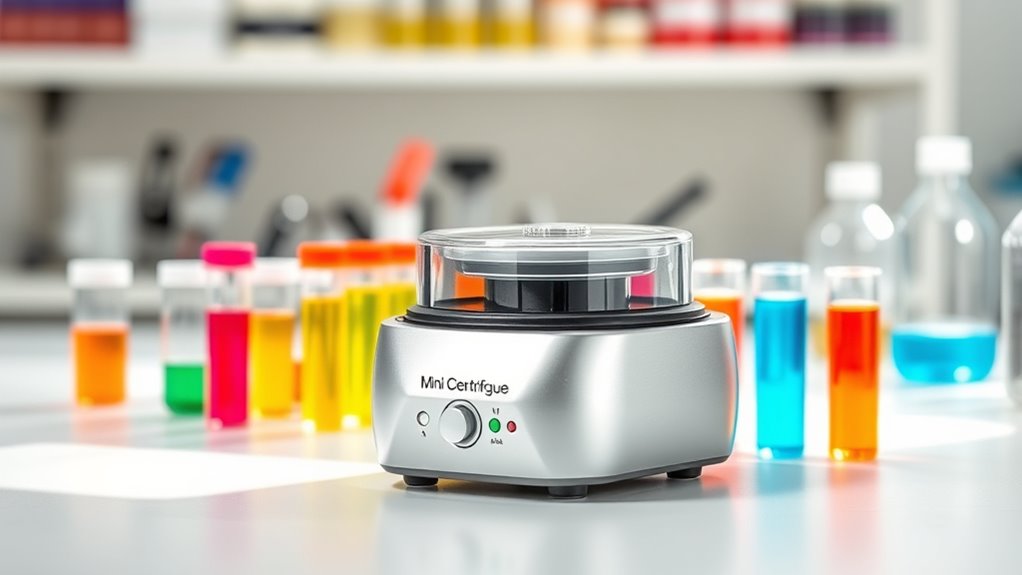

When selecting a mini centrifuge for lab use at home or school, the main considerations include speed, safety, ease of use, and versatility. The Mini Centrifuge Machine with 10,000 RPM stands out as the best overall for its high speed and multi-tube compatibility, ideal for varied experiments. For those prioritizing affordability without sacrificing essential features, the NEWTRY Mini Centrifuge offers a compact, budget-friendly option. Meanwhile, the SCILOGEX EZee Mini Centrifuge provides a reliable choice for microtubes and PCR strips, perfect for more specific applications. However, tradeoffs often involve balancing speed, safety features, and price. Continue reading for a detailed comparison to help you pick the best fit for your lab needs.
Get ready for Prime Big Deal Days — try Prime free
Exclusive member deals on October 6–7, plus fast free delivery. Cancel anytime.
Start your free trialAs an affiliate, we earn on qualifying purchases.
Key Takeaways
- Top picks balance speed, safety, and ease of operation, with high-speed models like 12,000 RPM suited for advanced use.
- Versatility in rotor options and tube compatibility is key for accommodating different sample types in home or school labs.
- Budget models often lack advanced safety features but can perform adequately for basic sample spinning tasks.
- Compact size and straightforward controls make some models more suitable for beginners or limited lab space.
- Higher price often correlates with better build quality, safety features, and precision, which matter for frequent or sensitive experiments.
| Mini Centrifuge Machine, 10000RPM, OLED Display, High Speed Lab Benchtop Centrifuge with 3-in-1 Rotor for 0.5/1.5/2mL Tubes and PCR Strips |  | Best Overall for Precision and Speed | Speed: 10000 RPM | Max RCF: 6708×g | Rotor Compatibility: 0.5/1.5/2mL tubes, PCR strips | VIEW ON AMAZON | See Our Full Breakdown |
| Ohaus Frontier 5306 Mini Centrifuge Machine, Laboratory Benchtop Centrifuge for Sample Separation, Dual Safety Switch, Quiet Operation, Simple Controls, 2 Rotor Options, 6000 RPM |  | Best for Safety and Versatility in Routine Labs | Max Speed: 6000 RPM | Centrifugal Force: 2000 g | Tube Compatibility: 8 x 1.5/2 mL | VIEW ON AMAZON | See Our Full Breakdown |
| NEWTRY Mini Centrifuge Machine, Electric Desktop Lab Centrifuge |  | Best Compact and Portable for Basic Use | Speed range: 300-4000 rpm | Timing range: 0-60 minutes | Support centrifuge tube range: 5ml, 10ml | VIEW ON AMAZON | See Our Full Breakdown |
| ONiLAB Mini Benchtop Centrifuge, 7000RPM, 2680×g, 2 Rotors |  | Best for Speed and Efficiency in Small Labs | Max RPM: 7000rpm | Max G-force: 2680×g | Rotors: 2 rotors (various capacities) | VIEW ON AMAZON | See Our Full Breakdown |
| ONiLAB Lab PRP Centrifuge, 6x15ml/10ml/7ml/1.5-5ml, 300-5000RPM, Max 2600×g |  | Best for Versatile Tube Sizes and Precise Control | Rotor capacity: 6x15ml/10ml/7ml/1.5-5ml | Speed range: 300-5000 RPM | Max G-force: 2600×g | VIEW ON AMAZON | See Our Full Breakdown |
| ONiLAB PRP Centrifuge, 300-5000RPM, 2600×g LCD Lab Centrifuge |  | Best for Precise Laboratory and Clinical Use | Speed Range: 300-5000 RPM | RCF: 2600×g | Tube Compatibility: 6 × 15 mL, 10 mL, 7 mL, 1.5–5 mL tubes | VIEW ON AMAZON | See Our Full Breakdown |
| Mini Centrifuge Machine 5400rpm for 0.2/0.5/1.5/2mL by FOUR E’S SCIENTIFIC |  | Best for Small-Volume, Education, and Basic Lab Use | Speed: 5400rpm | Max RCF: 2000×g | Rotors: 2 interchangeable rotors | VIEW ON AMAZON | See Our Full Breakdown |
| JOANLAB LC-400 PRP Centrifuge, 8×2/5/10ml & 4x15ml Tubes |  | Best for Delicate, Low-Speed Sample Preparation | Max RPM: 4000 RPM | Max RCF: 1717×g | Cycle Duration: 30s-59min | VIEW ON AMAZON | See Our Full Breakdown |
| LC-400 RP PRF Centrifuge Machine, 500-4000rpm, 1717×g, Plasma |  | Best for High-Precision, Industrial-Grade Separation | Speed Range: 500-4000 rpm | Relative Centrifugal Force: 1717×g | Tube Capacity: 4 x 15 ml or 8 x 2/5/10 ml | VIEW ON AMAZON | See Our Full Breakdown |
| Mxmoonant Mini Centrifuge Machine, 12000RPM Lab Benchtop PCR Centrifuge |  | Best for Versatile Speed and Precise Digital Control | Speed: 12000 RPM | Weight: 5.98 pounds | Dimensions: 15.75 x 9.57 x 8.39 inches | VIEW ON AMAZON | See Our Full Breakdown |
| Mini Laboratory Centrifuge Machine LCD 100-12000RPM 99-Minute Timer 7245×g RCF |  | Best for Safety and Durability in Lab Settings | Dimensions: 6.7 x 5.7 x 4.7 inches | Speed Range: 100-12,000 RPM | RCF: 7245×g | VIEW ON AMAZON | See Our Full Breakdown |
| Lab Mini Centrifuge 7000 RPM, Max 2680 x g RCF |  | Best for Compact, Low-Noise Operation | Max Speed: 7000 RPM | Max RCF: 2680 x g | Noise Level: ≤50dB | VIEW ON AMAZON | See Our Full Breakdown |
| mini centrifuges for lab use spin samples at home or school | Dimensions |
|---|---|
| Mini Centrifuge Machine | — |
| Ohaus Frontier 5306 Mini Centr | — |
| NEWTRY Mini Centrifuge Machine | 9” x 8.6” x 6.8” |
| ONiLAB Mini Benchtop Centrifug | — |
| ONiLAB Lab PRP Centrifuge | 11.8 x 9.5 x 7.1 inches |
| ONiLAB PRP Centrifuge | 300 × 240 × 180 mm |
| Mini Centrifuge Machine 5400rp | — |
| JOANLAB LC-400 PRP Centrifuge | 12 x 12 x 9.5 inches |
| LC-400 RP PRF Centrifuge Machi | — |
| Mxmoonant Mini Centrifuge Mach | 15.75 x 9.57 x 8.39 inches |
| Mini Laboratory Centrifuge Mac | 6.7 x 5.7 x 4.7 inches |
| Lab Mini Centrifuge 7000 RPM | — |
More Details on Our Top Picks
Mini Centrifuge Machine, 10000RPM, OLED Display, High Speed Lab Benchtop Centrifuge with 3-in-1 Rotor for 0.5/1.5/2mL Tubes and PCR Strips
This model excels in combining high-speed operation—up to 10,000 RPM—with user-friendly features like an OLED display, making it ideal for precise sample processing at home or in school labs. Compared with the ONiLAB Mini Benchtop Centrifuge, it offers faster speeds but at a higher noise level and smaller capacity, which may matter for larger sample volumes. The robust rotor system and quick, tool-free rotor changes enhance its practicality, though it remains a desktop unit, not portable. Its limited capacity suits micro-samples but could be a drawback for those needing larger volumes or high throughput. Overall, this pick fits users who prioritize speed, monitoring, and quiet operation in a compact form.
Pros:- High-speed operation at 10,000 RPM for quick sample separation
- OLED display provides clear, real-time monitoring
- Low noise level ensures quiet operation during experiments
- Easy rotor swapping without tools enhances convenience
Cons:- Limited to micro-sample sizes, unsuitable for larger tubes
- Power supply may vary with voltage fluctuations
Best for: Students and small lab experimenters who need reliable, high-speed centrifugation in a fixed lab setting.
Not ideal for: Families or educators seeking portable options or larger sample volumes for classroom demonstrations.
- Speed:10000 RPM
- Max RCF:6708×g
- Rotor Compatibility:0.5/1.5/2mL tubes, PCR strips
- Power:AC100-240V
- Noise Level:≤58dB
- Item Weight:4.69 pounds
Our verdict“This centrifuge is best for those needing high speed and precision in a stationary lab environment with small sample volumes.”
Ohaus Frontier 5306 Mini Centrifuge Machine, Laboratory Benchtop Centrifuge for Sample Separation, Dual Safety Switch, Quiet Operation, Simple Controls, 2 Rotor Options, 6000 RPM
The Ohaus Frontier 5306 stands out for its straightforward controls and safety features, making it suitable for educational settings and home labs where ease of use matters. While it operates at a modest 6000 RPM—less than the Mini Centrifuge Machine—its dual rotors and safety mechanisms provide added security and flexibility. Its lack of a digital display might frustrate users accustomed to more advanced interfaces, but this simplicity reduces complexity for beginners. Its limited capacity and absence of advanced features mean it’s better suited for small, routine samples rather than high-throughput or research-grade applications. Overall, this model makes the most sense for those prioritizing safety, quiet operation, and simple controls over speed or advanced features.
Pros:- Quiet operation up to 60 dB, ideal for shared spaces
- Dual safety switches prevent accidental operation
- Multiple rotor options for different sample types
- Simple, one-touch operation for ease of use
Cons:- Limited to small sample volumes, not suitable for large tubes
- No digital display or advanced controls
Best for: School or home users who want a safe, easy-to-operate centrifuge for basic sample separation.
Not ideal for: Advanced researchers or users needing high speed and large capacity for complex experiments.
- Max Speed:6000 RPM
- Centrifugal Force:2000 g
- Tube Compatibility:8 x 1.5/2 mL
- Operation:One-touch, automatic start
- Safety Features:Dual safety switches
- Noise Level:Up to 60 dB
Our verdict“This centrifuge is best for beginners and educators prioritizing safety and ease over speed and capacity.”
NEWTRY Mini Centrifuge Machine, Electric Desktop Lab Centrifuge
The NEWTRY Mini Centrifuge offers a versatile speed range from 300 to 4000 RPM, making it suitable for lightweight, small-volume samples in school or home environments. While it lacks the extreme speeds of larger lab models, its portability and adjustable settings make it appealing for on-the-go use or beginner labs. Compared with the ONiLAB Mini Benchtop Centrifuge, it provides a broader speed range but at a slightly lower maximum RPM. Its simple interface and durable ABS shell support basic sample separation tasks, though its limited capacity and basic features restrict more advanced applications. This pick is ideal for those who need a compact device that can handle a variety of small samples without fuss.
Pros:- Compact, lightweight, easy to carry
- Adjustable speed and timing for flexibility
- Durable ABS shell for long-lasting use
- Quiet operation at ≤50dB
Cons:- Limited to small sample volumes (5-10 mL tubes)
- Basic features may not meet advanced needs
Best for: Students and hobbyists who want a portable, adjustable centrifuge for small experiments.
Not ideal for: Professionals requiring high speeds or large-volume processing for research or clinical purposes.
- Speed range:300-4000 rpm
- Timing range:0-60 minutes
- Support centrifuge tube range:5ml, 10ml
- Vibration coefficient:≤0.6mm/s
- Motor power:50W
- Dimensions:9” x 8.6” x 6.8”
Our verdict“This centrifuge is best for beginners or students needing a portable, adjustable device for small-scale experiments.”
ONiLAB Mini Benchtop Centrifuge, 7000RPM, 2680×g, 2 Rotors
The ONiLAB Mini Benchtop Centrifuge provides a solid balance of speed—up to 7000 RPM—and safety with quick rotor changes. Its rapid acceleration and braking, combined with two versatile rotors, make it suitable for small labs needing quick turnaround times. Compared with the Ohaus Frontier 5306, it offers higher maximum RPM but less advanced safety features and digital controls. The absence of a display means it’s less suited for users who want detailed monitoring, but its low noise level and ease of rotor swapping make it a practical choice for routine use. Its capacity is limited, making it less ideal for high-throughput tasks but perfect for quick, small-sample spins.
Pros:- Fast acceleration and braking for efficiency
- Quiet operation at ≤45dB
- Easy rotor change with click-on design
- Includes multiple rotors for different sample sizes
Cons:- Limited to small sample sizes
- No digital interface for advanced control
Best for: Laboratory or educational users who prioritize speed, efficiency, and quick rotor changes in small-scale experiments.
Not ideal for: Users needing detailed digital controls or processing larger sample volumes.
- Max RPM:7000rpm
- Max G-force:2680×g
- Rotors:2 rotors (various capacities)
Our verdict“This centrifuge is ideal for users who need quick, efficient spins with minimal fuss in a compact form.”
ONiLAB Lab PRP Centrifuge, 6x15ml/10ml/7ml/1.5-5ml, 300-5000RPM, Max 2600×g
The ONiLAB Lab PRP Centrifuge offers a comprehensive combination of adjustable speed—up to 5000 RPM—and a large capacity for various tube sizes, making it suitable for more complex applications like platelet-rich plasma separation. Its digital controls and extended timer range provide precise operation, comparable to larger laboratory models like the Lab Mini Centrifuge 7000 RPM. The safety features, such as automatic lid lock and overspeed detection, add peace of mind during use. However, its larger footprint and noise level of ≤56dB may be less convenient for small or quiet environments. This machine suits users who need a flexible, multi-purpose centrifuge for more advanced or clinical tasks in a home or school setting.
Pros:- Wide speed range up to 5000 RPM for diverse applications
- Digital controls enable precise settings
- Safety features protect users and samples
- Supports various tube sizes for flexibility
Cons:- Relatively noisy at ≤56dB
- Higher price point compared to smaller models
Best for: Advanced students or hobbyists performing varied experiments requiring precise control and multiple tube sizes.
Not ideal for: Those seeking a lightweight, portable centrifuge for quick, small samples, as it is relatively bulky and more expensive.
- Rotor capacity:6x15ml/10ml/7ml/1.5-5ml
- Speed range:300-5000 RPM
- Max G-force:2600×g
- Timer:30 seconds to 99 minutes
- Dimensions:11.8 x 9.5 x 7.1 inches
- Weight:11.4 pounds
Our verdict“This centrifuge suits users needing precise, versatile operation for varied laboratory or educational experiments, accepting its larger size and cost.”
ONiLAB PRP Centrifuge, 300-5000RPM, 2600×g LCD Lab Centrifuge
This centrifuge stands out for its precise control over speed and RCF, making it ideal for delicate procedures like PRP that demand accuracy. Compared to the JOANLAB LC-400, it offers a broader speed range and supports multiple tube sizes, but its design is more suited for stationary lab environments rather than portable or home use. Its compact size and safety features like imbalance detection are valuable for research settings, though it requires an electrical outlet and isn’t designed for remote or casual applications. The adjustable speed and RCF ensure controlled separation, which is essential for clinical accuracy, but its higher cost and complexity might be overkill for simple home experiments. If your focus is on laboratory-grade precision, this model delivers, but it isn’t practical for DIY or school projects due to its size and professional features.
Pros:- Precise speed and RCF control for accurate sample separation
- Supports multiple tube sizes with interchangeable adapters
- Safety features like automatic lid lock and imbalance detection
- Compact design suitable for lab environments
Cons:- Limited portability due to size and power requirements
- No battery operation for remote or field use
- Designed primarily for professional lab settings, not casual or home use
Best for: Laboratory professionals or researchers needing precise, controlled spins for clinical or research samples.
Not ideal for: Home users or teachers seeking a lightweight, portable centrifuge for educational demonstrations or basic science projects.
- Speed Range:300-5000 RPM
- RCF:2600×g
- Tube Compatibility:6 × 15 mL, 10 mL, 7 mL, 1.5–5 mL tubes
- Display:LCD
- Timer Range:30 seconds to 99 minutes
- Dimensions:300 × 240 × 180 mm
- Weight:5.2 kg
- Power:100–240 V
Our verdict“This centrifuge is best suited for professional labs needing accuracy and safety over portability or ease of use.”
Mini Centrifuge Machine 5400rpm for 0.2/0.5/1.5/2mL by FOUR E’S SCIENTIFIC
This model is a strong choice for quick, simple spins of tiny samples, especially in educational or home settings. Its fixed speed of 5400rpm and 2000×g max RCF are suitable for general laboratory tasks like pelleting small volumes, but it falls short compared to the SCILOGEX EZee which reaches higher speeds up to 7,000 RPM, offering more versatility for micro-filtration or separation tasks. The interchangeable rotors support a range of tube sizes, ensuring flexibility, yet its fixed speed limits its use for applications requiring more precise control or variable speeds. Its low noise, lightweight design makes it ideal for classrooms or small labs, though it’s not suitable for blood or larger-volume samples. If your needs are basic sample spins in a compact form, this centrifuge provides good value, but it lacks the adjustable speed features of more advanced models.
Pros:- Compact and lightweight for easy handling
- Supports multiple small tube sizes and PCR strips
- Low noise operation and safety features like lid protection
- Fixed high speed suitable for basic applications
Cons:- Limited to small sample volumes and fixed speed
- Not suitable for blood or large-volume samples
- Lacks digital controls or precise speed adjustments
Best for: Students or teachers needing a reliable, affordable centrifuge for small-volume experiments and demonstrations.
Not ideal for: Users requiring variable speed control or processing larger sample volumes, such as blood or large tubes.
- Speed:5400rpm
- Max RCF:2000×g
- Rotors:2 interchangeable rotors
- Tube capacity:6×0.2/0.5/1.5/2mL and 2×0.2mL PCR strips
- Size:6.9 x 5.5 inches
- Weight:4.07 pounds
- Operation Safety:Lid protection, automatic stop when lid is opened
Our verdict“This centrifuge excels for small-scale, educational, or hobbyist use where simplicity and portability are priorities.”
JOANLAB LC-400 PRP Centrifuge, 8×2/5/10ml & 4x15ml Tubes
The JOANLAB LC-400 is tailored for applications like PRP and PRF, where low and precise speeds are essential. Its maximum RPM of 4000 and RCF of 1717×g make it more suitable for delicate separations compared to higher-speed models like the SCILOGEX EZee. Its LED interface simplifies operation, and the support for standard tubes makes it versatile for clinical or research settings. However, it offers limited information on noise levels and power specifications, which might matter for sensitive environments. Its stable performance with imbalance detection makes it reliable for precision work, but it requires balanced loading and isn’t designed for high-throughput or large-volume samples. If your focus is on gentle, controlled spins for medical research, this model provides excellent control but is less suitable for rougher or high-speed applications.
Pros:- Precise low-speed operation for delicate samples
- User-friendly LED control panel
- Supports common tube sizes for versatility
- Stable and safe with imbalance detection
Cons:- Limited noise level data; potentially noisy in quiet environments
- Lack of detailed power specifications
- Requires careful balancing for best results
Best for: Researchers or clinicians performing PRP or PRF procedures requiring gentle, low-speed centrifugation.
Not ideal for: Casual users or teachers needing a simple, budget-friendly centrifuge for basic classroom experiments.
- Max RPM:4000 RPM
- Max RCF:1717×g
- Cycle Duration:30s-59min
- Item Weight:10.28 pounds
- Dimensions:12 x 12 x 9.5 inches
- Tubes Supported:8×2/5/10ml & 4x15ml
- Power:Not specified
Our verdict“This centrifuge is ideal for precise, low-speed separations in medical or research contexts where delicate handling matters most.”
LC-400 RP PRF Centrifuge Machine, 500-4000rpm, 1717×g, Plasma
The LC-400 RP PRF excels in delivering high separation accuracy thanks to its adjustable speed and durable brushless motor. Its wide voltage compatibility and vibration protection make it robust for industrial or professional laboratory environments. The digital LCD display offers straightforward control, and the capacity for multiple tube configurations supports varied research needs. However, its limited tube capacity could be a drawback for larger sample batches, and the absence of detailed pricing or warranty information leaves some uncertainty about long-term reliability. This machine is best for labs that prioritize precise control, durability, and consistency over sheer throughput or portability. It’s less suited for casual or educational use, especially where budget constraints are tighter.
Pros:- High separation accuracy with adjustable speed
- Durable brushless motor ensures long lifespan
- User-friendly digital LCD display
- Vibration protection enhances stability
Cons:- Limited tube capacity for larger batches
- No detailed pricing or warranty info
- Requires level, balanced loading for best results
Best for: Industrial or research laboratories requiring reliable, precise, and durable centrifugation for small batches of sensitive samples.
Not ideal for: Home or school users seeking a portable, easy-to-use device for basic experiments or large-volume processing.
- Speed Range:500-4000 rpm
- Relative Centrifugal Force:1717×g
- Tube Capacity:4 x 15 ml or 8 x 2/5/10 ml
- Vibration Protection:Yes
- Display:LCD digital
- Motor:Brushless, maintenance-free
- Housing Material:High-quality ABS
- Noise Level:≤ 56 dB
Our verdict“This centrifuge is designed for professional environments demanding reliable, precise separation, not for casual or portable use.”
Mxmoonant Mini Centrifuge Machine, 12000RPM Lab Benchtop PCR Centrifuge
This model excels for users who need precise digital control combined with high-speed performance, making it well-suited for detailed sample separation tasks at home or school. Its digital keypad offers easy, accurate adjustments, and support for multiple rotor types adds to its versatility, unlike some simpler models that only handle basic tubes. Compared with the Mini Laboratory Centrifuge Machine LCD 100-12000RPM, the Mxmoonant’s support for various rotor sizes enhances flexibility but lacks detailed noise level info, which could impact noise-sensitive environments. This pick is ideal for those who prioritize control and speed in more complex experiments, though it may require additional accessories for certain applications.
Pros:- Digital keypad enables precise, easy adjustments
- Supports multiple rotor sizes for versatility
- High-speed operation ensures efficient sample separation
Cons:- Limited information on noise levels, which may be a concern in quiet environments
- No automatic safety shutoff or additional safety features
Best for: Students or hobbyists needing precise control and multiple rotor options for varied experiments.
Not ideal for: Users seeking a quiet, low-maintenance device for occasional use, as noise levels are not specified and additional accessories might be needed.
- Speed:12000 RPM
- Weight:5.98 pounds
- Dimensions:15.75 x 9.57 x 8.39 inches
- Model Number:900MINI
- First Available:August 9, 2024
- Supports:Multiple rotor sizes
Our verdict“This centrifuge suits users who require high-speed performance and control for diverse laboratory tasks at home or school.”
Mini Laboratory Centrifuge Machine LCD 100-12000RPM 99-Minute Timer 7245×g RCF
This centrifuge offers a wide speed range and high RCF, making it suitable for various scientific applications, unlike the Lab Mini Centrifuge 7000 RPM, which has a lower maximum speed and RCF. Its automatic safety features and interchangeable rotors provide additional protection and flexibility, ideal for educational labs and more serious experiments. However, its maximum continuous operation time of 30 minutes requires users to monitor usage carefully, especially during longer runs. Its durable design and safety features make it a strong choice for environments where safety and reliability are priorities, though it isn’t designed for large-volume samples.
Pros:- Wide speed and RCF range for various applications
- Automatic safety features protect users during operation
- Interchangeable rotors accommodate different tube types
Cons:- Should not be used continuously for over 30 minutes
- Requires careful balancing to prevent damage
Best for: School or lab environments needing a reliable, safe, and versatile centrifuge for varied sample processing.
Not ideal for: Users who need to process large volumes or longer continuous runs, as it is limited to small sample sizes and shorter operation times.
- Dimensions:6.7 x 5.7 x 4.7 inches
- Speed Range:100-12,000 RPM
- RCF:7245×g
- Timer:1-99 minutes
- Power Supply:100-240V
- Rotor Types:8-place round, 16-place strip
Our verdict“This centrifuge balances safety, versatility, and durability, making it ideal for educational and small-scale lab use.”
Lab Mini Centrifuge 7000 RPM, Max 2680 x g RCF
This model is perfect for users who prioritize quiet operation and ease of use, especially in small home or classroom settings, unlike the more powerful Mini Laboratory Centrifuge Machine LCD 100-12000RPM. Its dual start/stop buttons and quick-change rotor system simplify operation, making it accessible for beginners. However, its limited capacity and small volume design restrict its use to small sample sizes, which may not suit more demanding experiments. Its low noise level and compact form factor make it a good fit for environments where minimizing disruption is important, but it isn’t ideal for processing larger volumes or extended runs.
Pros:- Easy-to-operate dual start/stop buttons
- Low noise and vibration for quiet environments
- Quick-change rotor system for convenience
Cons:- Limited capacity due to small sample volume design
- No detailed info on maximum sample volume
Best for: Beginners or educators needing a quiet, easy-to-operate centrifuge for small-scale experiments or demonstrations.
Not ideal for: Advanced users needing high-volume processing or extended run times, as its capacity and maximum sample volume are limited.
- Max Speed:7000 RPM
- Max RCF:2680 x g
- Noise Level:≤50dB
- Design:Compact, low heat rise
- Rotor System:Quick-change, tool-free
Our verdict“This centrifuge’s quiet operation and simple controls make it ideal for beginners or classrooms with limited space and noise concerns.”

How We Picked
The products were evaluated based on performance, usability, safety features, build quality, and value for home or school lab environments. Speed and rotor versatility were prioritized, as they directly impact the range of experiments possible. Ease of operation and safety features like lid locks or automatic shutoff influenced rankings, especially for less experienced users. Durability and maintenance requirements also played a role, ensuring that the selected models are reliable over time. Products were ranked to highlight the best overall balance of these factors, with special consideration for affordability and user-friendliness for educational settings.Factors to Consider When Choosing Mini Centrifuges For Lab Use Spin Samples At Home Or School
Choosing the right mini centrifuge for lab use at home or school involves understanding key factors that influence safety, performance, and convenience. It’s important to match the centrifuge’s speed and capacity with your specific sample types and experimental needs. Additionally, safety features such as lid lock mechanisms can prevent accidents, especially in environments with young or inexperienced users. Considering ease of use and maintenance can save time and frustration, while evaluating build quality ensures the device withstands frequent use. Keep in mind that investing in a slightly more expensive model might offer better durability and safety for ongoing use.Speed and Rotor Compatibility
Speed, measured in RPM, determines how effectively a centrifuge can separate samples. For most home and school applications, models offering 6000 to 12000 RPM are suitable, allowing for versatile sample processing. Rotor compatibility is equally important; models with multiple rotor options or adjustable rotors can handle different tube sizes and experimental protocols, making the device more versatile and future-proof. Avoid models with limited rotor options if you anticipate varying sample types or need higher speeds for specific protocols.
Safety Features
Safety features like lid locks, automatic shutoff, and balanced load sensors are critical, especially in educational environments. These features help prevent accidents caused by improper use or sample imbalance. Cheaper models often lack these protections, increasing risk. Investing in a centrifuge with safety mechanisms can be worthwhile, providing peace of mind and reducing the chance of injury or equipment damage during operation.
Ease of Use and Maintenance
Simple controls, clear displays, and straightforward setup are essential for users who may be new to centrifugation. Touchscreen or OLED displays can improve usability, while easy cleaning and maintenance extend the device’s lifespan. Consider models with automatic speed regulation and simple calibration features to minimize user errors. Maintenance should be minimal, with accessible components and clear instructions for cleaning and parts replacement.
Build Quality and Durability
A centrifuge subjected to frequent use needs sturdy construction, often involving metal components and quality plastics. Cheaper models may be more fragile and prone to breakdown, especially in busy educational settings. Look for devices with good reviews on durability, and consider brands with a reputation for reliable lab equipment. Proper storage and routine maintenance can also extend the lifespan of your centrifuge.
Price and Value
While budget models can meet basic needs, spending a bit more on a trusted brand or a model with enhanced safety and performance features provides better long-term value. Evaluate the tradeoffs between cost and features to find a model that fits your budget while offering reliable operation. Remember, a more expensive centrifuge might be justified if it ensures safety, durability, and flexibility for future experiments.
Frequently Asked Questions
Can I use a mini centrifuge for biological samples at home?
Yes, many mini centrifuges are suitable for biological samples like blood, saliva, or cell cultures, provided they support the necessary speeds and tube sizes. Ensure the centrifuge has safety features like lid locks and is compatible with your sample tubes. Always follow safety guidelines and manufacturer instructions, especially when handling biological materials at home. Regular cleaning and maintenance are also vital to prevent contamination and ensure consistent performance.
What safety features should I look for in a mini centrifuge for school use?
Safety features such as lid locks, automatic shutoff, and imbalance sensors are crucial. Lid locks prevent accidental opening during operation, while automatic shutoff can stop the device if it detects imbalance or overheating. These features protect users from injury and prevent damage to the device. For school environments, prioritizing models with these safety measures ensures safer operation for students and teachers alike.
Is higher RPM always better for a mini centrifuge?
Higher RPM can improve the separation process, especially for small or dense samples, but it isn’t always necessary for every application. Many home or school experiments are effective at moderate speeds around 6000-8000 RPM. Higher speeds often require more robust safety features and better maintenance. Choose a model that matches your typical sample types and experimental needs rather than focusing solely on maximum RPM.
How important are rotor options in choosing a mini centrifuge?
Rotor versatility significantly impacts the range of experiments you can perform. Multiple rotor options or adjustable rotors allow you to accommodate various tube sizes and sample volumes. This flexibility can save money and space, as you won’t need separate centrifuges for different tubes. For educational purposes or diverse home projects, a model with interchangeable rotors is often more practical and cost-effective.
Should I prioritize affordability over safety features?
While budget-friendly centrifuges can handle basic tasks, sacrificing safety features can lead to risks, especially in environments with less experienced users. Investing in a model with safety mechanisms like lid locks and auto shutoff enhances safety and reduces the chance of accidents. For regular use or in educational settings, spending a bit more on safety pays off through increased reliability and user protection.
Conclusion
For casual use at home or in a school lab, the Mini Centrifuge Machine with 10,000 RPM offers a balanced mix of performance and safety, making it the best overall choice. Budget-conscious buyers or beginners will find the NEWTRY Mini Centrifuge sufficient for basic tasks. Those needing higher speeds or more specialized features should consider premium options like the SCILOGEX EZee Mini Centrifuge. Ultimately, your choice depends on your specific needs: safety and ease for beginners, versatility for educators, or speed and durability for advanced users.
As an affiliate, we earn on qualifying purchases.Fall Picks
fall essentials