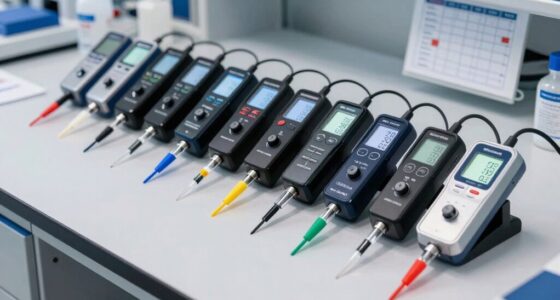
Choosing a UV Vis spectrophotometer depends on your specific application, budget, and required features. The Nix Spectro 2 stands out as the best overall for its portability and versatility, ideal for labs needing mobility. For those prioritizing high precision, the UV-5500 offers excellent accuracy and a wide wavelength range. Budget-conscious buyers might prefer models like the UV-5100B, which deliver reliable performance at a lower cost. However, tradeoffs often involve balancing features like software integration, wavelength accuracy, and portability. Continue reading for a detailed breakdown of these options and what suits your needs best.

Prime made for students and young adults
- Fast, free delivery for dorm and study essentials
- Prime Video and Amazon Music included
- Member-only deals
Key Takeaways
- High-precision models like the UV-5500 excel in accuracy, suitable for detailed analytical work.
- Portability features in the Nix Spectro 2 make it ideal for field use or mobile labs.
- Software integration with PC or cloud improves workflow but often increases the price.
- Wavelength range and bandwidth are critical for specific applications, impacting choice significantly.
- Budget models like the UV-5100B still offer reliable basic performance for general measurement tasks.
| Nix Spectro 2 Spectrophotometer – Portable Color Measurement Tool for Print, Packaging, Paint, and Coatings |  | Best Overall for Portable Color Accuracy | Scan Speed: 1 scan/sec | Channels: 31 UV-visible | Color Recognition: CMYK, Ink Density, RGB, HEX | VIEW ON AMAZON | See Our Full Breakdown |
| UV-5100 Single Beam UV-Vis Spectrophotometer 190-1100nm, 2nm |  | Best for Entry-Level Laboratory Use | Wavelength Range: 190-1100nm | Display: 2.5-inch LCD | Light Source: Imported deuterium lamp | VIEW ON AMAZON | See Our Full Breakdown |
| SCILOGEX SCI-UV1100 UV Vis Spectrophotometer 190-1100nm – Single Beam, Tungsten & Deuterium Lamps, LCD Display, Data Storage |  | Best for Research and Education with Versatile Features | Wavelength Range: 190-1100nm | Design: Single beam | Bandwidth: 2nm | VIEW ON AMAZON | See Our Full Breakdown |
| UV-5500 UV/VIS Spectrophotometer 190-1100nm Wavelength Range, 2nm Bandwidth, ±0.5nm Accuracy |  | Best for High-Precision Quantitative Analysis | Wavelength Range: 190-1100nm | Bandwidth: 2nm | Wavelength Accuracy: ±0.5nm | VIEW ON AMAZON | See Our Full Breakdown |
| UV-5500PC UV-Vis Spectrophotometer 190-1100nm 2nm with PC Software |  | Best for Integrated Data and Automated Analysis | Wavelength Range: 190-1100nm | Resolution: 2nm | Display: 128×64 LCD | VIEW ON AMAZON | See Our Full Breakdown |
| Digital Lab Spectrophotometer Visible Spectrophotometer LCD Display 350-1020nm Tungsten Lamp Lab Analytical Equipment 110V |  | Best for Versatile Laboratory Analysis | Wave Range: 350-1020nm | Spectral Bandwidth: 6nm | Length Accuracy: ±3nm | VIEW ON AMAZON | See Our Full Breakdown |
| UV-VIS Spectrophotometer 752N/UV1100 – High Accuracy, Wide Application Range | 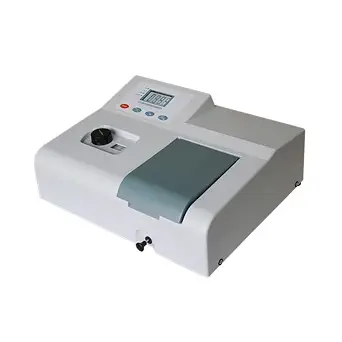 | Best for Education and Industrial Use | Wavelength Range: 195-1020nm | Spectral Bandwidth: 5nm | Wavelength Accuracy: ±2nm | VIEW ON AMAZON | See Our Full Breakdown |
| UV-5200PC UV Vis Spectrophotometer 190-1100nm 2nm with PC Software |  | Best for Detailed Quantitative Analysis with Software Support | Wavelength Range: 190-1100nm | Spectral Bandwidth: 2nm | Wavelength Accuracy: ±1.0nm | VIEW ON AMAZON | See Our Full Breakdown |
| Ultraviolet UV Visible Spectrophotometer 200-1020nm |  | Best for Basic Wide-Range Measurement | Wavelength Range: 200-1020nm | Accessories: 4 glass cuvettes, 2 quartz cuvettes | Features: Power-on self-test | VIEW ON AMAZON | See Our Full Breakdown |
| Ultraviolet Lab Spectrophotometer |  | Best for Versatile Laboratory Research | Wavelength Range: 190-1100nm | Wavelength Accuracy: 1nm | Spectral Bandwidth: 4nm | VIEW ON AMAZON | See Our Full Breakdown |
| UV-5100B UV-Vis Spectrophotometer 190-1000nm 2nm Bandwidth |  | Best Overall Versatile UV-Vis Spectrophotometer | Wavelength Range: 190-1000nm | Bandwidth: 2nm | Wavelength Accuracy: ±1nm | VIEW ON AMAZON | See Our Full Breakdown |
| Ultraviolet Digital Lab Spectrophotometer |  | Best for Precision and User-Friendly Operation | Display: 7-inch color LCD touchscreen | Measurement Range: UV spectrum | Sample Rack: Four-slot adjustable, 10-50mm path length | VIEW ON AMAZON | See Our Full Breakdown |
| UV-5100B Single Beam UV-Vis Spectrophotometer 190-1000nm, 2nm | 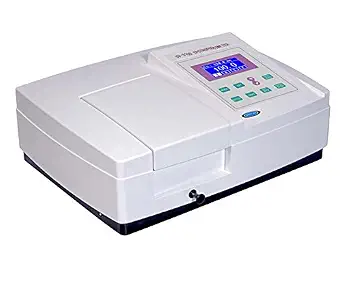 | Best for Simple, Reliable Data Collection | Wavelength Range: 190-1000nm | Resolution: 2nm | Connectivity: USB | VIEW ON AMAZON | See Our Full Breakdown |
| uv vis spectrophotometer | Wavelength Range |
|---|---|
| Nix Spectro 2 Spectrophotomete | — |
| UV-5100 Single Beam UV-Vis Spe | 190-1100nm |
| SCILOGEX SCI-UV1100 UV Vis Spe | 190-1100nm |
| UV-5500 UV/VIS Spectrophotomet | 190-1100nm |
| UV-5500PC UV-Vis Spectrophotom | 190-1100nm |
| Digital Lab Spectrophotometer | — |
| UV-VIS Spectrophotometer 752N/ | 195-1020nm |
| UV-5200PC UV Vis Spectrophotom | 190-1100nm |
| Ultraviolet UV Visible Spectro | 200-1020nm |
| Ultraviolet Lab Spectrophotome | 190-1100nm |
| UV-5100B UV-Vis Spectrophotome | 190-1000nm |
| Ultraviolet Digital Lab Spectr | — |
| UV-5100B Single Beam UV-Vis Sp | 190-1000nm |
More Details on Our Top Picks
Nix Spectro 2 Spectrophotometer – Portable Color Measurement Tool for Print, Packaging, Paint, and Coatings
The Nix Spectro 2 stands out for combining portability with high-precision color measurement, making it ideal for on-the-go professionals in print, packaging, and coatings. Compared with larger benchtop options like the SCILOGEX SCI-UV1100, it sacrifices some advanced features but gains mobility and cost-effectiveness. Its support for multiple color standards such as Pantone, RAL, and NCS, along with fast scans at 1 scan/sec, makes it suitable for quick quality checks in dynamic environments. The integration with the Nix Toolkit App provides access to extensive color libraries, which is a major advantage over simpler handheld devices. However, some features require an additional software purchase, and the learning curve may be steep for beginners. This pick makes the most sense for color professionals needing accurate, portable measurement without the expense of a full laboratory setup.
Pros:- Highly accurate color measurement with fast scan speed
- Supports multiple color recognition standards and libraries
- Portable and cost-effective compared to benchtop devices
- Integrates with mobile app for easy access to extensive color libraries
Cons:- Requires separate purchase for advanced software features
- Some features depend on subscription services
- May have a learning curve for new users
Best for: Color professionals in print and packaging sectors who need mobile, accurate measurements.
Not ideal for: Small laboratories or hobbyists seeking a low-cost, basic device without smartphone integration.
- Scan Speed:1 scan/sec
- Channels:31 UV-visible
- Color Recognition:CMYK, Ink Density, RGB, HEX
- Compatibility:Pantone, RAL, NCS
- Connectivity:Nix Toolkit App, cloud storage
- Software:Nix Print Pro (separate purchase)
Our verdict“This device is perfect for mobile color professionals who require precise, versatile measurements in the field.”
UV-5100 Single Beam UV-Vis Spectrophotometer 190-1100nm, 2nm
The UV-5100 offers a straightforward solution for basic spectrophotometry, with a clear 2.5-inch LCD display and automatic wavelength setting that simplifies operation. Its imported deuterium lamp ensures good measurement accuracy for routine tasks, surpassing simpler models like the Ultraviolet UV Visible Spectrophotometer 200-1020nm in terms of precision. While it provides essential features for concentration determination and spectrum analysis, the software is optional, which could be limiting for those needing integrated analysis tools. Its basic design makes it less suitable for complex research or high-throughput labs, but it performs reliably for educational and routine lab applications. Compared to more advanced models like the UV-5500, it emphasizes cost-effectiveness over high-end features.
Pros:- Clear LCD display for easy readings
- Accurate measurements with imported deuterium lamp
- USB connectivity for simple data transfer
- Automatic wavelength adjustment reduces user errors
Cons:- Software is optional, limiting advanced data analysis
- Limited details on calibration procedures and support
- Less suited for complex or high-volume testing
Best for: Laboratory technicians or students needing a reliable, affordable UV-Vis spectrophotometer for routine analysis.
Not ideal for: Advanced research labs requiring comprehensive software integration and extensive data management.
- Wavelength Range:190-1100nm
- Display:2.5-inch LCD
- Light Source:Imported deuterium lamp
- Connectivity:USB port
- Software:Optional
Our verdict“Ideal for educational and routine lab settings where simplicity and reliability are priorities.”
SCILOGEX SCI-UV1100 UV Vis Spectrophotometer 190-1100nm – Single Beam, Tungsten & Deuterium Lamps, LCD Display, Data Storage
The SCILOGEX SCI-UV1100 offers a broad wavelength range suitable for research, with automatic lamp switching between tungsten and deuterium, ensuring high precision across diverse samples. Its large backlit LCD makes data visualization straightforward, and the inclusion of multiple cuvettes supports flexible experimentation. While it provides a comprehensive set of features comparable to the UV-5500, it is notably heavier at 28 pounds, making portability a challenge. This model is better suited for dedicated laboratory environments rather than fieldwork or mobile use. The automatic features and extensive data storage make it a powerful choice for detailed analysis, though it comes at a higher price point.
Pros:- Wide wavelength range suitable for various applications
- Automatic lamp switching ensures consistent results
- Large backlit LCD for easy data review
- Includes multiple cuvettes and supports accessories
Cons:- Relatively heavy, less portable
- Higher cost may be prohibitive for small labs
- Designed primarily for laboratory use, not fieldwork
Best for: Research laboratories and educational institutions requiring versatile, accurate UV-Vis measurements with extensive data options.
Not ideal for: Small labs or users needing a lightweight, portable device with basic functionality.
- Wavelength Range:190-1100nm
- Design:Single beam
- Bandwidth:2nm
- Lamps:Tungsten and Deuterium, automatic switch
- Display:Backlit LCD
- Data Storage:Up to 200 results and curves
Our verdict“This instrument is ideal for detailed research and educational purposes in fixed laboratory settings.”
UV-5500 UV/VIS Spectrophotometer 190-1100nm Wavelength Range, 2nm Bandwidth, ±0.5nm Accuracy
The UV-5500 combines high accuracy with a broad wavelength range, making it suitable for precise quantitative work in chemistry, biochemistry, and environmental testing. Its automatic wavelength setting and ±0.5nm accuracy outperform many budget models like the UV-5100, especially where measurement precision is critical. The device’s data storage and USB output facilitate seamless data management, though its setup might be complex for less experienced users. The limited information on calibration procedures suggests that proper training is necessary for optimal performance. This model is a strong choice for laboratories prioritizing measurement accuracy over portability or simplicity.
Pros:- High resolution with 2nm bandwidth
- Exceptional wavelength accuracy of ±0.5nm
- Built-in data storage and USB for easy data handling
- Supports quantitative analysis and curve creation
Cons:- Setup complexity may require technical training
- Lack of portable power options limits mobility
- No detailed calibration procedures included
Best for: Analytical labs and researchers needing high-precision measurements for quantitative assays.
Not ideal for: Field-based applications or users seeking a simple, plug-and-play device without extensive training.
- Wavelength Range:190-1100nm
- Bandwidth:2nm
- Wavelength Accuracy:±0.5nm
- Repeatability:0.3nm
- Display:128×64 dot matrix LCD
- Data Storage:200 groups
Our verdict“This model is best suited for labs that demand high measurement precision and detailed data analysis capabilities.”
UV-5500PC UV-Vis Spectrophotometer 190-1100nm 2nm with PC Software
The UV-5500PC extends the capabilities of the standard UV-5500 by adding PC software control, making it highly suitable for labs that rely on comprehensive data handling and automation. Its large sample compartment and independent lamp controls enhance flexibility for diverse experiments, including DNA and protein testing. Compared with the standalone UV-5500, this model offers more streamlined data management and analysis, especially for labs with existing computer systems. However, the setup process is more complex, and it requires a consistent power source, which could limit its use in field conditions. This device is ideal for labs demanding extensive data processing and integration with existing software pipelines.
Pros:- Wide wavelength range with high resolution
- Large data storage capacity for multiple experiments
- Software control for automation and detailed analysis
- Large sample compartment accommodates various cuvettes
Cons:- Complex setup and software installation required
- Dependent on PC connection, limiting portability
- No standalone operation without a computer
Best for: Research labs and clinical facilities that require automated, software-controlled spectrum analysis.
Not ideal for: Field technicians or small-scale users who need a portable, standalone device without PC dependency.
- Wavelength Range:190-1100nm
- Resolution:2nm
- Display:128×64 LCD
- Data Storage:200 groups
- Software:UV-Professional
- Sample Compartment:Accommodates 5-100mm cuvettes
Our verdict“This model is best for professional laboratories seeking integrated, automated spectrum analysis with extensive data handling features.”
Digital Lab Spectrophotometer Visible Spectrophotometer LCD Display 350-1020nm Tungsten Lamp Lab Analytical Equipment 110V
This model stands out for its broad wavelength range of 350-1020nm, making it suitable for diverse material analysis in biochemistry, medicine, and environmental testing. Compared with the UV-5200PC, it offers a wider spectral scope but lacks PC software integration, which may limit data analysis capabilities. Its automatic calibration feature enhances measurement precision, yet the device’s weight and bulkiness can challenge smaller labs with limited space. The large sample chamber is advantageous for bigger samples or multiple cuvettes, but the need for regular maintenance and calibration can be a deterrent for less experienced users. Overall, this spectrophotometer is ideal for labs prioritizing range and reliability over portability and ease of use.
Pros:- Wide wavelength range (350-1020nm) for versatile analysis
- Automatic calibration ensures measurement accuracy
- Large sample chamber accommodates bigger samples
- Clear LCD display simplifies data reading
Cons:- Heavy and bulky, limiting portability
- Requires regular calibration and maintenance
- Limited to laboratory settings, not suitable for field use
Best for: Laboratories requiring a robust, wide-range instrument for detailed material analysis
Not ideal for: Small or mobile labs needing a portable, lightweight device for quick testing
- Wave Range:350-1020nm
- Spectral Bandwidth:6nm
- Length Accuracy:±3nm
- Photometric Range:0-200%T, -0.3A~3A
- Photometric Accuracy:±1%T
- Light Source:D2 lamp (1500hr), Tungsten lamp (2000hr)
Our verdict“This spectrophotometer is best suited for labs that need a reliable, wide-range instrument with high precision, accepting its size and maintenance requirements.”
UV-VIS Spectrophotometer 752N/UV1100 – High Accuracy, Wide Application Range
This instrument offers high accuracy and stability within a 195-1020nm range, making it suitable for educational labs, food quality control, and agricultural testing. Its 5nm spectral bandwidth is narrower than some broader-range options, like the UV-5200PC, which can enhance measurement precision but slightly limit flexibility. Its user-friendly digital interface and included accessories make it ready for immediate operation, yet the need for some basic knowledge to fully utilize features and potential additional costs for PC software might deter less experienced users. Compared to the UV-5200PC, it emphasizes stability and simplicity for routine applications, sacrificing some advanced features.
Pros:- High measurement accuracy (±2nm wavelength precision)
- Stable performance suitable for routine industrial and educational applications
- Complete with accessories for quick setup
- Intuitive digital display enhances ease of use
Cons:- Limited spectral bandwidth (5nm) may restrict some applications
- Operation requires basic technical knowledge
- Additional costs for PC software and printer
Best for: Educational institutions and industrial labs seeking high accuracy with straightforward operation
Not ideal for: Users desiring a highly flexible or software-integrated system for advanced research
- Wavelength Range:195-1020nm
- Spectral Bandwidth:5nm
- Wavelength Accuracy:±2nm
- Photometric Accuracy:±0.5%T
- Photometric Repeatability:0.2%T
- Stability:0.002A
Our verdict“This spectrophotometer fits well for users prioritizing accuracy and stability in routine testing, with some tradeoffs in flexibility and software features.”
UV-5200PC UV Vis Spectrophotometer 190-1100nm 2nm with PC Software
This model provides high spectral accuracy with a 2nm bandwidth across 190-1100nm, making it suitable for DNA, protein, and other biochemical analyses. Its automatic wavelength setting simplifies operation compared to manual systems like the Ultraviolet UV Visible Spectrophotometer, but the complex setup and need for PC software might challenge less technical users. The inclusion of software allows comprehensive data analysis, yet the setup may be overwhelming for beginners or those without prior laboratory experience. Compared to the UV-5100B, it offers more precision and detailed analysis, at the cost of increased complexity.
Pros:- High spectral accuracy (±1.0nm) and repeatability
- Automatic wavelength setting for easier operation
- Includes PC software for advanced data analysis
- Wide wavelength range suitable for various tests
Cons:- Complex setup requiring technical knowledge
- Additional costs for software and calibration procedures
- Limited information on calibration process
Best for: Laboratories doing detailed biochemical research or requiring comprehensive data analysis software
Not ideal for: Small labs or users seeking a simple, standalone device without software dependencies
- Wavelength Range:190-1100nm
- Spectral Bandwidth:2nm
- Wavelength Accuracy:±1.0nm
- Wavelength Repeatability:0.5nm
- Stray Light:≤0.1%T
Our verdict“Ideal for labs needing precise, software-driven data analysis, with some complexity in setup and operation.”
Ultraviolet UV Visible Spectrophotometer 200-1020nm
This device provides a straightforward, broad wavelength measurement from 200-1020nm, making it suitable for general UV-Vis testing in various labs. Its inclusion of standard accessories like glass and quartz cuvettes adds convenience, and the self-test feature simplifies startup. Compared with more advanced models like the UV-5100B, it offers less detailed information on calibration and accuracy, which could impact precision in sensitive applications. Its simplicity makes it appealing for basic routine measurements but less ideal for high-accuracy research.
Pros:- Wide measurement range (200-1020nm)
- Includes standard glass and quartz cuvettes
- Self-test feature facilitates easy operation
- Simple and straightforward for routine use
Cons:- Limited calibration information available
- No specified measurement accuracy details
- Lacks advanced features for complex analysis
Best for: Basic testing needs in educational or clinical labs where ease of use is prioritized
Not ideal for: Research settings demanding detailed calibration and high precision
- Wavelength Range:200-1020nm
- Accessories:4 glass cuvettes, 2 quartz cuvettes
- Features:Power-on self-test
Our verdict“Suitable for basic UV-Vis testing where ease of operation and range matter more than high precision or advanced features.”
Ultraviolet Lab Spectrophotometer
This model excels with its 190-1100nm range and 1nm wavelength accuracy, making it suitable for detailed research involving DNA, proteins, and environmental samples. Compared with the UV-5200PC, it offers higher precision but lacks the integrated PC software, which could limit complex data analysis. Its multi-wavelength measurement and spectral scanning capabilities provide flexibility for various experiments, though the device requires preheating for optimal results and manual access for operation instructions. It’s a solid choice for labs focusing on accuracy and versatility without the need for extensive software integration.
Pros:- High measurement accuracy with 1nm wavelength precision
- Supports spectral scanning and DNA/protein analysis
- Wide application range for scientific research
- Includes standard cuvettes for immediate testing
Cons:- Requires preheating for best results
- Operation manual only accessible via USB drive
- Limited info on user interface and ease of use
Best for: Research labs needing high accuracy and multi-wavelength capabilities for biological and environmental samples
Not ideal for: Users seeking a plug-and-play device with integrated software for routine testing
- Wavelength Range:190-1100nm
- Wavelength Accuracy:1nm
- Spectral Bandwidth:4nm
- Included Accessories:4 glass cuvettes
Our verdict“Best suited for detailed research requiring high accuracy and flexible measurement modes, accepting some operational complexity.”
UV-5100B UV-Vis Spectrophotometer 190-1000nm 2nm Bandwidth
The UV-5100B stands out for its wide wavelength range of 190-1000nm, making it suitable for a broad spectrum of applications from absorbance to transmittance testing. Compared with the UV-5100, it offers higher accuracy and better repeatability, thanks to its 2nm bandwidth and ±1nm wavelength precision. Its built-in data storage and clear LCD facilitate straightforward operation, but it lacks software integration, requiring a separate purchase for advanced analysis. This makes it ideal for labs needing reliable standalone measurements without heavy software reliance. The main tradeoff is that its lack of portability and absence of battery operation could limit field use or quick setup in dynamic environments.
Pros:- Wide wavelength range supports diverse testing needs
- High accuracy and repeatability ensure reliable results
- Built-in data storage simplifies data management
- Supports standard curve creation for quantitative analysis
Cons:- Optional PC software requires additional purchase
- No built-in software for advanced data analysis
- Lacks portable power options, limiting field use
Best for: Research laboratories and quality control labs that need a versatile, accurate instrument with data storage capabilities.
Not ideal for: Field technicians or mobile labs requiring portable, battery-powered devices or integrated software for on-the-go analysis.
- Wavelength Range:190-1000nm
- Bandwidth:2nm
- Wavelength Accuracy:±1nm
- Repeatability:≤0.2nm
- Stray Light:≤0.05%T at 220nm and 360nm
- Display:128×64 LCD
Our verdict“This model is best suited for labs prioritizing accuracy and versatility over portability and software integration.”
Ultraviolet Digital Lab Spectrophotometer
The Ultraviolet Digital Lab Spectrophotometer excels with its high-stability C-T monochromator, delivering precise UV measurements essential for detailed research. Its 7-inch color LCD touchscreen offers intuitive operation, surpassing the more basic LCD displays of the UV-5100B. The device’s easy lamp replacement and adjustable racks make it a durable choice for labs that require frequent calibration and flexible sample handling. However, its setup can be complex for newcomers to spectrophotometry, and it assumes some familiarity with the process. Compared to the UV-5100, it emphasizes precision and ease of use, at the expense of a steeper learning curve. It’s best for experienced users needing reliable data and straightforward interface.
Pros:- High stability and precision for consistent results
- Large, user-friendly touchscreen interface
- Easy lamp replacement and flexible sample racks
- Designed for durability in demanding environments
Cons:- Requires familiarity with spectrophotometry for effective use
- Potentially complex setup for users new to the technology
- Higher cost compared to basic models
Best for: Laboratories that prioritize measurement accuracy, stability, and user experience, especially with complex or sensitive samples.
Not ideal for: Beginners or small labs with minimal training resources, as setup and operation may be challenging without prior experience.
- Display:7-inch color LCD touchscreen
- Measurement Range:UV spectrum
- Sample Rack:Four-slot adjustable, 10-50mm path length
- Light Sources:Deuterium and tungsten lamps
- Operation Manual:Pre-loaded on USB drive
Our verdict“This device suits experienced users seeking precise, stable measurements with an intuitive interface, despite its higher complexity and cost.”
UV-5100B Single Beam UV-Vis Spectrophotometer 190-1000nm, 2nm
The UV-5100B Single Beam offers a straightforward approach with automatic wavelength setting, reducing user error compared to manual setup in the UV-5100B. Its sturdy aluminum base provides stability, making it suitable for routine laboratory measurements. Connectivity via USB simplifies data transfer, but as a single beam model, it may lack the accuracy and stability of double beam systems like the SCILOGEX SCI-UV1100. This model is ideal for users who need a dependable, easy-to-operate instrument for standard absorbance and transmittance measurements, yet it falls short for highly precise or complex spectral analysis. The main tradeoff involves its limited measurement stability relative to double beam options.
Pros:- Automatic wavelength setting minimizes user errors
- Sturdy aluminum base enhances stability
- USB connectivity facilitates quick data transfer
- Simple operation suitable for routine tasks
Cons:- Limited to single beam design, less precise than double beam systems
- Software is optional and may require additional purchase
- Potential for baseline drift affecting measurement accuracy
Best for: Routine testing environments where ease of use and reliable data transfer are priorities, such as educational labs or quality control stations.
Not ideal for: Advanced research requiring high spectral resolution and minimal baseline drift, which are better served by double beam models.
- Wavelength Range:190-1000nm
- Resolution:2nm
- Connectivity:USB
- Memory:200 results
- Base Material:Aluminum
Our verdict“This model is ideal for straightforward, reliable measurements in routine lab settings where simplicity and data transfer are key.”

How We Picked
To determine the best UV vis spectrophotometers, I evaluated each product based on performance, build quality, usability, and value. Key criteria included wavelength accuracy, spectral range, ease of operation, and software capabilities. I also considered the robustness of construction for lab environments and the availability of customer support. The ranking reflects a balance between professional-grade features and affordability, aiming to serve different user needs—from beginners to advanced laboratories. Products with clear tradeoffs—such as lower accuracy for cost savings—were included to offer a comprehensive view of what’s available in 2026.
Factors to Consider When Choosing Uv Vis Spectrophotometer
When selecting a UV Vis spectrophotometer, understanding your specific measurement needs is essential. Beyond basic specifications, consider how features like software compatibility, wavelength range, and portability impact your workflow. Making an informed choice involves balancing performance with budget constraints, especially if your application demands high precision or frequent use.Wavelength Range and Bandwidth
The spectral range determines which samples and analytes you can measure. A broader range (e.g., 190-1100nm) enables more flexibility, especially for complex or diverse samples. Bandwidth impacts resolution; narrower bandwidths (like 2nm) allow for more precise measurements, which is crucial in research settings but may increase cost and complexity.
Accuracy and Precision
High-accuracy models typically feature advanced calibration and stable light sources, essential for research or quality control. Cheaper options might suffice for routine testing but can lead to less reliable readings. Confirm the instrument’s specified accuracy and consider if your application requires the highest precision or general measurements.
Software and Data Management
Intuitive software that integrates with PCs or cloud platforms streamlines data collection, analysis, and reporting. However, advanced software features often come with higher prices. Consider whether your team needs comprehensive data management tools or simple, standalone operation for basic measurements.
Portability and Size
If your work requires mobility—such as field testing or on-site measurements—compact, battery-powered models are advantageous. Conversely, benchtop units generally offer higher stability and more features but are less portable. Match your workspace and mobility needs to the device’s design.
Build Quality and Support
Durability and ease of maintenance are important for long-term use. Look for sturdy construction, reliable lamps, and accessible components. Additionally, good customer support and readily available spare parts can influence the total cost of ownership and user experience over time.
Frequently Asked Questions
What is the most important feature for a beginner using a UV Vis spectrophotometer?
For beginners, ease of use is paramount. Look for models with straightforward operation, clear displays, and simple calibration procedures. Many entry-level units come with user-friendly software and minimal setup, allowing new users to focus on learning measurement techniques without being overwhelmed by complex options. While high accuracy is desirable, ease of use typically outweighs advanced features in initial stages.
Should I prioritize wavelength range or accuracy in my spectrophotometer?
The decision depends on your specific application. If you need to analyze a wide variety of samples across different wavelengths, a broader spectral range is beneficial. However, if your work demands detailed, precise measurements—such as in research or quality control—accuracy and narrow bandwidths become more critical. Often, a balance between the two offers the best overall performance.
Is software integration necessary for a UV Vis spectrophotometer?
Software integration enhances data management, analysis, and reporting, making workflows more efficient, especially in professional or high-volume settings. However, for basic measurements or occasional use, standalone models without sophisticated software may suffice. Consider your workflow complexity and whether software features justify the additional expense.
How important is wavelength stability in a UV Vis spectrophotometer?
Wavelength stability is vital for reliable, repeatable measurements, particularly in research and quality control. Instruments with stable light sources and precise calibration maintain their accuracy over time, reducing errors and the need for frequent recalibration. Cheaper models may sacrifice some stability, so assess your precision needs before choosing.
Can I use a UV Vis spectrophotometer for both qualitative and quantitative analysis?
Yes, UV Vis spectrophotometers are versatile tools used for both qualitative identification of substances and quantitative measurements of concentration. However, the level of accuracy, spectral resolution, and software features will influence how effectively each application can be performed. For critical quantitative work, select a model known for high precision and calibration stability.
Conclusion
For most users seeking a reliable, all-around instrument, the UV-5500 stands out as the best overall choice thanks to its balance of accuracy, range, and usability. Budget-conscious buyers will find the UV-5100B a practical option for routine measurements. Laboratories requiring advanced features and high precision should consider premium models like the SCILOGEX SCI-UV1100. Beginners or casual users benefit from straightforward, easy-to-operate units, while research facilities should prioritize models with software integration and stability. Assess your specific needs, frequency of use, and budget to make the best investment in 2026.