
A professional particulate meter for PM2.5 and PM10 needs to do more than flash a color-coded number — it should hold its calibration, distinguish between particle sizes reliably, and give you data you can actually act on. Across this lineup, the Temtop Professional Particle Counter & Environmental Monitoring Analyzer earned the best overall spot for its lab-grade counting across multiple size channels and its data export workflow, while the Temtop M2000C 2ND stands out for adding CO2 monitoring at a more accessible level, and the AOPUTTRIVER Professional Laser Particle Counter wins for buyers who want true multi-channel counting (0.3/2.5/10 µm) on a tight budget. The core tradeoff in this category is versatility versus precision: 16-in-1 monitors with big displays track many pollutants but often use simpler sensors, while dedicated particle counters measure fewer parameters with far more rigor. Battery life, calibration options, and whether the device can log and export data also separate the professional tools from the consumer gadgets. Keep reading for the full breakdown of all 12 models and which one fits your workflow.

Get school and study supplies delivered free — and shop member deals
- Fast, free delivery on millions of items
- Access to Prime Big Deal Days deals on October 6–7
- Prime Video, Amazon Music and more included
Key Takeaways
- The Temtop models dominated the top of the ranking because of their combination of true particle counting, factory calibration, and data export — the three features that most consistently separate professional units from consumer air quality gadgets in this lineup.
- The 16-in-1 monitors (Sainlogic, bonoch AirSentry, and the generic 7-inch model) are compelling for at-a-glance home or office monitoring, but their PM2.5/PM10 readings rely on simpler sensors that sacrifice accuracy for breadth, which is why none of them topped the ranking.
- True multi-channel counting (0.3, 2.5, and 10 µm) appeared only on the Temtop professional analyzer, the AOPUTTRIVER counter, and the 6-channel dust detector — if you need to see fine particles below PM2.5, these are your only real options here.
- Data export and logging was the biggest differentiator for professional use: only four models in this roundup support exporting readings, which matters for workplace compliance documentation and long-term trend analysis.
- Handheld portability (Temtop Handheld and P600) trades screen size and multi-pollutant coverage for field-ready battery operation — the right choice for spot checks across multiple sites, the wrong choice for continuous fixed monitoring.
- CO2 and formaldehyde detection is bundled on roughly half the lineup, but buyer beware: on the cheaper multi-parameter units, these secondary sensors are often less reliable than the particle channels, so don’t buy them primarily for HCHO or TVOC.
| Temtop LKC-1000S+ Air Quality Monitor PM2.5 PM10 Particle Counter with Formaldehyde, Temperature, Humidity, TVOC and Data Export |  | Best for Renovation and Formaldehyde Tracking | Parameters: PM2.5, PM10, HCHO, TVOC, Temperature, Humidity, AQI | HCHO Sensor: Dart electrochemical | Data Export: 3-month log via USB to Excel | VIEW ON AMAZON | See Our Full Breakdown |
| Temtop Professional Particle Counter & Environmental Monitoring Analyzer | 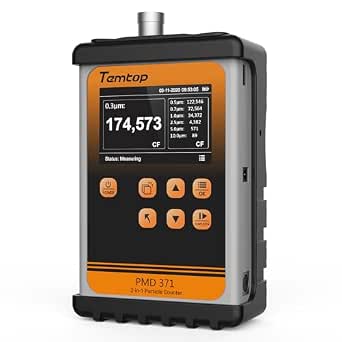 | Best Professional / Cleanroom Grade | Particle Concentration: PM1, PM2.5, PM4, PM10, TSP | Particle Count Channels: 0.3, 0.5, 0.7, 1, 2.5, 5, 10 μm | Flow Rate: 2.83 L/min | VIEW ON AMAZON | See Our Full Breakdown |
| Temtop M2000C 2ND Advanced Air Quality Monitor for CO2, PM2.5 & PM10 |  | Best for Classrooms and Small Offices | Measurements: CO2, PM2.5, PM10, Temperature, Humidity | Data Export: CSV via USB | Display: Colorful TFT | VIEW ON AMAZON | See Our Full Breakdown |
| AOPUTTRIVER Professional Laser Particle Counter – 0.3/2.5/10 µm with PM2.5, PM10, Temperature & Humidity |  | Best Value Handheld for On-Site Audits | Particle Sizes: 0.3 μm, 2.5 μm, 10 μm | PM2.5 Range: 0–1000 μg/m³ (±12 μg/m³, 1 μg/m³ resolution) | Flow Rate: 1 L/min | VIEW ON AMAZON | See Our Full Breakdown |
| Sainlogic 16-in-1 Indoor Air Quality Monitor with VOC/CO2/HCHO/PM2.5 and 7.2″ Display |  | Best Wall-Style Display for Whole-Room Awareness | Parameters: CO2, PM1.0, PM2.5, PM10, AQI, HCHO, TVOC, Temperature, Humidity | Display: 7.2 inches, 3-stage adjustable brightness | Sampling Interval: 1.5 seconds (1-2 second refresh) | VIEW ON AMAZON | See Our Full Breakdown |
| 16-in-1 Indoor Air Quality Monitor with 7-Inch Display |  | Best Station for Full-Home Air Monitoring | Display: 7-inch LED, 3 brightness settings | Parameters: CO2, PM2.5, PM1.0, PM10, HCHO, TVOC, Temperature, Humidity, AQI | Sensor Accuracy: 0.001 units, external probes | VIEW ON AMAZON | See Our Full Breakdown |
| Temtop Handheld Airborne Particle Counter, Portable PM2.5 PM10 TSP Monitor |  | Best for Field Work with Data Logging | Particle Size Detection: 0.3µm, 0.5µm, 1.0µm | Mass Concentrations: PM2.5, PM10, TSP | Battery: 3500mAh rechargeable | VIEW ON AMAZON | See Our Full Breakdown |
| Temtop P600 PM2.5 Monitor, Air Quality Monitor & Particle Counter |  | Best Value for Focused PM2.5/PM10 Tracking | Sensor: Temtop 2nd-generation PM2.5 laser sensor | Measurements: PM2.5, PM10 with color health-level indicators | Sensor Lifespan: Over 20,000 hours (industrial-grade) | VIEW ON AMAZON | See Our Full Breakdown |
| Dust Particle Detector – High Sensitivity 6-Channel Air Quality Monitor |  | Best Professional-Grade Compliance Tool | Particle Sizes: 0.3, 0.5, 1.0, 3.0, 5.0, 10 μm (6 channels) | PM Measurement: PM2.5, PM10 | Counting Efficiency: 50% at 0.3μm; 100% above 0.5μm (ISO 21501-4, JIS) | VIEW ON AMAZON | See Our Full Breakdown |
| bonoch AirSentry 16-in-1 Indoor Air Quality Monitor with 7″ HD Display |  | Best Premium Home Monitoring Station | Display: 7-inch HD panel | Parameters: CO2, PM1.0, PM2.5, PM10, HCHO, TVOC, Temperature, Humidity, AQI | Sensor Accuracy: 0.001-level, external sensors | VIEW ON AMAZON | See Our Full Breakdown |
| Temtop M2000 2nd Professional Air Quality Analyzer & CO2 Monitor Particle Counter |  | Best for Long-Term Data Logging | Model: M2000 2nd | CO2 Sensor: SenseAir NDIR | HCHO Sensor: Dart | VIEW ON AMAZON | See Our Full Breakdown |
| Indoor Air Quality Monitor with CO2, TVOC, PM2.5, PM10, and HCHO Detection |  | Best Budget-Friendly All-in-One | Sensor Types: CO2 (NDIR), TVOC, HCHO, PM2.5, PM10 | Display: LCD | Power: USB rechargeable | VIEW ON AMAZON | See Our Full Breakdown |
| particulate meter pm25 pm10 professional | Display |
|---|---|
| Temtop LKC-1000S+ Air Quality | — |
| Temtop Professional Particle C | — |
| Temtop M2000C 2ND Advanced Air | Colorful TFT |
| AOPUTTRIVER Professional Laser | — |
| Sainlogic 16-in-1 Indoor Air Q | 7.2 inches, 3-stage adjustable brightness |
| 16-in-1 Indoor Air Quality Mon | 7-inch LED, 3 brightness settings |
| Temtop Handheld Airborne Parti | Large LCD |
| Temtop P600 PM2.5 Monitor | — |
| Dust Particle Detector | — |
| bonoch AirSentry 16-in-1 Indoo | 7-inch HD panel |
| Temtop M2000 2nd Professional | Colorful TFT with backlight |
| Indoor Air Quality Monitor wit | LCD |
More Details on Our Top Picks
Temtop LKC-1000S+ Air Quality Monitor PM2.5 PM10 Particle Counter with Formaldehyde, Temperature, Humidity, TVOC and Data Export
The LKC-1000S+ earns its place by pairing PM2.5/PM10 particle tracking with a Dart electrochemical formaldehyde sensor — something the M2000C 2ND and the Sainlogic 16-in-1 can’t match with their broader but less specialized sensor suites. That combination makes this the pick for anyone living through a renovation, where off-gassing furniture or new flooring matters as much as dust. The 12-hour trend histogram and three-month Excel export turn raw numbers into evidence you can share with a contractor or physician, and the color-coded display keeps daily use simple. Compared with the AOPUTTRIVER counter, it trades particle-count precision for a much wider parameter set. The tradeoffs are real: the formaldehyde sensor is sensitive to alcohol, perfumes, and cleaning sprays, so placement discipline matters, and it needs a 10-minute warm-up after temperature swings.
Pros:- Electrochemical HCHO sensor is more trustworthy than the semiconductor sensors in cheaper monitors
- Three-month data export to Excel with no subscription or app
- Seven parameters including PM2.5, PM10, TVOC, and real-time AQI in one device
- Works as a 24/7 plug-in monitor or a 6-8 hour portable spot-checker
Cons:- Formaldehyde readings are easily skewed by alcohol, perfume, and cleaning products nearby
- Requires a 10-minute warm-up after moving between temperature extremes
- No wireless connectivity — data export and continuous logging require a USB cable
Best for: Homeowners mid-renovation or tracking formaldehyde and PM2.5 sources over weeks, who need exportable records
Not ideal for: Cleanroom technicians or anyone needing certified particle counts — this is a trend-detection consumer device, not a lab instrument
- Parameters:PM2.5, PM10, HCHO, TVOC, Temperature, Humidity, AQI
- HCHO Sensor:Dart electrochemical
- Data Export:3-month log via USB to Excel
- Trend Display:12-hour histogram
- Battery:6-8 hours portable use, Type-C charging
- Operating Range:32°F to 122°F
- Warranty:12 months
Our verdict“If you need defensible, exportable records of both particulates and formaldehyde during or after a renovation, this is the tool that does both jobs without a subscription.”
Temtop Professional Particle Counter & Environmental Monitoring Analyzer
This is the only option in the lineup built to ISO 21501 and NIST accuracy standards, and it behaves like it: true particle counting across six size bins from 0.3μm to 10μm, plus mass-concentration readings for PM1 through TSP. Where the LKC-1000S+ tells you your living room air got worse after cooking, this instrument tells you exactly how many 0.3μm particles per volume are present — the distinction that matters in cleanrooms, labs, and pharmaceutical facilities. The full-metal housing resists electromagnetic interference, the 8GB storage holds over two million data sets, and RS-232 Modbus support means it can integrate into an existing monitoring system rather than sit alone. The compromises: it’s heavy on process (ISO certificates for individual units cost extra and require a quote), and it measures particles only — no CO2, formaldehyde, or TVOC like the M2000C 2ND offers.
Pros:- Dual measurement of particle concentration and particle count from 0.3μm to 10μm
- ISO 21501 and NIST-compliant accuracy with included calibration certificates
- 8GB internal storage plus USB and RS-232 Modbus transfer for system integration
- Full-metal anti-interference construction with 5-year warranty and 2 years of free calibration
Cons:- Individual-unit ISO certificates cost extra and require a customized quote
- Steep learning curve and cost for non-professional users
- No gas measurements — strictly a particle instrument
Best for: Facility managers, cleanroom auditors, and lab technicians who need standards-compliant particle counts and system integration
Not ideal for: Home users — it’s expensive, complex, and measures no gas parameters, so a household wanting CO2 or formaldehyde readings should look at the LKC-1000S+ instead
- Particle Concentration:PM1, PM2.5, PM4, PM10, TSP
- Particle Count Channels:0.3, 0.5, 0.7, 1, 2.5, 5, 10 μm
- Flow Rate:2.83 L/min
- Internal Storage:8GB (2,000,000+ data sets)
- Data Transfer:USB, RS-232 Modbus
- Battery Life:8 hours
- Standards:ISO 21501, NIST
- Warranty:5 years with 2 years free calibration
Our verdict“If your job depends on defensible, standards-compliant particle data, this is the only entry here that qualifies — everyone else should save money with a consumer monitor.”
Temtop M2000C 2ND Advanced Air Quality Monitor for CO2, PM2.5 & PM10
The M2000C 2ND occupies a smart middle ground: it covers CO2 alongside PM2.5 and PM10, which neither the AOPUTTRIVER counter nor the ISO-grade Temtop analyzer does. That CO2 reading is the reason it’s the right fit for schools and shared workspaces — high CO2 is the earliest signal that a room needs ventilation, long before particulate levels look alarming. Compared with the Sainlogic 16-in-1, its display is smaller and its parameter list shorter, but the CSV export over USB gives it a record-keeping edge that matters for facilities documentation, and the audio alarm provides an unattended alert the Sainlogic’s LED-only warnings don’t. The rechargeable battery and portable frame make room-to-room sweeps easy. The main frustrations are the manual USB tether for every data pull and a sensor package aimed at educational and scientific observation rather than certified measurement.
Pros:- Combines CO2, PM2.5, and PM10 in one portable device — rare at this tier
- CSV export via USB supports long-term documentation and analysis
- Audio alarm enables unattended monitoring of occupied spaces
- Rechargeable battery and bright TFT display make multi-room checks simple
Cons:- No wireless connectivity; all data export is manual via USB
- Shorter parameter list than rivals like the Sainlogic 16-in-1 (no HCHO or TVOC)
Best for: Teachers, facilities coordinators, and small-business owners who need CO2 plus particulate readings with exportable records
Not ideal for: Users who want wireless app access or cloud logging — every export requires plugging in a cable
- Measurements:CO2, PM2.5, PM10, Temperature, Humidity
- Data Export:CSV via USB
- Display:Colorful TFT
- Alarm:Audio alarm
- Power:Rechargeable battery
- Warranty:12 months
Our verdict“The most sensible choice when ventilation and occupancy are your main concerns and you need logged CO2-plus-particulate data to act on.”
AOPUTTRIVER Professional Laser Particle Counter – 0.3/2.5/10 µm with PM2.5, PM10, Temperature & Humidity
For buyers who need true particle counting on a budget, the AOPUTTRIVER splits the difference between consumer monitors and the full ISO-grade Temtop analyzer. It reads 0.3, 2.5, and 10μm channels like a professional instrument, but at a fraction of the investment, and its one-click PDF report export is a genuine workflow advantage — the M2000C 2ND makes you compile CSVs yourself, while this hands clients a finished report. The 3.2-inch backlit screen with trend curves is adequate for field work, and the tripod mount enables hands-free continuous monitoring that handheld rivals skip. The catch is precision: at ±12 μg/m³ on PM2.5, it’s fine for filter inspections and general industrial air checks but not for certifying a cleanroom — that job still belongs to the ISO-compliant Temtop. Add manual USB transfer and a 999-record ceiling, and the limits of the value proposition show.
Pros:- Genuine three-channel particle counting (0.3/2.5/10 μm) at an accessible price
- One-click PDF report export for client-facing documentation
- Tripod mount enables hands-free continuous monitoring
- Large backlit color screen with real-time trend curves plus temperature and humidity
Cons:- PM2.5 accuracy of ±12 μg/m³ is too loose for precision certification work
- 999-record storage ceiling limits long-term logging
- No wireless connectivity; USB cable required for data transfer
Best for: HVAC technicians and QA staff doing filter checks and air quality audits who need shareable PDF reports without lab-grade cost
Not ideal for: Cleanroom certification work — the ±12 μg/m³ accuracy falls short of ISO 21501 requirements
- Particle Sizes:0.3 μm, 2.5 μm, 10 μm
- PM2.5 Range:0–1000 μg/m³ (±12 μg/m³, 1 μg/m³ resolution)
- Flow Rate:1 L/min
- Screen:3.2-inch backlit TFT color
- Data Storage:999 record groups
- Report Format:PDF export via USB
- Weight:1.2 pounds
Our verdict“The smartest middle path for field audits and filter verification when you need particle counts and clean reports, not certified accuracy.”
Sainlogic 16-in-1 Indoor Air Quality Monitor with VOC/CO2/HCHO/PM2.5 and 7.2″ Display
The Sainlogic wins on visibility, not precision. Its 7.2-inch screen with 1-2 second refresh is readable from across a room, which no handheld in this lineup — including the compact LKC-1000S+ — can claim. That makes it less a measuring instrument and more a always-on household dashboard: nine parameters including CO2, PM1.0, PM2.5, PM10, HCHO, and TVOC, with seven customizable alert thresholds and tri-color LED warnings that anyone in the house can understand at a glance. Setup is genuinely zero-friction — no app, no WiFi, no account — where the M2000C 2ND at least assumes you’ll manage USB exports. The tradeoffs follow from the dashboard positioning: the 2500mAh battery caps wireless use at about 8 hours, so this is happiest plugged in on a shelf, and its sensor accuracy tolerances (±3°F, ±3% RH at extremes) put it closer to informed estimation than the AOPUTTRIVER’s measured particle counts.
Pros:- Nine parameters including CO2, PM1.0/2.5/10, HCHO, TVOC, and AQI in one glanceable unit
- 7.2-inch display with adjustable brightness readable across a room
- Works instantly out of the box with no app, WiFi, or account
- Seven user-defined alert thresholds with tri-color LED warnings
Cons:- No data export or logging capability whatsoever
- Battery maxes out around 8 hours, so it’s effectively a plugged-in device
- Sensor tolerances loosen at temperature and humidity extremes
Best for: Families and home-office users who want an always-visible, glanceable read on nine air parameters with no app setup
Not ideal for: Anyone needing measurement-grade accuracy or logged data for professional reporting — there’s no data export at all
- Parameters:CO2, PM1.0, PM2.5, PM10, AQI, HCHO, TVOC, Temperature, Humidity
- Display:7.2 inches, 3-stage adjustable brightness
- Sampling Interval:1.5 seconds (1-2 second refresh)
- Alerts:7 user-defined thresholds, tri-color LED
- Battery:2500mAh rechargeable, up to 8 hours
- Charging:USB-C
- Connectivity:None — no app or WiFi required
Our verdict“Buy this to watch your home’s air at a glance and get loud alerts — skip it if you need records, exports, or certified accuracy.”
16-in-1 Indoor Air Quality Monitor with 7-Inch Display
For buyers who want a desk or wall-mounted command center rather than a handheld spot-checker, this monitor earns its place by showing all nine parameters — CO2, PM2.5, PM1.0, PM10, HCHO, TVOC, temperature, humidity, and AQI — simultaneously on a 7-inch display. That single-screen layout is what separates it from the Temtop P600, which only covers particulates and requires you to interpret trends from a small histogram. The external sensors sample air directly at 0.001-level precision, so readings respond quickly when a room’s conditions change. The tradeoff is sensitivity: the external probes react to touch and strong odors like perfume, so placement near a kitchen or vanity will distort results. It also lacks app or smart-home connectivity, which the larger Sainlogic-style alternatives in this roundup may cover.
Pros:- Shows all nine parameters on one large screen with no menu digging
- External high-precision sensors deliver fast, direct air sampling
- Seven distinct AQI alert buzzers with a mute option for nighttime use
- Three display brightness settings suit both day and bedroom use
Cons:- External sensors are easily skewed by touch, perfume, and strong odors
- No app, Wi-Fi, or smart-home integration for remote viewing
Best for: Homeowners or office managers who want continuous, at-a-glance monitoring of nine air parameters from a fixed station
Not ideal for: Industrial hygiene professionals who need ISO-compliant particle counting and logged data export — this is a display-first home device
- Display:7-inch LED, 3 brightness settings
- Parameters:CO2, PM2.5, PM1.0, PM10, HCHO, TVOC, Temperature, Humidity, AQI
- Sensor Accuracy:0.001 units, external probes
- Alerts:7 AQI buzzer alarms with mute
- Time Format:12/24-hour adjustable
- Connectivity:None (standalone device)
Our verdict“Buy this if you want a set-and-forget indoor station that surfaces every major air concern at once; skip it if you need portable, standards-compliant particle counting.”
Temtop Handheld Airborne Particle Counter, Portable PM2.5 PM10 TSP Monitor
Where the Temtop P600 focuses purely on PM2.5 and PM10 trends, this handheld goes wider: it counts particles at 0.3, 0.5, and 1.0µm while also reporting PM2.5, PM10, and TSP mass concentrations, plus temperature and humidity. The standout feature for professionals is 32GB of onboard storage, letting you log readings across a full site walk-through and export them over USB later — something the bonoch AirSentry simply cannot do. The compromise is endurance: expect around four hours per charge of the 3500mAh battery, which is fine for inspections but not for all-day continuous monitoring. If your work involves documenting conditions room by room and producing records afterward, this model makes the most sense; if you just want a live number, simpler monitors cost less hassle.
Pros:- Counts three particle size channels alongside PM2.5, PM10, and TSP mass readings
- 32GB internal storage records extended sampling sessions
- Built-in temperature and humidity sensors contextualize particle data
- USB export moves logs to a computer for reporting
Cons:- Four-hour battery limit restricts long continuous jobs
- Data must be manually exported — no wireless syncing or app
Best for: Consultants, HVAC technicians, and facility inspectors who need logged, exportable particle data from multiple locations
Not ideal for: Anyone wanting continuous 24/7 home monitoring — the battery life and manual export workflow fight that use case
- Particle Size Detection:0.3µm, 0.5µm, 1.0µm
- Mass Concentrations:PM2.5, PM10, TSP
- Battery:3500mAh rechargeable
- Battery Life:Over 4 hours
- Internal Storage:32GB
- Display:Large LCD
- Connectivity:USB port
Our verdict“This is the pick for professionals who need defensible, logged particle data in the field, not just an instant reading.”
Temtop P600 PM2.5 Monitor, Air Quality Monitor & Particle Counter
The P600 does one job well: particulate measurement. Its second-generation laser sensor paired with a particle swarm optimization algorithm produces readings that are more stable than typical budget PM meters, and Temtop rates the industrial-grade sensor at over 20,000 hours of lifespan — a genuine longevity claim most competitors don’t make. Compared with the Temtop handheld counter, you give up multi-channel sizing and onboard storage, but you gain a 12-hour histogram view that makes trend-spotting intuitive, plus a back stand and lightweight body that works indoors or out. This pick makes the most sense for buyers whose main concern is dust, smoke, or pollen — anyone who also needs CO2 or formaldehyde readings should step up to the bonoch AirSentry instead. The absence of gas detection is the real boundary of its usefulness.
Pros:- Second-gen laser sensor with a stabilization algorithm for steady readings
- Industrial-grade sensor rated for 20,000+ hours of use
- 12-hour histogram makes air quality trends visible at a glance
- Lightweight handheld design with back stand for indoor or outdoor use
Cons:- No gas, CO2, HCHO, or TVOC detection
- Data storage limited to a 12-hour on-device histogram with no export
Best for: Budget-conscious buyers primarily worried about dust, smoke, and pollen who want reliable PM2.5/PM10 trend data
Not ideal for: Homeowners tracking VOCs, formaldehyde, or CO2 — this model covers particulates only
- Sensor:Temtop 2nd-generation PM2.5 laser sensor
- Measurements:PM2.5, PM10 with color health-level indicators
- Sensor Lifespan:Over 20,000 hours (industrial-grade)
- Data Display:12-hour histogram trend view
- Design:Handheld with back stand, indoor/outdoor
- Warranty:12 months with customer support
Our verdict“The smart choice if particulates are your only concern and you want proven sensor longevity without paying for gas sensors you won’t use.”
Dust Particle Detector – High Sensitivity 6-Channel Air Quality Monitor
This is the most technically serious entry in the batch. With six counting channels from 0.3μm to 10μm, a fixed 2.83 L/min sampling flow rate, and counting efficiency rated per ISO 21501-4 and JIS standards, it produces data that cleanroom and pharmaceutical audits actually accept. The Temtop handheld counter covers three channels and adds TSP, but it doesn’t claim the same standards compliance, which matters when documentation will be reviewed. USB export works without installing software, so moving count data onto a computer for reports is straightforward. The drawbacks are real: the listing’s typos and muddled instructions make setup harder than it should be, and there’s no gas or VOC capability whatsoever — it is a particle counter, full stop. For microelectronics, food hygiene, and precision manufacturing, that specialization is exactly the point.
Pros:- Six particle size channels spanning 0.3μm to 10μm
- ISO 21501-4 and JIS compliant counting efficiency for audit-ready data
- USB data export to computer with no additional software
- Wide operating range (0–50°C, 10–90% RH) for demanding environments
Cons:- Documentation is riddled with typos and unclear setup instructions
- Particle counting only — no CO2, VOC, or formaldehyde sensing
Best for: Quality-control staff in microelectronics, pharmaceuticals, cosmetics, and food hygiene who need ISO-compliant particle count records
Not ideal for: Home users and general air-quality curious buyers — no gas detection and audit-grade features go unused at home
- Particle Sizes:0.3, 0.5, 1.0, 3.0, 5.0, 10 μm (6 channels)
- PM Measurement:PM2.5, PM10
- Counting Efficiency:50% at 0.3μm; 100% above 0.5μm (ISO 21501-4, JIS)
- Sampling Flow Rate:2.83 L/min (0.1 ft³)
- Battery:3.7V 2000mAh lithium-ion, built-in
- Operating Range:0–50°C, 10–90% RH
- Data Export:USB to computer, no software required
Our verdict“If your workplace requires standards-compliant particle counts for compliance records, this is the tool; everyone else will overpay for features they don’t need.”
bonoch AirSentry 16-in-1 Indoor Air Quality Monitor with 7″ HD Display
The AirSentry competes directly with the 16-in-1 monitor with 7-inch display reviewed above — same nine parameters, same external 0.001-level sensors, same seven customizable AQI alarms. Where it pulls ahead is polish: an HD rather than standard LED panel, and one-handed convenience features like switchable °F/°C and 12/24-hour formats, which matter more than they sound for households split between metric and imperial habits. The alarm customization also lets you set thresholds per parameter rather than accepting fixed defaults, useful if someone in the home is sensitive to formaldehyde but relaxed about CO2. The frustrations mirror its rival, though: the probes react to touch, perfume, and cooking odors, so placement discipline is required, and the multi-step time-setting procedure is genuinely unintuitive — expect a session with the manual on day one.
Pros:- Nine real-time parameters including HCHO, TVOC, and CO2 on a 7-inch HD screen
- Customizable per-parameter AQI alarms with mute for flexible thresholds
- 0.001-level external sensors respond quickly to changing conditions
- Simple °F/°C and 12/24-hour switching suits mixed-preference households
Cons:- External sensors drift when touched or exposed to perfume and strong odors
- Time setup is a confusing multi-step procedure
Best for: Households wanting a polished, fixed monitoring station with per-parameter alarm control and flexible unit settings
Not ideal for: Data-driven users who need logging, export, or app access — this station displays but doesn’t record history
- Display:7-inch HD panel
- Parameters:CO2, PM1.0, PM2.5, PM10, HCHO, TVOC, Temperature, Humidity, AQI
- Sensor Accuracy:0.001-level, external sensors
- Alerts:7 customizable AQI buzzer alarms with mute
- Units:°F/°C switchable
- Time Format:12/24-hour switchable
Our verdict“Choose this over its near-identical rival if you value the sharper HD display and unit flexibility; choose something else entirely if you need recorded data.”
Temtop M2000 2nd Professional Air Quality Analyzer & CO2 Monitor Particle Counter
Where most monitors in this roundup, like the Temtop M2000C 2ND, focus on live readings alone, this option stands out for its 3+ months of continuous data logging with USB export — a genuine differentiator for anyone documenting air quality over time. The 8-in-1 sensor array pairs a SenseAir NDIR CO2 sensor with a Dart formaldehyde sensor, giving it more analytical depth than simpler LCD units such as the Sainlogic 16-in-1 when it comes to traceable gas measurements.
The tradeoff is ownership effort: the professional-grade sensors demand periodic recalibration to stay accurate, and readings can drift if you frequently move it between indoor and outdoor environments before it re-equilibrates. Compared with plug-in desk units, though, the rechargeable battery and carry case make it far more field-ready.
Pros:- 8-in-1 measurement covering CO2, PM2.5/PM10, formaldehyde, particles, temperature, and humidity
- Over 3 months of internal data logging with USB export for reporting and analysis
- Professional-grade SenseAir NDIR and Dart sensors with a built-in calibration program
- Rechargeable battery and included carry case make it genuinely portable for field work
Cons:- Professional sensors require periodic recalibration to maintain accuracy
- Readings take time to stabilize when moved frequently between environments
- Larger and heavier than compact desktop monitors in this roundup
Best for: Consultants, facility managers, and researchers who need documented, exportable air quality records spanning weeks or months
Not ideal for: Casual home users who just want a glance-and-go reading — the calibration routine and larger footprint are more tool than toy
- Model:M2000 2nd
- CO2 Sensor:SenseAir NDIR
- HCHO Sensor:Dart
- Measurements:CO2, PM2.5, PM10, HCHO, particles, temperature, humidity
- Response Time:2 seconds
- Data Logging:Over 3 months of continuous data
- Data Export:USB
- Display:Colorful TFT with backlight
- Power:Rechargeable battery, 5 VDC max supply
Our verdict“This is the pick for buyers who need defensible, long-duration air quality data rather than a simple desktop indicator.”
Indoor Air Quality Monitor with CO2, TVOC, PM2.5, PM10, and HCHO Detection
This monitor takes a simpler, more affordable path to whole-picture air monitoring: CO2 via NDIR sensing, plus TVOC, formaldehyde, PM2.5, PM10, temperature, humidity, and a live AQI readout on one LCD screen. Compared with the Temtop M2000 2nd, it skips long-term data logging and the calibration program, which is exactly why it costs less and suits everyday spaces like classrooms and home offices rather than professional documentation work.
The compromises are real. Battery life tops out around 8 hours, so this is closer to a semi-portable unit than a field instrument, and the calibration process demands more patience than the auto-everything experience of models like the bonoch AirSentry. But for buyers who want to spot CO2 buildup during meetings or PM spikes while cooking, this covers the fundamentals without paying for features they will never open.
Pros:- Broad sensor coverage including NDIR CO2, TVOC, HCHO, PM2.5, and PM10 in one affordable unit
- Clear LCD with real-time AQI and CO2 indicators that are easy to interpret at a glance
- Auto calibration and °C/°F switching reduce setup friction for non-technical users
- Compact and USB rechargeable enough to move between rooms
Cons:- Battery life caps at around 8 hours, requiring frequent recharging
- No data logging or export, so trends can only be tracked manually
- Calibration process is less intuitive than on higher-end rivals
Best for: Teachers, home office workers, and renters who want full-spectrum air readings on a tight budget
Not ideal for: Anyone needing all-day untethered operation or exportable logs — the 8-hour battery and lack of data export rule it out for professional reporting
- Sensor Types:CO2 (NDIR), TVOC, HCHO, PM2.5, PM10
- Display:LCD
- Power:USB rechargeable
- Battery Life:Up to 8 hours
- Features:Auto calibration, °C/°F switch, real-time AQI and CO2 indicators
- Application:Home, office, classroom
Our verdict“A sensible entry point for everyday indoor monitoring where breadth of readings matters more than logging, battery endurance, or lab-grade accuracy.”

How We Picked
My ranking logic for this roundup started with sensor architecture: dedicated laser particle counters that count individual particles across size channels outrank estimators that derive PM values from a single sensor. I then weighted calibration and accuracy claims, favoring models with documented factory calibration over units that make no accuracy statement at all. Third, I evaluated data handling — logging capacity, export options, and software support — because a professional meter that can’t produce records is little more than an expensive indicator light. Fourth, I factored in build and usability: display readability, battery runtime for field work, and how quickly a new user can get trustworthy readings.
Finally, I scored value within role rather than value in absolute terms. A $100 16-in-1 monitor isn’t competing against a lab-grade counter; it’s competing against other home monitors, so I ranked it on that basis. This is why the list deliberately mixes professional analyzers, mid-tier multi-parameter monitors, and budget handhelds — the ordering reflects which model best serves its intended buyer, from consultant-grade measurement down to household awareness.
Factors to Consider When Choosing Particulate Meter Pm25 Pm10 Professional
Before choosing a particulate meter, it helps to understand what actually drives price and performance differences in this category. These are the factors that shaped my ranking — and the ones most buyers get wrong.True Particle Counting vs. Mass Estimation
The single most important distinction is whether the device counts individual particles by size channel or estimates PM mass from a single photometer reading. Professional counters draw a controlled air sample past a laser and tally particles at 0.3, 0.5, 2.5, and 10 µm thresholds, then convert to mass concentration — this is the method referenced in cleanroom and industrial hygiene work. Estimator-style monitors use a simpler optical sensor that infers PM2.5 and PM10 from light scattering, which is fine for trend tracking but can drift badly when particle composition changes (wood smoke reads differently than road dust at the same concentration). If your readings will inform compliance, remediation, or health decisions, pay for the counter. If you just want to know when to run an air purifier, the estimator saves real money.
Calibration and Long-Term Drift
Every optical particle sensor drifts over time as the laser and optics accumulate dust — a fact that marketing copy rarely mentions. The best professional meters ship with a calibration certificate and some support recalibration against a reference standard, while budget units offer nothing and quietly lose accuracy within a year or two of continuous use. A common buyer mistake is treating a first-day reading as ground truth; consumer-grade units can be off by 20–40% even when new, especially for PM10 where larger particles settle unevenly in the sampling chamber. My advice: if long-term accuracy matters, buy from a brand with a service path (Temtop is the strongest here), and consider an annual cross-check against a known-good reference or a co-located calibrated device.
Data Logging and Export
For professional use, what happens after the reading matters as much as the reading itself. Models that log continuously and export via USB or software let you document exposure over time, generate reports for clients or employers, and spot patterns a single spot-check would miss. Units without logging force you to transcribe numbers manually, which is both tedious and error-prone — and it makes before/after comparisons (say, around an air purifier intervention) nearly impossible to verify. Also check whether export produces raw time-series data or only summaries; some budget monitors only show a rolling average on screen with no way to retrieve history. This single feature is where most ‘professional-looking’ devices reveal themselves as consumer products.
Multi-Parameter Breadth: Help or Distraction?
The 16-in-1 style monitors bundle PM2.5, PM10, CO2, TVOC, formaldehyde, temperature, and humidity into one box, and that breadth is genuinely useful for whole-home air quality awareness. But there’s a physics problem: each pollutant needs its own sensor technology (NDIR for CO2, electrochemical or photoelectric for HCHO, metal-oxide for TVOC), and cheap multi-sensor boards compromise on all of them. Formaldehyde sensors on sub-$200 devices are especially unreliable and prone to false alarms from alcohol, cleaning products, and even new furniture off-gassing unrelated compounds. Buy a multi-parameter unit for the PM channels and treat the extras as directional indicators — or buy a dedicated single-purpose instrument if one specific pollutant is your actual concern.
Form Factor: Handheld, Desktop, or Fixed Install
Think honestly about where you’ll use the meter. Handheld battery-powered counters shine for spot checks across rooms, job sites, or client facilities, but their smaller displays and shorter battery runtime make them awkward for continuous monitoring. Desktop monitors with large 7-inch screens are excellent fixed sentinels for an office or nursery but lose their purpose if you want to carry them anywhere. Some professional analyzers split the difference with rechargeable batteries and carry cases. A frequent mistake is buying a fixed monitor then discovering you need portability — or vice versa — so map your actual workflow first.
Total Cost of Ownership
The sticker price is only part of the equation. Professional particle counters may need periodic factory recalibration, which costs money and takes the unit out of service; some require replaceable pump or sensor modules after a few thousand hours of operation. Cheaper monitors sidestep this by being effectively disposable — when the sensor drifts, you replace the whole unit. If you’re a consultant or facilities manager, factor calibration cycles into the budget. For home users, a mid-tier monitor you replace every few years is often cheaper overall than a professional unit you can’t maintain. Also watch for consumables like filters on sampling inlets, which some industrial models require.
Frequently Asked Questions
Do I need a true particle counter, or is a PM2.5/PM10 monitor enough?
It depends entirely on what the data is for. A standard PM monitor reports mass concentration (µg/m³) using an estimating sensor, which is perfectly adequate for tracking indoor air quality trends, purifier performance, and general pollution awareness. A true particle counter reports particles per volume at each size channel, which is what cleanroom verification, industrial hygiene assessments, and filter efficiency testing require — PM2.5 alone can’t tell you whether you have a surge of ultrafine 0.3 µm particles. In this lineup, the Temtop professional analyzer, the AOPUTTRIVER counter, and the 6-channel dust detector are the only true counting options. If your readings will be reported to a client, employer, or regulator, the counter is non-negotiable; for personal use, the monitor delivers 90% of the practical value at a fraction of the cost.
Are the extra sensors on 16-in-1 monitors — CO2, formaldehyde, TVOC — actually reliable?
Honestly, they’re a mixed bag, and it’s worth calibrating your expectations. The CO2 channels on these units are usually decent because NDIR sensors have become genuinely affordable, and the PM channels hold up for trend tracking. The formaldehyde and TVOC readings are the weak links: the sensors used in consumer multi-monitors cross-react with alcohol, cleaning solvents, cooking odors, and countless other compounds, so a sudden HCHO spike often just means someone mopped the floor. They’re directional indicators — useful for noticing that something changed — not measurement instruments. If a specific pollutant like formaldehyde is your primary concern (say, after renovation or new furniture), a dedicated single-gas monitor is the better purchase than any multi-parameter device in this price class.
How long do PM2.5/PM10 sensors last before they lose accuracy?
Plan on two to five years of dependable service from an optical particle sensor, with accuracy degrading gradually rather than failing outright — which is what makes drift so sneaky. Continuous operation shortens lifespan because the laser and photodiode age and dust accumulates on optics; a meter running 24/7 will drift sooner than one used for weekly spot checks. Higher-end professional counters mitigate this with sealed optical blocks and factory recalibration programs, which is part of why they cost more. A practical habit is to co-locate your meter next to a trusted reference (or a freshly calibrated unit) every six months and compare readings. If the discrepancy grows beyond 15–20% and there’s no recalibration path, the sensor has earned its retirement.
Can one meter handle both indoor and outdoor monitoring?
Mostly yes, but with caveats around humidity and weatherproofing. Optical particle sensors are sensitive to high humidity — above roughly 70–80% relative humidity, water droplets get counted as particles and PM readings inflate, sometimes dramatically. Outdoor use in fog, rain, or humid climates will skew results unless the meter has humidity compensation, which only the professional-tier units here offer. None of these devices are weatherproof in the IP-rated sense, so outdoor use means carrying it out, taking a reading, and bringing it back in — not leaving it on a patio. Battery-powered handhelds like the Temtop P600 and the portable TSP monitor are the natural fit for outdoor spot checks; fixed 7-inch desktop monitors really belong indoors.
Is data export worth paying extra for if I’m just monitoring my home?
For purely casual home use, probably not — a clear on-screen reading and an AQI color indicator cover most household needs. But data export becomes surprisingly valuable the moment you want to answer a why question: why does PM spike every evening, whether the purifier actually helps, whether pollution tracks with cooking or outdoor conditions. Logged time-series data turns guesswork into evidence, and it’s what allows legitimate before/after comparisons if you install filtration or seal a pollution source. It also future-proofs you — if you later hire an HVAC contractor or air quality consultant, having months of your own records makes their diagnosis faster and cheaper. If the price gap between an exporting and non-exporting model is small, take the export; it’s the feature people most regret skipping.
Conclusion
Choosing the right particulate meter comes down to matching the tool to the job rather than chasing the longest spec sheet. For best overall, the Temtop Professional Particle Counter & Environmental Monitoring Analyzer justifies its premium with true multi-channel counting, calibration support, and exportable data — the trio that defines professional-grade measurement. The AOPUTTRIVER Professional Laser Particle Counter takes best value, delivering genuine 0.3/2.5/10 µm counting at a price where most competitors only offer estimation.
For best premium, the Temtop M2000 2nd Professional Air Quality Analyzer adds CO2 and fuller environmental analysis for consultants who need one instrument to carry to every job site. Beginners should start with the Temtop P600 or the bonoch AirSentry 16-in-1 — simple operation, readable displays, and gentle price tags that make early mistakes cheap. For specific needs: field technicians doing multi-site spot checks get the most from the Temtop Handheld TSP monitor, the Sainlogic 16-in-1 with its 7.2-inch display suits fixed office or nursery monitoring, and anyone documenting workplace air quality over time needs the M2000C’s logging and export. Whatever you pick, remember that in this category accuracy and data provenance beat parameter count every time — a meter that does three things reliably will serve you better than one that does sixteen things approximately.
Halloween Picks
halloween
As an affiliate, we earn on qualifying purchases.