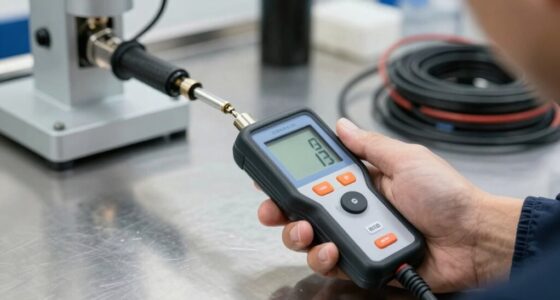
Optically clear adhesives achieve invisible bonding through specialized chemistry that matches the refractive index of your materials, reducing light scattering. UV curing quickly solidifies the adhesive with photoinitiators responsive to UV light, ensuring a complete, uniform cure while preserving optical clarity. Proper surface preparation and formulation chemistry are key to preventing cloudiness or yellowing over time. If you keep exploring, you’ll discover how these advanced techniques create durable, nearly invisible bonds perfect for high-performance optical applications.
Key Takeaways
- Photoinitiators enable rapid UV curing, ensuring complete and uniform polymerization for transparent, durable bonds.
- Matching the adhesive’s refractive index with bonded materials minimizes light scattering and maintains optical clarity.
- Proper surface preparation, including cleaning and priming, promotes strong adhesion and prevents optical distortions.
- Formulation chemistry ensures compatibility, stability, and resistance to yellowing or cloudiness over time.
- Controlled UV curing processes produce high-quality, nearly invisible bonds essential for optical applications.

One key aspect of working with OCAs is UV curing. This process uses ultraviolet light to rapidly initiate the adhesive’s polymerization, transforming the liquid resin into a solid bond in seconds. UV curing offers considerable advantages, including fast processing times, reduced thermal stress, and the ability to control the curing process precisely. When you’re working with OCAs that require UV curing, it’s crucial to verify that the adhesive is formulated with photoinitiators that respond efficiently to UV light. This responsiveness guarantees a complete and uniform cure, resulting in a clear, durable bond. Proper UV curing not only enhances the mechanical strength of the adhesion but also preserves the optical properties, preventing cloudiness or yellowing over time. Additionally, selecting an adhesive with a suitable refractive index ensures minimal light scattering, maintaining optical clarity. Surface preparation plays a critical role in maximizing the effectiveness of optically clear adhesives. Before applying the OCA, you need to ensure that the surfaces are thoroughly cleaned and free from contaminants such as dust, oils, or fingerprints. Any residue can interfere with adhesion, causing optical distortions or bond failures. Typically, you should clean surfaces using isopropyl alcohol or specialized cleaning agents that do not leave residues. In addition, lightly roughening the surface or applying a primer can improve adhesion, especially with smooth or non-porous materials. Proper surface preparation creates a clean, uniform interface that allows the adhesive to spread evenly and bond strongly, leading to a clearer, more consistent optical path. When selecting an OCA, considering the formulation chemistry is essential to ensure compatibility with the materials and the environment in which it will be used. Understanding the photoinitiators involved in UV curing can help optimize the process for specific applications. Furthermore, understanding the chemistry behind these adhesives can help predict their long-term stability and performance. Incorporating knowledge of material compatibility can also prevent potential issues such as delamination or yellowing over time. When you combine meticulous surface preparation with proper UV curing techniques, you enhance the performance of your optically clear adhesive markedly. The formulation of the OCA itself is designed to match the refractive index of the materials being bonded, minimizing light scattering and maintaining transparency. By carefully controlling each step—from surface cleaning to curing—you ensure that the bond remains invisible and durable over time. In the end, understanding the chemistry behind OCAs and adhering to best practices in surface preparation and curing will help you achieve flawless, nearly invisible bonds that meet the demanding requirements of high-performance optical applications.
optically clear adhesive for optical applications
As an affiliate, we earn on qualifying purchases.
As an affiliate, we earn on qualifying purchases.
Frequently Asked Questions
How Do Optical Adhesives Perform Under Extreme Temperature Conditions?
You’ll find that optical adhesives with high thermal stability perform well under extreme temperatures, maintaining clear bonds without yellowing or cracking. Their adhesive resilience guarantees they stay durable even when subjected to temperature fluctuations. This means your optical devices will keep their clarity and performance, no matter how harsh the environment gets. Relying on these adhesives provides long-lasting, invisible bonding that withstands extreme heat and cold, ensuring consistent optical performance.
Are There Environmentally Friendly Options for Optically Clear Adhesives?
You’ll be pleased to know that eco-friendly alternatives for optically clear adhesives are gaining traction. These biodegradable formulations are designed to minimize environmental impact while maintaining clarity and performance. By choosing adhesives made from sustainable materials, you can contribute to a greener future without sacrificing quality. Many manufacturers now offer options that combine environmental consciousness with excellent optical properties, making it easier for you to make responsible choices in your projects.
How Long Do Optically Clear Adhesives Maintain Their Transparency?
Optically clear adhesives typically maintain their transparency for several years, depending on factors like UV stability and optical durability. If the adhesive has high UV stability, it resists yellowing or clouding caused by sunlight exposure, extending its clarity. Proper formulation enhances optical durability, ensuring the adhesive remains transparent despite environmental stresses. Regularly choosing adhesives with these properties guarantees your bonded materials stay clear and visually appealing over time.
Can Optical Adhesives Be Used for Flexible or Curved Surfaces?
Yes, optical adhesives can be used for flexible or curved surfaces. Their surface conformability and adhesive flexibility allow them to adapt to various shapes without losing transparency or bond strength. This makes them ideal for applications like curved displays or flexible electronics. You’ll find these adhesives provide a seamless, invisible bond, maintaining optical clarity even on non-flat surfaces, ensuring durability and performance in dynamic environments.
What Are the Best Practices for Removing Optically Clear Adhesives?
A stitch in time saves nine, and that’s true for removing optically clear adhesives. To guarantee effective adhesive removal, start with proper surface preparation—gently heat or use a solvent suitable for your material. Carefully peel or apply an adhesive remover, avoiding damage to the substrate. Patience and precision are key, and always test a small area first to prevent surface damage during adhesive removal.
Conclusion
Now that you understand the chemistry behind optically clear adhesives, you realize they’re more than just invisible bonds—they’re the silent heroes behind seamless displays and durable coatings. Think of them as the wizard’s spell, casting clarity and strength with a touch of chemistry. As you explore more, remember: the magic of transparency isn’t just in what you see, but in what’s hidden behind the scenes, holding everything together flawlessly.