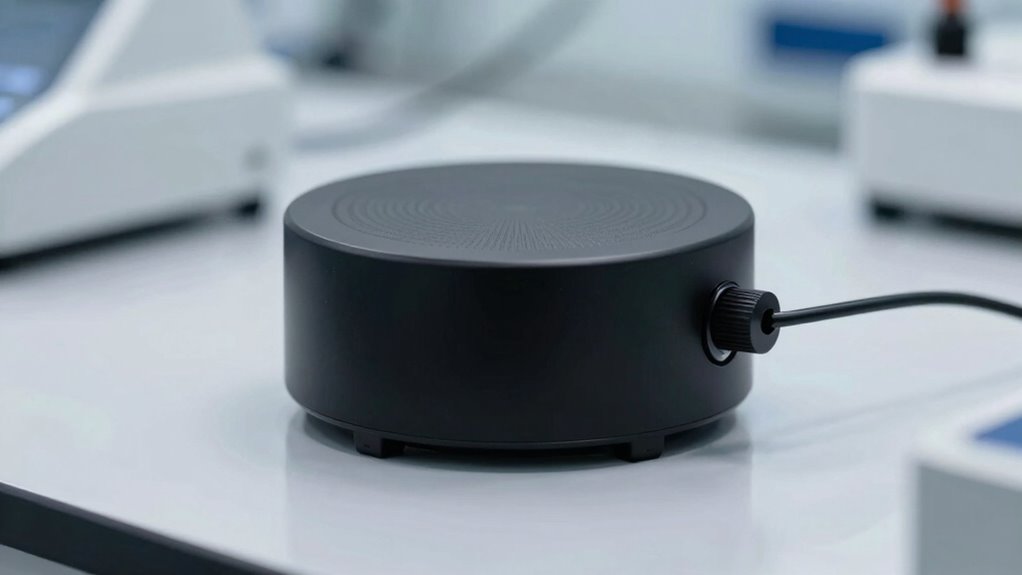

Blackbody calibrators are essential reference sources that help you achieve accurate thermal measurements. They emit radiation with a predictable spectrum based on their temperature, allowing your devices to be precisely calibrated. By using stable and uniform blackbody sources, you can guarantee your thermal imaging tools provide reliable data across various applications. Understanding how these calibrators work will give you deeper insight into maintaining accurate temperature readings and the science behind thermal safety.
Key Takeaways
- Blackbody calibrators provide stable, predictable spectral emission essential for accurate thermal measurements.
- They serve as primary reference sources, ensuring the calibration of thermal imaging devices.
- Precise temperature control of blackbody sources allows for reliable calibration across various wavelengths.
- Calibration against blackbody standards accounts for environmental and instrumental variations.
- Their consistent spectral behavior underpins the accuracy and traceability of thermal measurement systems.
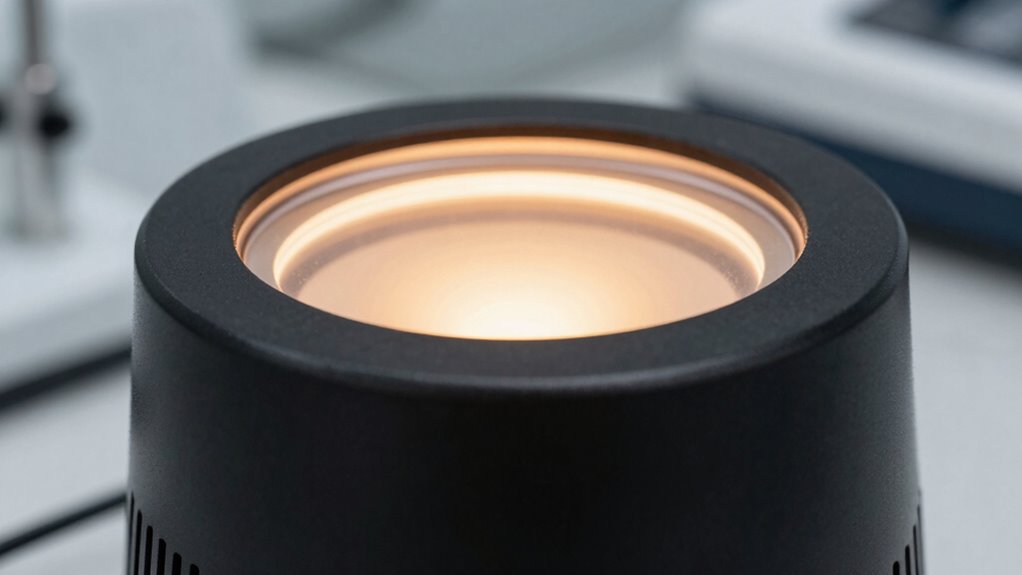
Have you ever wondered how scientists achieve precise temperature measurements in thermal imaging and radiometry? The key lies in understanding and accurately controlling spectral emission — the way objects emit radiation across different wavelengths. Blackbody calibrators serve as the foundational reference sources, providing a stable and predictable spectrum of thermal radiation. These devices mimic the ideal blackbody, which absorbs all incident radiation and emits a characteristic spectrum solely determined by its temperature. This predictable spectral emission is essential for calibrating thermal imaging instruments, ensuring that measurements are accurate across a range of temperatures.
Blackbody calibrators provide stable, predictable spectra essential for precise thermal imaging calibration.
To leverage blackbody calibrators effectively, you need to understand the calibration techniques that guarantee their reliability. Calibration involves comparing the blackbody’s emitted radiation against a known standard, often traceable to national or international measurement institutes. This process accounts for any deviations in the device’s spectral emission, ensuring it maintains a consistent and known temperature-dependent radiation profile. Techniques such as using a secondary calibrated sensor or referencing a primary standard help verify the blackbody’s spectral emission and confirm its stability over time. By continuously monitoring and adjusting these parameters, calibration techniques maintain the high precision necessary for scientific and industrial applications.
The spectral emission of a blackbody calibrator depends tightly on its temperature, following Planck’s law. As you increase the temperature, the spectral emission shifts toward shorter wavelengths, and the intensity of emitted radiation rises. This predictable behavior allows you to use blackbody sources as a benchmark for calibrating thermal cameras and radiometers. When you set your instrument against a well-characterized blackbody, you can correct for any measurement inaccuracies by referencing this spectral emission profile. The calibration process also involves compensating for factors like optical path losses, detector sensitivities, and environmental conditions, all of which can influence the accuracy of thermal measurements. Spectral emission plays a crucial role in ensuring the precision and reliability of temperature calibration.
In practice, blackbody calibrators are designed with high stability and uniformity, allowing you to perform repeatable and reliable calibrations. You can achieve precise temperature readings by ensuring your instrument’s response aligns with the blackbody’s spectral emission across the relevant wavelengths. This process is fundamental in fields like remote sensing, industrial inspections, and scientific research, where even minor measurement errors can lead to significant consequences. Ultimately, blackbody calibrators serve as the cornerstone of thermal accuracy, bridging the gap between raw sensor data and precise temperature information through meticulous calibration techniques centered on spectral emission.

Dry Block High Temperature Calibrators (Range: 20°C to 650°C) with Thermocouples (T, J, K, N, R, S) for Calibration Labs,Thermal Plants | Temperature calibrator | Model: AI-DBC-02
- Temperature Range: 20°C to 650°C
- High Accuracy: ±0.6°C
- Stable Bath: ±0.05°C stability
As an affiliate, we earn on qualifying purchases.
As an affiliate, we earn on qualifying purchases.
Frequently Asked Questions
How Do Blackbody Calibrators Compare to Other Thermal Reference Sources?
Blackbody calibrators excel over other thermal reference sources because they provide superior spectral accuracy and environmental stability. You benefit from consistent, precise temperature references that aren’t easily affected by environmental changes. Unlike some sources, blackbody calibrators maintain their accuracy over time, making them ideal for calibration tasks requiring high precision. This dependability ensures your measurements are both accurate and repeatable, essential for advanced thermal testing and calibration processes.
What Industries Primarily Utilize Blackbody Calibrators?
You’ll find blackbody calibrators mainly used in industries like aerospace, electronics, and manufacturing, where precise temperature measurements are critical. They serve as calibration standards because of their exceptional thermal stability, ensuring accurate temperature readings across various applications. By providing consistent, reliable references, blackbody calibrators help maintain quality control and compliance with industry standards, making them essential tools for industries demanding high thermal accuracy.
How Often Should a Blackbody Calibrator Be Recalibrated?
You should recalibrate your blackbody calibrator at least annually—think of it as essential as your morning coffee! Regular calibration frequency ensures peak accuracy, preventing costly errors. Stick to strict maintenance schedules, and if your calibrator operates in harsh environments or sees heavy use, consider more frequent checks. Don’t wait for errors; proactive calibration keeps your thermal measurements precise and your operations running smoothly, like a well-oiled machine.
Are Blackbody Calibrators Suitable for Portable or Field Use?
Yes, blackbody calibrators are suitable for portable or field use, thanks to their portable design and rugged construction. They’re ideal for field deployment because you can easily carry them to different locations without compromising accuracy. These calibrators provide consistent thermal reference points on-site, making them perfect for applications like maintenance, calibration checks, or inspections in remote or challenging environments. Their portability guarantees reliable thermal measurements wherever you need them.
What Are the Main Limitations of Blackbody Calibration Technology?
You should know that blackbody calibration technology faces limitations like calibration stability issues over time and material aging. These factors can cause temperature accuracy to drift, requiring regular recalibration to maintain precision. Environmental conditions, such as temperature fluctuations, also impact stability. To guarantee reliable results, you need to monitor calibration stability closely and replace aging materials periodically, especially in demanding or long-term applications.
Conclusion
So, next time you rely on thermal measurements, remember the humble blackbody calibrator—your unsung hero. It’s the quiet, unassuming source ensuring everything from space exploration to industrial heating stays on point. Ironically, its simplicity masks its precision, making it the ultimate reference in thermal accuracy. Without it, your measurements might be off, your science flawed, and your confidence misplaced. Truly, in the world of heat, blackbody calibrators keep everything perfectly in check—without a fuss.