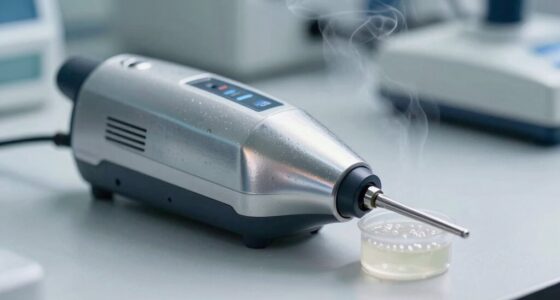
You use Differential Scanning Calorimetry (DSC) to measure energy changes during heating or cooling, revealing phase shifts like melting points. Thermal Gravimetric Analysis (TGA) tracks weight loss related to decomposition or moisture loss, helping assess stability. Dynamic Mechanical Analysis (DMA) measures how materials respond mechanically to stress across temperatures, highlighting stiffness and damping. Each tool provides distinct insights into material properties; exploring further shows how each plays a crucial role in material characterization.
Key Takeaways
- DSC measures heat flow during temperature changes to identify phase transitions, unlike TGA which tracks weight loss.
- TGA focuses on thermal stability by monitoring mass changes, differing from DMA’s assessment of mechanical properties under oscillation.
- DSC detects melting and glass transitions; TGA detects decomposition temperatures; DMA evaluates viscoelastic behavior.
- Calibration ensures accurate temperature and heat flow readings in DSC, while TGA calibration centers on weight and temperature accuracy.
- DMA measures mechanical response to oscillating forces, distinguishing it from the thermal and weight-based data of DSC and TGA.

Have you ever wondered how engineers guarantee materials and systems perform reliably under varying heat conditions? The answer lies in thermal analysis tools, which help assess how materials respond to temperature changes. These tools are essential for material characterization and ensuring accurate results, which depends heavily on proper instrument calibration. Understanding the differences between Differential Scanning Calorimetry (DSC), Thermogravimetric Analysis (TGA), and Dynamic Mechanical Analysis (DMA) can help you select the right method for your needs.
DSC measures how much energy a material absorbs or releases as it’s heated or cooled. It’s particularly useful for identifying phase transitions, such as melting points or glass transitions. When performing DSC, precise instrument calibration is fundamental to obtain reliable data. Calibration involves using standards with known thermal properties, ensuring the instrument’s temperature and heat flow readings are accurate. This accuracy is critical because even small deviations can lead to incorrect interpretations of a material’s thermal behavior. As you work with DSC, you’ll find that proper material characterization depends on understanding these thermal transitions, which influence product stability, processing conditions, and performance. Additionally, instrument calibration plays a vital role in maintaining measurement accuracy over time, preventing drift that could compromise results. Regular calibration procedures help detect and correct instrument drift, ensuring consistent data quality throughout testing. Incorporating standardized calibration procedures is essential for obtaining reproducible and trustworthy measurements.
TGA, on the other hand, tracks the change in a material’s weight as it’s heated. It’s commonly used to study decomposition, oxidation, or moisture loss. TGA provides insights into the thermal stability and composition of materials, which are essential for applications like polymer manufacturing or pharmaceuticals. Like DSC, TGA requires meticulous instrument calibration. You’ll need to verify the balance’s accuracy and ensure the temperature sensors are correctly aligned. Accurate calibration guarantees that weight changes are precisely recorded and correlated with temperature, making your material characterization trustworthy. This precision enables you to determine decomposition temperatures and residual content, key factors in quality control and material design.
DMA differs from DSC and TGA by measuring a material’s mechanical response to an applied oscillating force as temperature varies. It reveals how a material’s stiffness, damping, and viscoelastic properties change with heat. DMA is particularly useful for analyzing polymers and composites, helping you understand how they will perform under mechanical stress at different temperatures. Calibration in DMA involves checking the force and displacement sensors to guarantee measurement accuracy. Properly calibrated instruments allow you to accurately capture subtle changes in mechanical properties, which are indispensable for predicting real-world performance. Additionally, understanding the thermal behavior of materials through these tools can significantly enhance the design process of home appliances and smart devices, ensuring durability and efficiency.
Differential Scanning Calorimetry DSC instrument
As an affiliate, we earn on qualifying purchases.
As an affiliate, we earn on qualifying purchases.
Frequently Asked Questions
Which Thermal Analysis Method Is Best for Polymers?
You should use Differential Scanning Calorimetry (DSC) for analyzing polymers. It helps you determine polymer crystallinity and the glass change temperature, both vital for understanding material properties. DSC provides clear insights into thermal shifts, making it ideal for evaluating how polymers behave under different temperatures. This method allows you to optimize processing conditions and predict performance, ensuring your polymers meet specific application requirements.
How Do Sample Size and Shape Affect Results?
Sample size and shape profoundly impact your results because they influence sample uniformity and shape effects. Larger or irregularly shaped samples may lead to uneven heat transfer, causing inconsistent data. To get accurate results, keep your samples uniform in size and shape, ensuring consistent contact with the instrument. Proper preparation minimizes shape effects and improves the reliability of your thermal analysis, giving you clearer insights into your material’s properties.
Are There Safety Concerns With Thermal Analysis Instruments?
You should know that thermal analysis instruments are generally safe when properly maintained. Remarkably, over 60% of lab accidents involve equipment misuse. To ensure safety, always calibrate your equipment regularly and follow manufacturer guidelines. Pay close attention to operator safety by wearing protective gear, avoiding inhalation of fumes, and handling samples carefully. Proper training and routine checks help prevent accidents and keep your experiments safe and reliable.
Can Thermal Analysis Detect Chemical Composition Changes?
Yes, thermal analysis can detect chemical composition changes. By monitoring how materials respond to temperature variations, you can assess chemical stability and identify reactions occurring within the sample. Techniques like DSC and TGA help you track reaction progress, giving insights into chemical transformations. This makes thermal analysis a valuable tool for reaction monitoring and ensuring the stability of your materials over time.
How Do Environmental Conditions Impact Measurements?
You might find that environmental conditions can make or break your measurements. Fluctuations in temperature, humidity, or even ambient vibrations can jeopardize environmental stability, leading to less accurate results. To keep measurement accuracy high, you need to control these factors closely. Think of it as keeping your ducks in a row—stability ensures your thermal analysis yields reliable, reproducible data, so you can trust your conclusions without second-guessing.
Conclusion
Understanding DSC, TGA, and DMA reveals more than just different tools—they’re like distinct conversations with your material. While DSC tells you about heat flow, TGA uncovers weight changes, and DMA explores mechanical behavior. Each offers unique insights, yet they all aim to uncover your material’s secrets. By choosing the right analysis, you’re not just observing—you’re truly understanding. It’s this blend of perspectives that empowers you to innovate, adapt, and excel in your material applications.