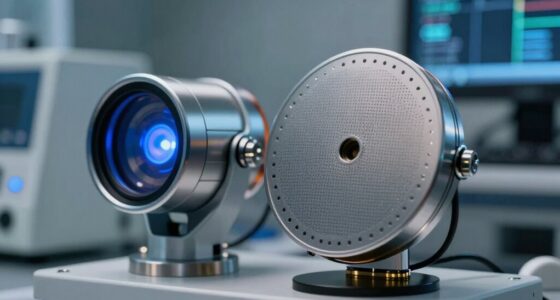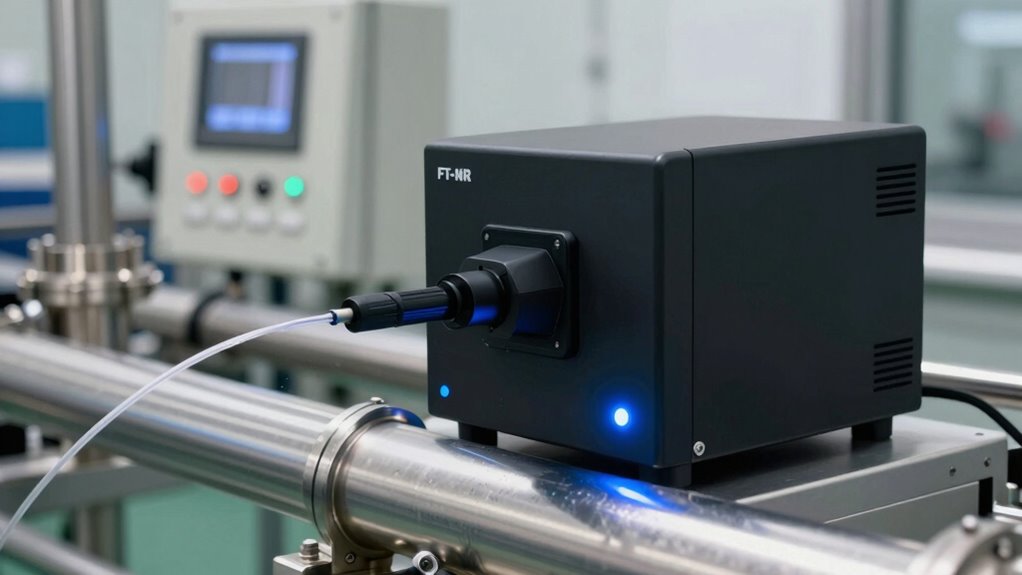

FT-NIR spectroscopy fits seamlessly into process monitoring by providing instant, non-destructive analysis right on your production line. It helps you detect deviations early, ensuring tight process control and reducing waste. With its high sensitivity and ability to analyze complex mixtures, FT-NIR offers real-time insights into multiple quality parameters simultaneously. Its rugged, portable design makes it suitable for harsh environments, giving you a clearer picture of your process. Keep exploring to discover how this technology can transform your operations even further.

Prime made for students and young adults
- Fast, free delivery for dorm and study essentials
- Prime Video and Amazon Music included
- Member-only deals
Key Takeaways
- FT-NIR provides rapid, non-destructive, real-time analysis directly on the production line for continuous process monitoring.
- It offers high sensitivity and detailed compositional data, enabling precise tracking of multiple quality parameters simultaneously.
- FT-NIR instruments can be deployed at various process points, enhancing overall process oversight and control.
- Integrated spectral data analysis with visualization and trend tools supports proactive adjustments and decision-making.
- Its ruggedness and portability make FT-NIR suitable for harsh industrial environments, ensuring reliable process monitoring.
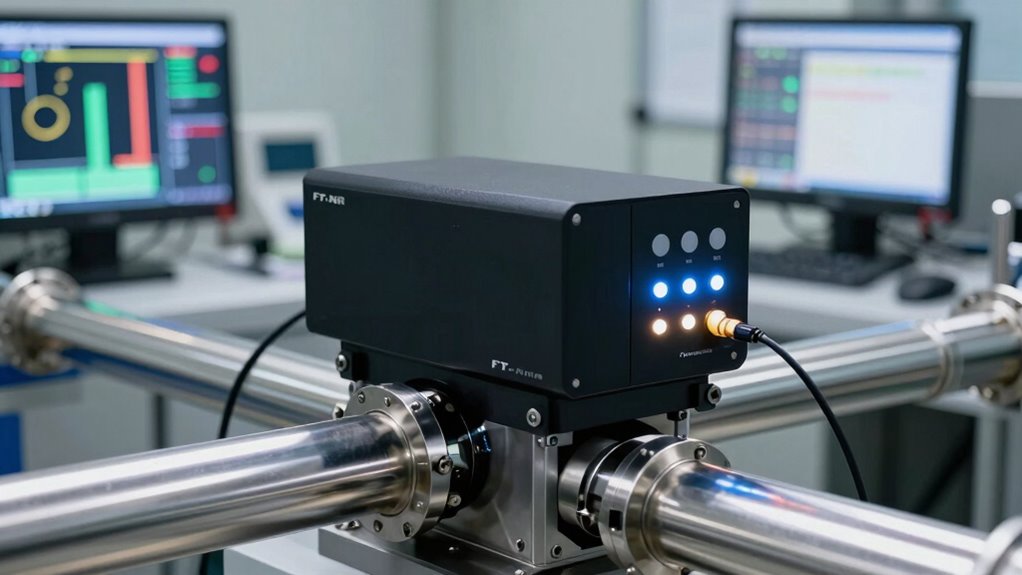
FT-NIR’s ability to provide rapid, non-destructive analysis is a game-changer. You don’t need to wait for lab results or perform extensive sample preparation. Instead, you can get instant insights directly on the production line. This real-time approach helps you detect deviations early, minimizing waste and reducing costly rework. As a result, you maintain tighter control over your manufacturing process, assuring products are within specifications and reducing the risk of defects reaching the end customer.
The spectroscopy advantages of FT-NIR extend beyond speed. Its high sensitivity allows you to analyze complex mixtures with multiple components, providing detailed compositional information. This means you can track multiple quality parameters simultaneously, improving process understanding and control. Additionally, FT-NIR instruments are often rugged and portable, making them suitable for harsh industrial environments. You can deploy them at various points along the production line, ensuring thorough process oversight. Understanding spectroscopy advantages can help you maximize the benefits of this technology and enhance your quality control strategies. Incorporating spectroscopy techniques into your process monitoring can further improve accuracy and efficiency. Moreover, advances in spectral data analysis enable more precise interpretation of complex signals, empowering more effective decision-making. Recognizing the importance of data integration can lead to better coordination between different systems and departments.
Integrating FT-NIR into your process monitoring system enhances automation and data management. Modern FT-NIR instruments often come with sophisticated software that offers real-time data visualization, trend analysis, and predictive analytics. This integration means you can quickly identify issues, adjust parameters on the fly, and optimize your process. Additionally, understanding the metaphysical concepts related to process data can help you make more informed decisions and foster a proactive approach to quality management. Over time, the collected data builds a robust database, helping you refine your control strategies and improve overall efficiency.
FT-NIR spectrometer for process monitoring
As an affiliate, we earn on qualifying purchases.
As an affiliate, we earn on qualifying purchases.
Frequently Asked Questions
What Are the Limitations of FT-NIR in Process Monitoring?
You might face limitations with FT-NIR in process monitoring due to calibration challenges and sample variability. It requires extensive calibration models, which can be time-consuming to develop and maintain. Variations in sample composition or physical properties can affect accuracy. Additionally, FT-NIR may struggle with complex matrices or low-concentration components, making it less effective for certain processes unless you invest in robust calibration strategies and proper sample handling.
How Does FT-NIR Compare to Other Spectroscopic Methods?
FT-NIR acts like a sharp-eyed scout compared to other spectroscopic methods, offering quicker, non-destructive analysis with high spectral accuracy. It seamlessly integrates data into process control systems, making real-time decisions easier. While Raman or UV-Vis may excel in specific applications, FT-NIR’s broad applicability and fast results make it a versatile tool. You’ll find it especially useful when continuous, reliable process monitoring is essential for maintaining product quality.
What Industries Benefit Most From FT-NIR Process Monitoring?
You’ll find FT-NIR process monitoring highly beneficial in industries like pharmaceuticals, food, and chemicals because it enhances quality control through real-time analysis. This technique allows you to quickly detect and adjust for inconsistencies during production, reducing waste and improving product quality. Its speed and accuracy make it ideal for industries where maintaining strict standards is critical, helping you streamline operations and guarantee compliance efficiently.
How Is Data From FT-NIR Analyzed and Interpreted?
You analyze FT-NIR data through spectral analysis and data calibration, transforming raw signals into meaningful insights. You compare spectral patterns to known standards, identify trends, and detect anomalies. You interpret the data by calibrating models to guarantee accuracy and consistency, enabling real-time decision-making. With each spectrum, you reveal the story behind your process, empowering you to optimize quality, reduce waste, and maintain control with confidence and precision.
What Are the Costs Associated With Implementing FT-NIR Systems?
The costs of implementing FT-NIR systems include initial investment, ongoing maintenance requirements, and training expenses. You should perform a thorough cost analysis to evaluate equipment prices, installation, and calibration. Maintenance costs involve routine checks and potential repairs, which are generally lower compared to other analytical tools. While the upfront costs can be significant, the system’s efficiency and reduced reagent use often lead to long-term savings, justifying the investment.
Conclusion
Imagine FT-NIR as a vigilant lighthouse, guiding your process through turbulent waters with unwavering clarity. Its real-time insights act as the steady beacon, steering you past potential pitfalls and toward peak performance. By integrating FT-NIR into your monitoring system, you’re not just observing changes—you’re anticipating them, like a seasoned sailor reading the stars. With this technology as your compass, you’ll navigate your processes with confidence, ensuring smooth sailing every time.
Halloween Picks
halloween
As an affiliate, we earn on qualifying purchases.