
TL;DR
A study published in April 2026 in Nature Communications reported several complex patterns of traveling brain waves in awake people performing memory tasks. The patterns differed between verbal recall and spatial navigation, but the findings do not yet establish that the waves cause the brain to process information in particular ways.
A team of neuroscientists has reported that traveling brain waves can form complex patterns—including spreading and converging waves and spirals—and that the patterns differed as people performed two kinds of memory task. The study, published in Nature Communications in April 2026, adds evidence that these waves may be connected to how the brain handles information, though it does not show that they cause particular mental processes.

Prime made for students and young adults
- Fast, free delivery for dorm and study essentials
- Prime Video and Amazon Music included
- Member-only deals
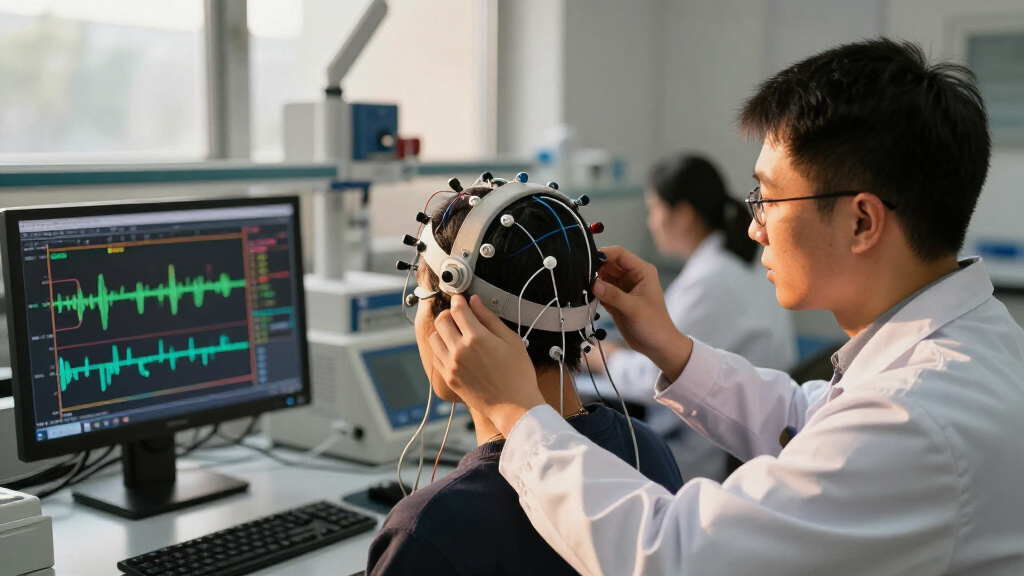
The researchers recorded electrical activity with intracranial electrodes in people who already had electrodes placed in their brains as part of care for severe epilepsy. With participants’ permission, the team used the recordings to examine brain activity at higher spatial and temporal resolution than is available from electrodes placed on the scalp. The source report does not specify the number of participants in the 2026 study.
Participants completed two memory exercises: a verbal recall task, in which they remembered words shown on a screen, and a more demanding spatial task, in which they navigated a virtual environment and recalled where they had encountered objects. The researchers observed distinct patterns of waves associated with the different tasks. The report describes waves spreading outward from a location, waves converging toward one, and vortex-like spiral patterns.
The findings extend earlier work by researchers including Joshua Jacobs and Uma Mohan. A 2024 study in Nature Human Behavior described waves traveling in opposite directions across the cortex during memory tasks. The newer study, involving Jacobs and Anup Das, suggests that wave activity is not limited to a simple front-to-back or back-to-front movement.
How Wave Patterns Could Support Memory
The study matters because it links the brain’s large-scale electrical activity with the demands of specific behaviors. Neurons can alter their connections over days or months, while everyday behavior must adapt much faster. Researchers cited by Quanta Magazine propose that traveling waves could help coordinate activity across brain regions on a shorter timescale, allowing the brain to respond to changing tasks without waiting for lasting changes in neural connections.
That interpretation remains a research hypothesis, not a conclusion proved by the reported observations. Even if the waves are a by-product of neurons firing rather than a mechanism that directs information, their relationship to what a person is doing could still offer clues about how activity is organized across the brain. Better understanding those patterns may help scientists study how the brain shifts between kinds of memory and other mental operations.
The work also highlights the value and limits of direct recordings. Intracranial electrodes can capture detailed activity from particular brain regions, but they are generally used when patients need clinical monitoring, not as a routine research tool for healthy volunteers. The findings therefore offer a close view of neural activity under specific conditions, rather than a complete map of how waves behave throughout the brain.
Popular right now

Ninja CM401 Specialty Coffee Maker with 10-Cup Carafe and Fold-Away Frother

Dyson Car+Boat Cordless Handheld Vacuum

Vitamix VX3 Professional-Grade Blender with BlendPilot, 48 oz, Black
As an affiliate, we earn on qualifying purchases.
From Scalp Signals to Complex Waves
Researchers have recorded the brain’s electrical oscillations for about a century. Since the 1920s, electroencephalography (EEG) has measured activity using electrodes on the scalp. These recordings reveal broad rhythms commonly labeled alpha, beta, gamma and theta, which vary with states such as attention, memory and sleep. But signals recorded outside the skull provide less detailed information about where activity is occurring and how it moves over time.
Traveling waves are coordinated changes in electrical activity that spread across neural tissue. They have often been described as relatively simple, planar oscillations—rather like a wave moving across a surface. In that view, they could be a general sign of neural activity rather than a functional part of information processing.
The 2024 study described in the Quanta report found waves moving in both directions across the cortex during memory tasks. Jacobs suggested that direction could reflect how information travels between visual areas at the back of the brain and memory-related regions toward the front. Mohan said the researchers thought this organization might help the brain switch between encoding and recalling information. The 2026 study adds more varied shapes to that account, but does not settle what each pattern does.
“The work coming out is moving this from ‘Are they relevant?’ to ‘This is a major motif of how the cortex processes information.’”
— Earl K. Miller, cognitive neuroscientist at the Massachusetts Institute of Technology
What the Recordings Cannot Yet Show
The reported association between wave patterns and task type does not establish cause and effect. The study material provided does not say whether the patterns directly help produce memory performance, arise as a consequence of other neural activity, or reflect both. Nor does it provide enough methodological detail to assess the size or representativeness of the participant group, the strength of the task-related differences, or how consistently the patterns appeared across individuals.
The findings came from people with intracranial electrodes placed for epilepsy care, so they should not automatically be treated as a description of brain activity in all healthy people. It is also unclear from the source report how the different wave forms relate to one another, whether particular patterns map reliably to specific cognitive operations, or whether the same patterns occur during tasks beyond memory. The report says researchers observed two new classes of waves in awake humans, but the supplied account ends before fully describing both classes or the study’s detailed results.
Testing Waves Across More Tasks
The immediate scientific task is to determine whether the observed patterns recur across more people and different kinds of activity, and whether they predict performance or changes in behavior. Further work would need to distinguish waves that merely accompany neural activity from patterns that help coordinate it. The source report does not identify a scheduled follow-up study or a specific next publication.
Researchers may also compare higher-resolution intracranial recordings with methods that can be used in broader groups, while accounting for the differences in what those tools can measure. Until more evidence is available, the April 2026 study is best understood as a report of complex wave patterns associated with memory tasks—not proof that the waves are the mechanism behind memory.
Key Questions
What did the April 2026 study find?
Researchers observed several forms of traveling brain waves in people doing memory exercises, including spreading, converging and spiral-like patterns. The patterns differed between verbal recall and a virtual spatial-navigation task.
How were the brain waves recorded?
The team used electrodes placed inside the brain of people being monitored for severe epilepsy. The approach provides more detailed recordings from sampled regions than scalp EEG, but it does not capture every part of the brain.
Do the findings prove that waves make memory work?
No. The reported results show an association between wave patterns and task type. They do not establish whether the waves cause or coordinate memory-related activity, or instead arise alongside other processes.
How does this differ from earlier research?
A 2024 study described waves traveling in opposite directions across the cortex during memory tasks. The 2026 report adds more varied wave shapes, rather than only movement from the back of the brain to the front or in the reverse direction.
Source: hn