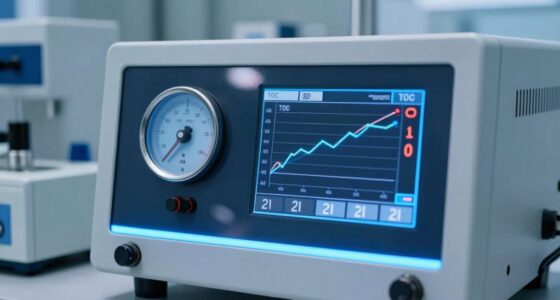

You’ll find capillary electrophoresis outperforms chromatography when analyzing small, complex, or precious samples. Its high resolution, rapid separation, and minimal sample volume make it ideal for delicate or limited materials. Unlike chromatography, it reduces sample contamination risks and provides faster results. When precision and efficiency matter most, capillary electrophoresis is often the better choice. Curious about how it consistently surpasses chromatography? Keep exploring to uncover more about this powerful technique.

Prime made for students and young adults
- Fast, free delivery for dorm and study essentials
- Prime Video and Amazon Music included
- Member-only deals
Key Takeaways
- Capillary electrophoresis offers faster separation times compared to traditional chromatography.
- It provides higher resolution for small sample volumes and complex mixtures.
- CE typically has higher sensitivity, detecting lower analyte concentrations.
- It requires minimal sample preparation, reducing analysis time and complexity.
- CE is more suitable for analyzing charged molecules and ions efficiently.

Capillary electrophoresis is a powerful analytical technique that separates charged molecules based on their size-to-charge ratio by applying an electric field across a narrow capillary tube. To get accurate and reliable results, you need to carefully focus on sample preparation and instrument calibration. Proper sample prep involves diluting your sample to an appropriate concentration, filtering it to remove particulates, and sometimes adding a buffer or internal standard to guarantee consistent mobility. Skipping or rushing this step can lead to poor separation or skewed data, so take your time to prepare your samples meticulously. When you prepare your samples correctly, you minimize potential contamination and variability that could interfere with the electrophoretic process. Additionally, understanding the electric field dynamics within the capillary can help optimize separation efficiency. Recognizing the electrophoretic principles is essential for troubleshooting and refining your technique. Gaining a solid understanding of sample mobility can aid in predicting separation outcomes and troubleshooting issues more effectively.
Careful sample prep ensures accurate capillary electrophoresis results by reducing contamination and variability.
Instrument calibration is equally crucial. You have to verify that your capillary electrophoresis system is functioning correctly before running samples. Calibration involves using standard solutions with known properties—such as mobility or migration time—to fine-tune your instrument settings. Regular calibration ensures the electric field, detection system, and temperature controls are all operating within specified parameters. If your instrument isn’t calibrated properly, your results might be inconsistent or inaccurate, leading to misinterpretations. Always follow manufacturer guidelines for calibration procedures and schedule routine checks to maintain ideal performance.
Once you’ve prepared your sample properly and calibrated your instrument, you can load your sample into the capillary with confidence. During the run, an electric field causes charged molecules to migrate at different speeds, separating them based on their size-to-charge ratio. The process is fast, often completing in just a few minutes, and provides high-resolution separation. Because of its precision, capillary electrophoresis often outperforms traditional chromatography in analyzing small sample volumes and complex mixtures. You’ll appreciate its sensitivity, speed, and the minimal amount of sample needed, especially when working with limited or precious samples.
In essence, the effectiveness of capillary electrophoresis hinges on your attention to detail during sample preparation and instrument calibration. These foundational steps ensure your runs are consistent and your data is accurate, allowing you to leverage the technique’s full potential. When you master these aspects, you’ll find that capillary electrophoresis not only surpasses many chromatography methods but also provides clearer insights into the molecules you’re studying. It’s a precise, efficient tool—one that rewards your meticulousness with reliable, high-quality results every time.
Popular right now

Shark Clean & Empty Cordless Stick Vacuum with Auto-Empty System, BU3521

KitchenAid Artisan 5-Qt Tilt-Head Stand Mixer – Dried Rose (KSM150PS)

Shark PowerPro Reveal Plus Cordless Vacuum Cleaner, Charcoal, IZ376H
As an affiliate, we earn on qualifying purchases.
Frequently Asked Questions
How Does Capillary Electrophoresis Compare in Cost to Chromatography?
You’ll find that capillary electrophoresis generally has a lower initial setup cost compared to chromatography, making it appealing for budget considerations. Its smaller equipment and fewer consumables reduce ongoing expenses. However, keep in mind that maintenance and specialized training might influence overall costs. Overall, capillary electrophoresis offers a cost-effective alternative, especially for labs aiming to optimize budget while maintaining high analytical performance.
What Are the Limitations of Capillary Electrophoresis?
Did you know capillary electrophoresis has an instrument sensitivity up to 1000 times higher than some chromatography techniques? Its limitations include complex sample preparation, which can be time-consuming, and sensitivity to buffer conditions that affect results. Additionally, it struggles with analyzing very large or highly complex molecules, making it less suitable for certain applications. You need to carefully optimize conditions to overcome these hurdles.
Can Capillary Electrophoresis Analyze Complex Biological Samples?
Yes, capillary electrophoresis can analyze complex biological samples effectively. You should focus on proper sample preparation to reduce complexity and potential interference. Ensuring accurate instrument calibration is essential for reliable separation and detection. By optimizing these steps, you can distinguish and analyze multiple biomolecules simultaneously, making this technique highly suitable for complex biological matrices like blood or tissue extracts.
What Are the Maintenance Requirements for Capillary Electrophoresis Systems?
You need to regularly clean and condition the capillary, check the buffer pH, and replace it if contaminated. Sample preparation should be thorough to prevent clogging and guarantee accurate results. Instrument calibration is essential, so you should routinely verify voltage and detector settings. Keep detailed maintenance logs, and replace worn-out parts promptly to maintain peak performance and reproducibility in your capillary electrophoresis system.
How Scalable Is Capillary Electrophoresis for Industrial Applications?
You can scale capillary electrophoresis for industrial applications by leveraging instrument miniaturization and streamlined sample preparation. Its high throughput and automation capabilities make it suitable for large-scale testing, while smaller, more efficient systems reduce costs and space needs. By optimizing sample prep processes and investing in advanced, scalable equipment, you guarantee consistent, rapid results across extensive sample volumes, making it a practical choice for industrial settings.
Conclusion
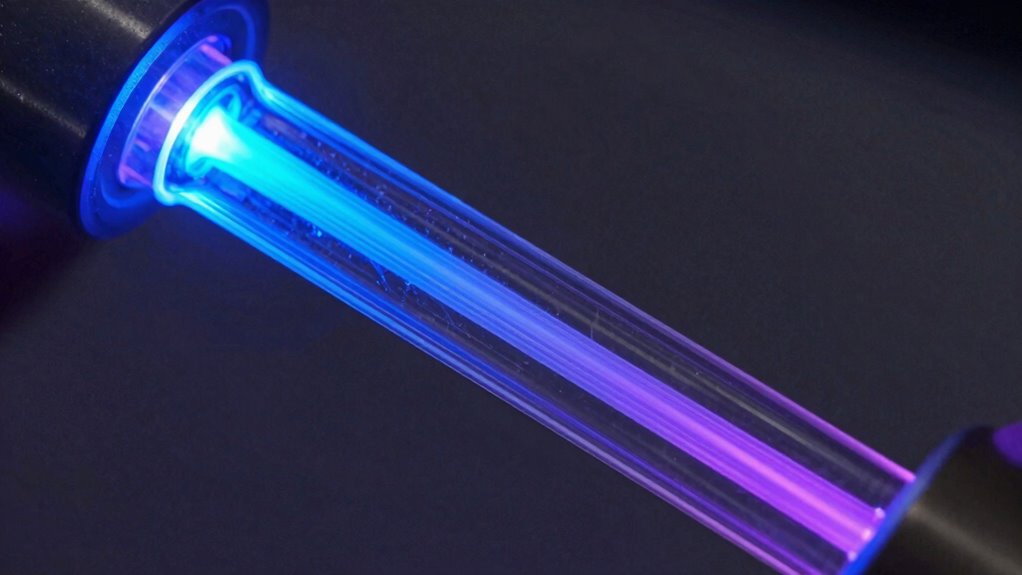
Imagine a race where tiny particles race through a slender, glowing capillary, swiftly separating with precision and speed. That’s capillary electrophoresis—faster, more sensitive, and able to distinguish even the most subtle differences. When compared to traditional chromatography, it’s like switching from a slow walk to a sprint. So, next time you need quick, accurate results, remember this shimmering highway of ions that outpaces the old methods, leading the charge in analytical science.