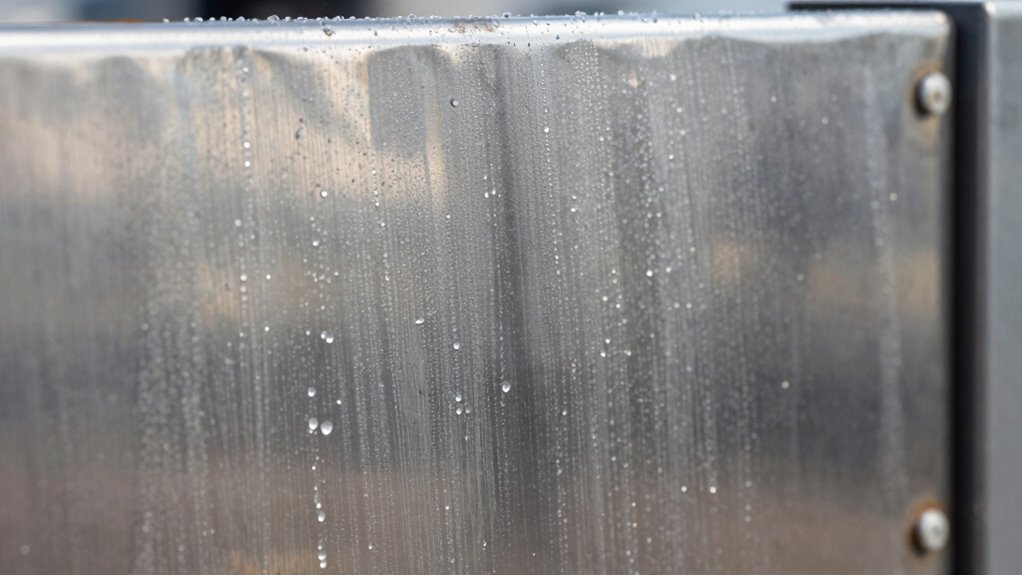

Salt spray testing shows how well your material resists corrosion under salty mist conditions, helping you assess its durability and rust resistance in a controlled environment. It can indicate likely field performance but isn’t a crystal ball for long-term use, as it doesn’t account for factors like temperature, UV exposure, or mechanical stresses. To fully understand your material’s real-world lifespan, you’ll want to explore additional tests and information. Keep going to discover more insights.

Prime made for students and young adults
- Fast, free delivery for dorm and study essentials
- Prime Video and Amazon Music included
- Member-only deals
Key Takeaways
- Salt spray testing proves a material’s resistance to corrosion under specific salty mist conditions.
- It cannot predict exact long-term lifespan or performance in diverse real-world environments.
- The test mainly assesses uniform corrosion, not localized issues like pitting or crevice corrosion.
- High resistance in the test suggests good potential field performance, but isn’t a guarantee.
- It should be complemented with other tests and real-world evaluations for comprehensive durability assessment.
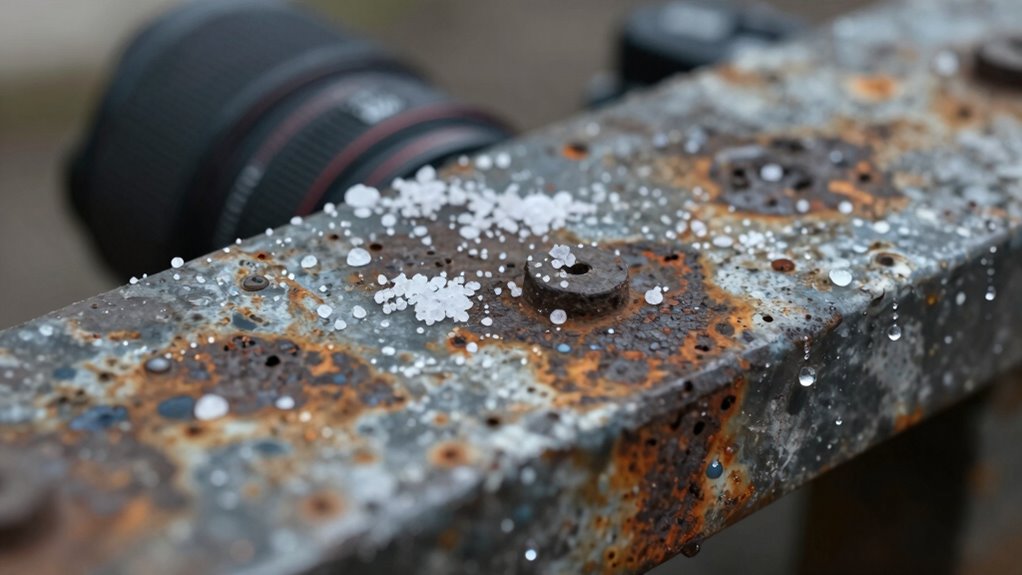
The primary goal of salt spray testing is to determine the corrosion resistance of your materials. By subjecting samples to a controlled, salty mist environment, you can observe how quickly and intensely corrosion develops. A material that resists rust and degradation during the test indicates high corrosion resistance, meaning it should hold up well in similar conditions outside the lab. This ability to withstand corrosion directly relates to material durability, as a resilient material will maintain its structural integrity and appearance over time, even when exposed to corrosive elements. When you see minimal corrosion after prolonged testing, you gain confidence that your product will perform reliably in the field. Additionally, understanding the specific corrosion mechanisms at play can help in selecting the most appropriate materials for your application.
However, it’s important to understand what salt spray testing can’t tell you. While it provides valuable data on corrosion resistance, it doesn’t predict the precise lifespan of a material under all environmental conditions. Real-world situations involve variable factors like temperature fluctuations, mechanical stresses, UV exposure, and other environmental influences that the test doesn’t replicate. Additionally, salt spray testing mainly focuses on uniform corrosion, so it might not reveal how a material reacts to localized corrosion types like pitting or crevice corrosion, which can be equally damaging over time. It is also important to note that test conditions may not fully mimic the complex interactions in actual operating environments.
Moreover, salt spray testing doesn’t account for long-term performance or fatigue resistance. Just because a material shows excellent resistance over a set period in the lab doesn’t guarantee it will maintain that performance indefinitely. It’s a helpful screening tool, but you should combine it with other testing methods and real-world testing to get a thorough picture of your material’s durability. Incorporating complementary tests can provide a more comprehensive understanding of how materials will behave in diverse environments.
salt spray corrosion test chamber
As an affiliate, we earn on qualifying purchases.
As an affiliate, we earn on qualifying purchases.
Frequently Asked Questions
How Long Should a Salt Spray Test Last?
You should plan for a salt spray test duration of 24 to 48 hours, depending on your corrosion mechanisms and desired results. Shorter tests may not reveal all vulnerabilities, while longer durations can better simulate real-world exposure. Consider your material’s susceptibility and the specific environment you’re replicating. Adjust the test duration accordingly to guarantee you accurately assess how your material withstands corrosion over time.
Can Salt Spray Testing Predict Real-World Corrosion?
Salt spray testing can’t fully predict real-world corrosion because environmental factors like humidity, temperature, and exposure to chemicals vary greatly. While it helps identify material resistance under controlled conditions, testing limitations mean it doesn’t account for all variables in actual environments. You should view it as a useful indicator, but not a definitive predictor, of how products will corrode outside the lab.
What Materials Are Suitable for Salt Spray Testing?
Think of salt spray testing as a metal’s personal fitness test. It’s best suited for materials like steel, aluminum, and coated metals that showcase material durability and coating effectiveness under harsh conditions. These materials reveal how well protective layers hold up when battled by salty sprays. If you want insights into corrosion resistance, stick to these sturdy contenders—they’re the perfect subjects for a true test of endurance.
How Does Temperature Affect Salt Spray Test Results?
Temperature influences salt spray test results by affecting corrosion mechanisms and environmental factors. Higher temperatures accelerate corrosion processes, making metal surfaces corrode faster due to increased chemical reactions. Conversely, lower temperatures slow down these mechanisms, potentially underestimating real-world corrosion. You should consider temperature variations during testing because they directly impact the accuracy of evaluating a material’s corrosion resistance, ensuring results reflect actual environmental conditions more reliably.
Are There Alternative Corrosion Testing Methods?
Yes, there are alternative corrosion testing methods like electrochemical analysis and environmental simulation. Electrochemical analysis measures corrosion rates and mechanisms by analyzing electrical signals, offering precise insights. Environmental simulation replicates real-world conditions, such as humidity and temperature, to evaluate corrosion resistance under specific environments. These methods complement salt spray testing, providing a broader understanding of material durability and helping you select the best options for your application.
Conclusion
While salt spray testing offers valuable insight into corrosion resistance, it’s not a crystal ball. Think of it as your trusty knight’s shield—not foolproof, but essential for spotting weaknesses before they become dragons. Remember, no test can predict every battle a coating will face. Use it as part of your armor, not the entire suit. Ultimately, it’s a helpful tool, but don’t rely on it alone—like trusting a compass in a foggy night.
Fall Picks
fall essentials
As an affiliate, we earn on qualifying purchases.